Showing posts with label Know Thyself. Show all posts

Monday, 20 February 2023

Dance With Your Demons


Dance With Your Demons by Omar Cherif, One Lucky Soul

Dance with your demons while your angels clap and sing along.


What is usually referred to as “inner demons” are not actual malevolent beings or fiery entities with pointy horns and red pitchforks. They do not live in the closet or under the bed nor are they lurking in that dark alley. Personal demons are the mental struggle caused by the critical, negative, self-defeating and self-loathing reptilian voice we sometimes hear in our minds. They are the egoic version of the self that tend to sabotage everything by fuelling and highlighting our own perceived flaws, weaknesses, imperfections, destructive tendencies, past traumatic experiences. They belong to the subconscious parts of our personality.

Having fear as a main driving force, inner demons are the primitive source of most of our problems. From anger, hatred, guilt and shame, to doubts, anxieties, insecurities, addictions, attachments, and limiting beliefs. If not tamed, they prevent humans from reaching their full potential while crippling their lives to a considerable degree.


Now, the subconscious mind is the intuitive, emotional mind. A reservoir of thoughts, feelings, memories, urges, desires residing outside of our conscious awareness. According to psychoanalysis, most of its content is deemed unacceptable and unpleasant, like repressed memories and feelings of fear, pain, anxiety. It embodies our deeper, shadowy, suppressed psychological side, which many spend a large portion of their lives trying to conceal from the world. The subconscious includes the aspects of the self that one hides, ignores, dislikes, disowns, or rejects — their vices, perceived flaws and imperfections, how they process their old wounds.

What makes the subconscious mind substantially powerful is that it is in charge of our brain’s activity and processing power during a staggering 95% of our lives. Naturally, such dominance is reflected on all our thoughts, emotions, decisions, judgments, behaviours, impulses, fantasies, as well as mental health. 

The internal self-talk is simply a byproduct of thoughts. When fed, identified with, believed it can become so potently dark, uncivilised, recurring, incessant and convincing, it could direct one’s life — often subconsciously without them knowing. “I will never be able to do this”, “I am not worthy of love”, “I don’t matter”, “I am too damaged or weird or a freak” among other self-pitying beliefs our poor-li’l-me victim mentality tends to perpetuate.

Due to our formidably restless and cunning imagination, we start relating to the very content of said monologue. Despite that it is largely filled with illusory conflicts and complicated scenarios, including the stories or the narratives we keep telling ourselves, which end up becoming internalised. But, We are NOT our thoughts, remember; for they come and go, they remain transient, temporary, ephemeral. Observing them objectively through impartial eyes allows us to see through our very own illusions. This spiritual awakening is the beginning of all wisdom and clarity.  


The following is a significantly illuminating part: According to research from Stanford University, out of the 60,000 thoughts the average human can have per day, 90% of them are repetitive and 80% are negative. Imagine the lunacy!


Thinking the same thoughts turned out to lead to making the same choices; same choices means same behaviours; same behaviours translates into same experiences; same experiences leads to same emotions; and same emotions generate the same thoughts — back to completing the self-destructive loop as one becomes stuck in certain thought-patterns.

Equally fascinating, Neuroscience has come to show that our biology, neural circuitry/chemistry/hormones, as well as genetic expression are all equal to how we think, act, and feel — that which constitute our personality. In other words, consciousness creates our personal reality.

As such, identifying with the unrefined, repetitive, mostly negative inner voice and being led by its neurotic nonsense remains the leading cause of a variety of mental and consequently physical health issues we suffer from.

Dance With Your Demons by Omar Cherif, One Lucky Soul

Y
ou see, when people are unconscious of their own dark sides if affects their personalities and influences their behaviour beyond their conscious awareness. They do not notice how they tend to project unrealised, unrecognised elements of their personalities by attributing them to another person or group. While the act may include positive characteristics, it usually focuses on negative ones. That means projecting the internal darkness outward into others and condemning evil in them; thereby transmuting the inner pain, self dislike, and disappointments into outward aggression. By doing so, they justify the darkness in others without ever admitting, or mayhap even accepting that darkness exists in them, too — at least to a certain degree. The more denial of the shadow, the more its power over us. Or as Carl Jung succinctly put it: “What you resist not only persists, but will grow in size.”


Whenever thoughts, motivations, desires, or feelings are suppressed, as cannot be accepted as one’s own, they are dealt with by being placed in the outside world and attributed to others. It is precisely what makes us judge, categorise, castigate, and vilify. Truly, until one faces their own shadow they will keep encountering its reflection in others. This is the basis of Psychological Projection. 


Without awareness of the Shadow Self, or without being in touch with it, also translates as unfulfillment, resentment, low self-esteem, self-confidence. It likewise reflects on how we view the world and on all our relationships. There is this internal void, which one attempts to fill using all sorts of distractions and things that are outside of themselves.

On the other hand, to truly Know Thyself means to courageously dive head-first deep into the abyss of our own being. Introspection and self-examination allow us to become aware of the innermost thoughts. Acknowledging the darkness followed by accepting it become imperative if we want to understand the full psyche. To know your own darkness, as Jung noted: “Would help you most to have a personal insight into the secrets of the human soul. Otherwise everything remains a clever intellectual trick, consisting of empty words and leading to empty talk.” 
 
The Shadow Work we do on ourselves was actually first pioneered by Jung — hence all the related quotes and valuable insights — and it boils down to making the unconscious conscious. To be able to change, one needs to start thinking about their own thinking; observe their actions, habits, patterns, and behaviour. Accordingly, bring that which has been suppressed and repressed out toward the light of awareness, freeing us from the bondage of their shackles. Freedom means to be in the present Here and Now without translating it using past experiences. Because in terms of conscious experience, the time is always, always NOW; not in the past nor in the future. “The Work” is therefore the way to confront — and hopefully also cherish the demons — to summon them in the moment with the intention of becoming less fragmented and more grounded, balanced, and above all, whole. 


Dance With Your Demons by Omar Cherif, One Lucky Soul
I stopped fighting my inner daemon; I’ve unleashed it 


Self-inquiry is rarely a walk in the park. At times it could certainly be uncomfortable, confusing, possibly also frightening to delve into your naked self and face your fears.
But there are no shortcuts to anywhere worth going.

Seemingly paradoxically, the dark side retains its own glamour. The badness and the misbehaving generally deemed wild, naughty, wicked and mischievous retain a certain forbidden and enigmatic allure or fascination within the psyche. Vices are found attractive, adventurous, and captivating by a wide variety of people, hence all stories and movies about “bad” things and people. Perhaps it is the case because they add contrast, hence also a healthy dose of realness and even balance to the human experience — virtues and vices. After all, they are part of our human nature. And as much as demons can be destructive, they can be creative just as well. For destruction tends to breed creation. That is part of the mystique of the dark side, one could say. To get to heaven, my friends, one must first pass by hell. 

Conversely, a thing about the good side is that it is often bland and boring and expected. Everyone wants to be good! But are they really, or is just just another illusory mask? For those who make an effort to appear good exist everywhere. 


Whether inner or outer, darkness itself is not the enemy; it is not something to fight nor despise. Darkness just is. It will always be there along with the light. Just as good and evil and positive and negative are complementary, one cannot exist without the other; for that’s how the cosmos is balanced. Inner demons, then, have a function, a necessity, and in the words of Gabor Maté, also deserves our compassion. They are a fundamental part of us after all.

Besides, demons are widely thought to have once been ‘fallen’ angels.
So they could be perceived as two sides of the same mythical coin. In fact, in the religion and philosophy pertaining to Greek Mythology a “daemon” [daimon] was a spirit or divine power that could influence a person’s character or fate, which was not necessarily good nor evil.

Jung at it again with:
 “Within every saint, a beast sleeps; within every beast, a saint”. 


Dance With Your Demons by Omar Cherif, One Lucky Soul
Beware the confusion 

In our human world, true mastery is simply how you handle your own internal voice during the awakening journey from reactive to reflective; to find balance amidst the chaos. Then, the poor-li’l-me victim mentality along with its self-pitying beliefs start to dissipate, while you stop trying to prove — to yourself before the world — that you matter or that you are worthy of love and all the rest. Because now you know you are. Time to just BE.   
 
What essentially matters is how you respond to life, your attitude and perspective. For life is mostly how you take it and partially what you make it. The full work still must be done if one chooses to shed their skin and grow through life. 

The more we understand this dynamic between the different counterparts of our inner being, the more we reconcile the seeming polarity into Oneness, the more we become better equipped to deal with the darkness of others. Because we can relate, so we see them for who they truly are, even when they don’t see it themselves. That means we do not judge, categorise, castigate, or vilify — not even our own demons. Choosing not to be led by your emotions does not mean you’re cold or heartless, it means you’re wiser.

It is worth noting that, in essence, the healing journey is fuelled and later embodied by love and self-forgiveness.


 The resulting self-knowledge entails change, growth, evolution, becoming better versions ourselves and, of course, truth and freedom. For love is the way, or so they say.

More about the topic is covered in my previous psycho-philosophical exposé, Theory of Mind: Thinking About Thinking and the Benefits of Observing the Observer.


Dance With Your Demons by Omar Cherif, One Lucky Soul

C
ertain individuals succeed to varying degrees in hiding their flaws, imperfections, eccentricities thinking them weaknesses. So they become weaknesses. Whether consciously realised or not, those tend to become victims of their own negative thought patterns — their shadow. As Sigmund Freud put it, “The more perfect a person is on the outside, the more demons they have on the inside.” 

Others learn how to use the flaws and imperfections, thereby transform the weakness into strength. Having recognised and fully accepted their darkness, these alchemists use it as a motivational force to stand confidently in their own light — owning their truth while finally transcending the seeming duality. Perfectly imperfect. Then Coincidentia Oppositorum, or the Union of Opposites. For it is the same fire that can either melt you or forge you.


The reality is, we rarely ever get to fully conquer or even outrun our inner demons by facing them on mere occasions. In fact, it is possible to overcome certain demons yet ignore or postpone dealing with others, rendering the healing process longer. Although changing locations like moving to a different country may help us reset ourselves, hence be able to change certain negative patterns and toxic habits, it does not slay or annihilate the dragon. Simply because it remains an integral part of us, so will never just vanish. Whenever someone thinks they have killed their own, for ever and ever, good for them. Maybe they did. But, it could still very well be an egoic trap, a story we tell ourselves — just another thought illusion. Such sobering nugget of truth was something I only came to learn later in life when wrestling with my old addiction demons.

Demons manifest themselves in unique ways depending on each person; just as each person deals with theirs differently. Some may be able to avoid or ignore, others may silence, escape, distract, numb themselves to the emptiness for a while. There are also those tortured souls who seem to be in a perpetual state of war with their own selves and very neurochemistry, slaves of their shadows, going through life in a “reaction mode” to the division of their fragmented minds. On the way to maturity, people oftentimes alternate between these different psychological coping mechanisms.


Dance With Your Demons by Omar Cherif, One Lucky Soul
I used to battle, wrestle, and quarrel with my demons. 
Now we cuddle, nuzzle, and snuggle. [Artwork by kfrbs]


Still, wherever we go, there we are. As a concept, inner demons will likely always reside somewhere deep down within us. Demons as well as angels do indeed seem to metaphorically embody the Human Condition, a way for man to understand himself and the true nature of his apparent dualistic psyche. Then again, we do not fight the darkness, we light a candle. Or in the words of Nietzsche: “Battle not with monsters, lest ye become a monster, and if you gaze into the abyss, the abyss gazes also into you.” Likewise, “Be careful when you cast out your demons that you don’t throw away the best of yourself.”

If we choose to fight inner demons, we may very well become at war with ourselves. Dancing with them, however, is the key to a considerable degree of inner peace in this life. 

So not just coexisting with our own darkness becomes essential, but also getting acquainted and developing a certain relationship with it. I actually hold that the simple ability to occasionally make fun of one’s thoughts is beneficial. For being playful in such a way helps not take ourselves or life too seriously while letting go of the nonsense of the ceaseless chatter, eventually allowing us to befriend ourselves. 

Another spirit to express the same sentiment was 
Charles Bukowski who said “Don’t fight your demons. Your demons are here to teach you lessons. Sit with them, have a drink, talk, learn their names and talk about the burns on their fingers and scratches on their ankles. Some of them are very nice.”


As it turned out, this relationship [with the self] is the catalyst to a peculiarly rich sense of serenity, fulfilment, depth, honesty, and some uniquely raw realness; but also of a certain refreshing kind of fearlessness. It equally teaches how to regulate our emotions. And artists are a living proof that darkness can be alchemically and purposefully channelled into creating something original that hasn’t existed before — a therapeutic experience in and of itself. To reduce the inner noise by creating an outer melody out of it, to which our demons and angels will learn to dance, clap, and sing together. This is how art can invite, inspire, entice the rest of humanity to do the same. Once more, Carl Jung would concur: “A creative person has little power over his own life. He is not free. He is captive and driven by his daimon.”


What can be done is to accept and cherish our authentic selves completely — with the ridiculous, sometimes absurdly dramatic internal monologue and all; the dormant beast and the dormant saint. Thereby welcome and embrace the dragon rather than battling it or trying to slay it; we tame the beast by putting a proverbial leash on it. Self-actualisation is how we overcome and master the darkness rather than become its victim the other way round. This is how to transcend the conflicting duality while embracing wholeness. 

When we awaken to our true nature our full potential is unlocked, the inner void and the struggle it causes then cease to exist... or is at least diminished to a manageable, witnessable level. Being human, fear still exists, but it cannot drive you crazy because you have learned not to give it the key. Whenever the negative voices visit, you can observe them objectively before letting go. Maybe even laugh at them if you see fit. Integration and liberation at last! 


To learn to ride the dragon is the secret to sincere transformation, reconciliation, and wholeness. Having these integral parts work together instead of against each other, we harness their power and might to our favour — perhaps through art and creativity, showing vulnerability, or for developing empathy towards fellow humans. Verily, befriending our darkness is to own our truth and to embody our higher wholesome self. It has the extraordinary ability to propel us forward toward a brighter existence. And those who have walked through the fire of their own hell and survived it tend to leave sparks of light wherever they go.

Tamed dragons also tend to develop wings, so they make great transportation and are capable of taking us to undreamed of heights.


He learned to ride the dragon
She learned to tame the beast
Getting on the celestial wagon
What Magick is this feast.


*Article adapted from my book 


ALSO VIEW: 


Related Posts Plugin for WordPress, Blogger...

Wednesday, 18 May 2022


The Parable


 of the Nugget of Truth


The Parable


 of the Nugget of Truth by Omar Cherif, One Lucky Soul


Back When Tigers Used To Smoke...


A man was walking in the woods when he came upon a nugget of truth. Pristine, illuminated, and quartz-crystal limpid, he bent his weary knees to pick it up. Once held in his hands, he became mesmerised by its sheer immaculate beauty. Eternity is what he could perceive as he gazes into the gem. But also a certain innate innocence. The man kept contemplating it for months — some say even years — till it became part of his inner truth. He owned it just as much as it owned him. 


When he finally re-emerged from the woods he happened to meet an old friend who, seeing the nugget glowing and shining, glimmering and shimmering through the man’s hand, got curious and inquired about it. The man hesitated and paused for moment. 

He then proceeded to tell his friend the story of how he came about the nugget. But then he realised that the more he tries to explain, describe, or conceptualise his experience, the more the nugget in his hands seemed to lose its eternal light and begin to flicker faintly like a twinkling star, and the more certain parts of his story seemed almost impossible to put into actual coherent words. 


By the time the man had awoken from this deep realisation, it was getting darker. He did not utter another word to his friend, about the nugget or otherwise, only nodded his head as if to say Adiós before they parted ways. 


Bewildered by what transpired, the man sought to understand. So he headed to the top of a nearby mountain and asked the Moon. 


“O’, you found the nugget and tried to share it, but couldn’t, did you? Well, my Brother, some truths are simply too deep for intellect or language. 

The words that attempt to mimic, explain, or describe the experience are just symbols, not the experience itself. They are not even yours; they were all one day made up by someone. Without trying to define it, if you objectively look through impartial eyes without judgement, evaluation, calculation, justification, expectation or conceptualisation,
you’ll see your truth as if for the first time.” 

Gazing upward, the man questioned the Moon: “You mean there is no way to truly convey the sheer everlasting beauty of the nugget?”


“Why would you want to do that?, the Moon cuts him off rather abruptly. “Let every man and woman find their own selves and undergo their own transformation. This is YOUR truth to be found, discovered, realised, owned.”


“But what if they don’t?”, wondered the man out loud.  

“Then that is that. Don’t concern yourself with others, even if out of love. Let them be while allowing your intuition to be your silent guide. For it is the real Guru in the equation who will help you see things for what they essentially are — behind your human mask, the persona, the cloak, the veil and its intellect and rationality.”  
 
Taking a reflective pause, the Moon finally murmured into the man’s inner ears, almost in a sarcastic tone: “But also never forget: This is only a nugget.” 

Partially convinced, yet still replaying the conversation in his mind, the man descended from the mountain. Some say he then went back to the woods. Others say that he was never heard of again — as if vanished from the face and body of the Earth. 


Following their meeting, the friend remained fascinated by the man’s find. He could not get the mere sight of it out of his mind. Now, every time he met someone on the road, he would ask if they wanted to know about the nugget of truth. But because it was not his own nugget, since it wasn’t him who found it, the story told remained his own version — merely a regurgitated second-hand replica, in which explanations, descriptions, and interpretations of the original man’s experience with the nugget of truth were unknowingly added. 

Nevertheless, many of those who listened ended up likewise being mesmerised by his version, believing it original and authentic. 

In turn, those very people began telling the story of the nugget of truth to whomever would listen. Naturally, each would recount their own version, a pale imitation of the original, based on their own level of consciousness — of understanding. And since the followers dispersed throughout the world, each had their own language and dialect. So communicating the story then became even more subjective, personalised, and impressionistic, hence whimsically arbitrary. This process kept self-ramifying ad infinitum. 


Many moons ahead, in a different epoch with different ethos, after our original man had passed on, followed by his friend, one of the many-hand storytellers of our nugget of truth decided that since the versions became numberless, they needed to get organised. “I will compile all the versions of this great story of how the original man came upon the nugget of truth in the woods into one story in one book in order to save humanity from itself,” he proudly uttered before his companions. “For there is only one nugget of truth, which ‘WE’ found.” 


Once the plan was set in motion, the storyteller sent far and wide to all four corners of the globe, looking for all raconteurs of the story. When he finally thought he had gathered them all, he began writing and compiling and editing and re-editing. Naturally, since it wasn’t him who initially found the nugget of truth nor owned it, what came to be inscribed in the book is still his own embellished, vicarious version of the story, heavily influenced by the various storytellers’ interpretations, opinions, and poetic imagery. After all, this one was perhaps a mere 17-hand author who had never even had a quick glimpse of the gem. Such Téléphone Cassé system made his followers, followers of followers, of followers.


While some parts of the story remain more factual, original, authentic than others — as they are directly and/or indirectly linked to the original finder of the nugget — the essence of the book turned out to be made up of a selected collection of metaphorical fables and parables full of poetic allegories, analogies, and image-making about our nugget of truth, first found by the original man aeons ago. In other words, it contained metaphorical truth rather than literal truth, meaning the implications of the story may be accurate whether or not the details had actually transpired. A way to teach a lesson… despite the lack of direct, first-hand experience.


But then, since every human being has a unique level of consciousness, understanding through their own language and dialect, some cannot see the book for what it essentially is. They blindly believe that it depicts actual historical figures, true events, and real happenings, as well as miracles, mythical entities, and cosmic, far-reaching poetic fancies and phantasmagorias.  

In subsequent ages, long after the compiler had passed on, some of the other storytellers began to quarrel; each claiming to be the sole raconteur of the nugget of truth story — to possess the authentic narrative.

Few even claimed they had an ancestral link to the original finder, as an attempt to compensate for their own doubts in the authentic truthfulness of the story while adding legitimacy to their own versions. 

However, the originator lived such a long time ago, that he then came to exist in a different time-space realm, making any unconfirmed claim to the existence of a link highly questionable. 

As such, throughout the coming eras countless fiery, devastating wars and epic battles were fought between the various factions, each followed by the readers of their own version. With some believing, while others deluding themselves into believing, that they owned, the “nugget of truth” itself, rather than just a version of the tale.


And then, the original man slowly opens his eyes to find his friend sitting beside him around a campfire. He thought he heard the echo of a voice somewhat repeating itself yet could not tell what it said the first time. “So, will you tell me about it, the nugget of truth you are holding in the palm of your hand?” 

The man smiled then got up and left without uttering a word, disappearing into the misty woods. He has seen enough in his heart to know better.


*Article inspired by a two-liner anecdote I once heard: God and the Devil were walking when they stumbled upon a nugget of truth. While God picked it up, the Devil instantly said: “Let us go organise it.”


ALSO VIEW:


The Millennium Eve Spent Alone at the Mosque 
 
The Ashram Sweeper Who Blocked Me on Facebook 
 
OLS Reflections 42 — The Spiritual Edition

Why We Should Not Fear Death 

What Being Conscious Means

The Parable of the Elephant 
 
The Parable of the Cow: You Are Not Your Thoughts

What Nomad Lions Can Teach Us About Growing Through Life  

The Intertwining of Pain and Pleasure
 
The Intertwining of Genius and Insanity

The Intertwining of Music and Sexuality ― A Djembefola’s Tale


Who Are We?

My Journey Towards Self-Transcendence
 
Unfollow The Crowd  

Change Is The Only Constant

Things I Got Rid Of To Become Happier


Related Posts Plugin for WordPress, Blogger...

Wednesday, 15 April 2020

Paycheque Addiction and COVID-19


Paycheck Addiction and COVID-19 by Omar Cherif, One Lucky Soul

T is an educated woman who had been working for the same prestigious company since graduating from university. She may have actually started just a month afterwards and remained with them until her early-mid 50s. What happened then was that she was offered an early retirement. 

Someone could have taken this opportunity to enjoy the rest of their life while they are still able to. But not T. The woman was shattered. She couldn’t handle being free; not being told what to do. Simply because she was never used to it. Strict traditional parents migrating to the U.S in the early 1960s, school, university, then work followed. She never had time for herself, and when life happened she didn’t take it too well.

Plans of travelling the world, starting Yoga classes, learning a new hobby or skill, or even chillaxing on the beach seemed not enough for the woman. 30 long years of a desk job can indeed do this to you. You obviously miss out on life as you trade it for some papers called money. Year after year, you get hooked on that paycheque, become its slave, and may start spending more and more on stuff you don’t need just to compensate, which end up owning you — certainly slowing you down. But fortunately for T, money is no really issue as she is well-established, one could say. 


Naturally, T doesn’t know how to cook, has quite the poor social skills, and is emotionally immature. Apart from her husband and parents, she has no friends — and never spoke of any.


The current COVID-19 pandemic, it seems, is revealing lots of different versions of T. Quarantined folks feeling restless and “stuck” at home instead of being grateful they don’t have to go to work, including many soul-sucking jobs they solely do for the money. Heck, some are even protesting against the break as well as against wearing masks! While it may be safe to note that no one likes to be forced to do something, ironically, most are initially somewhat forced to work; whether to bring food to the table, educate their kids, impress their family, please their spouses, or to become someone or the other in the society.

The reality is, now they are actually safe at home, owning their hours, perhaps for the first time in years. Many are in fact still getting paid. If I were them, I’d actually be ecstatic and learn how to enjoy the slow pace; how to master the art of living my own life — on my own terms, my own drum tunes. So it is precisely how you look at it that matters at the end.


A significant portion of those from my generation have been working for roughly 20 years, so they aren’t that far off from T. It became their routine system as they lead somewhat automatic existences, in which they rarely ever pause or reflect. Not even face themselves, get to know it on a deeper, less superficial level. Because usually they have no time nor energy to do so. 

Without solitude and introspection the distractions of life with all its drama win by default.

This brings us to Destination Addiction, a topic discussed in a full sub-chapter in my book. 

Destination addiction is the obsession with the idea that the future holds the promise for our happiness or fulfilment. Either in the next place, the next job, the next lottery ticket, the next big break, with the next partner, or in the next life. Most people have a subconscious tendency to believe that the next moment will be better than the current one. That is to say, they feel they need to leave where they are to reach where they want to be. “Chasing the Rainbow” is a lethal mindset to adopt. 

The chasing cycle of seeking satisfaction in future achievements or places is fuelled by the dopamine’s reward system in the brain. As long is there is progression, there is a dopamine surge, yet once arrived there comes the dip, leading to a constant chase for the next “destination” rather than enjoying the present. It is similar to doing cocaine... and mindless social media scrolling.

Neuroscientific studies show dopamine enhances our expectation of future pleasure, making us desire anticipated events such as weekends or holidays [or the next post] more intensely. This thereby creates a loop where we seek that dopamine hit from the idea of the goal rather than from the attainment itself. In other words, the the anticipation of pleasure — the dopamine — drives the behaviour more than the actual experience. Isn’t that something useful to learn about our humanness as well as about our consumption?


All that said, many forget that our time here is limited — a mere 100 years at most. The truth remains, however: Happiness or fulfilment or whatever else you may be seeking can never be found if you’re only expecting to find it in the next time or place. Not unexpectedly, if we’re always dismissing the Here and Now and postponing that which we’re looking for to the next moment or destination, we’ll never reach it. The present moment is all we got. Living it fully and madly is how we reach our full potential while creating our own reality. It was humans, you see, who made time up as a construct, and it is no commodity.
 

Based on modern society, if you somehow ever reach the pot of gold you may very well be too old to enjoy it. 
 

Are You Addicted To The News? is an article about another kind of addiction touching the lives of millions of people yet nobody seems to talk about it. These days it may be useful to come to terms with the fact that not all you hear or read in the media is factually true — especially with social media in the palm of your hands. 

Codependency: What Being Addicted to Someone Means is another article dealing with another kind of attachment. 


Coming from someone who worked in shifts six times a week for six straight years, I remember well. No wonder I eventually had to get sedated in my free time. To gain some kind of control over my life; to “do what I want”. This eventually evolved into yet another different kind of addiction involving a substance. Four more years of a slightly less hectic schedule followed. Yet, the passion and fulfilment were still missing. 

The only wise thing to do was to leave it all behind, travel far and away and get clean. The Rebirth. The Healing. The Becoming. The Renaissance. Taking arts in general and writing in particular as vocations then came to the rescue, helping me awaken to my true nature. Ever since and I work from home. So, luckily, the isolation, the comforting “me-time”, and not leaving the house for days at times come naturally here. In actual fact, my life has barely changed since the beginning of the pandemic. But that is just me.  

The best suggestion about what to do during this COVID-19 lockdown is to use the seclusion, free time, and unshackled, unobstructed energy to create and to learn. See, some people get bored, others get creative. This is how I began writing and taking photos — simply doing that which I love, and hence that which I can be good at. You can’t go wrong there, really. So get creative while you can or read books that you actually do finish. Research topics that captivate YOU, for almost anything and everything becomes interesting once we dig deep enough. Learn about yourself while taking this compulsory break from the rat race.


Do you think rats who feel stuck in a routine self-defeating life blame it on the “Human Race”?


ALSO VIEW:

Are You Addicted To The News? 

Codependency: What Being Addicted to Someone Means

Dear Single Parents

Why I Choose to Remain a Non-Dad for Now — Reflections on Being Childless

What Nomad Lions Can Teach Us About Growing Through Life

The Parents Dilemma

Do Parents Know Best When it Comes to Our Life Choices?

When Selective Men Reject Women

Different Shades of Passion

Debunking Myths We Were Exposed To While Growing Up

Who Are We?

Dealing with High Awareness and Empathic Accuracy

Change Is The Only Constant

Unfollow the Crowd


Related Posts Plugin for WordPress, Blogger...

Sunday, 28 April 2019

Connecting the Dots — a Storyteller Way of Seeing the Big Picture


Connecting the Dots — a Storyteller Way of Seeing the Big Picture by Omar Cherif, One Lucky Soul

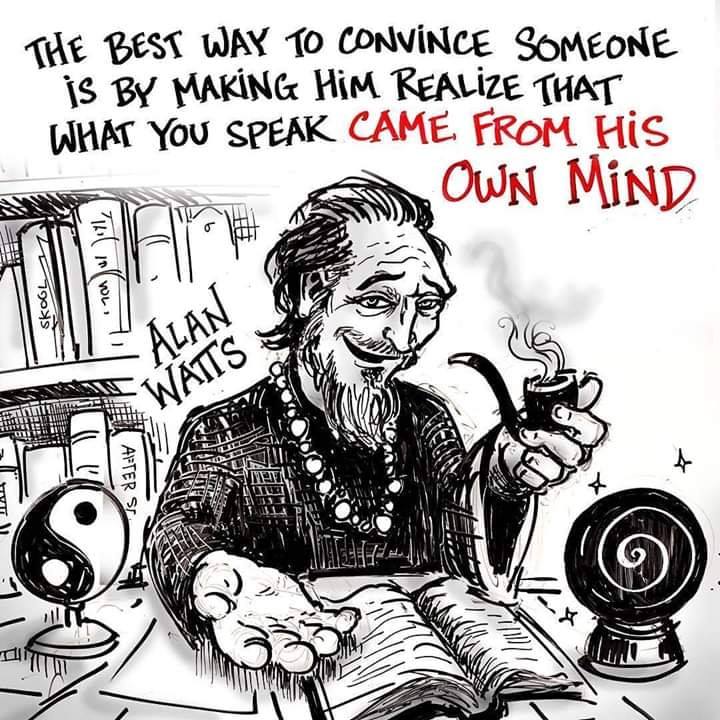
“The best way to convince someone is by making him realize that
what you speak came from his own mind.”
— Alan Watts

Like pieces of a jigsaw puzzle, sometimes a wide array of seemingly random dots connect and organise themselves in certain ways to form the cornerstone structure of a story. The process of seeing a bigger picture could take hours or it could take years. For a storyteller psychonaut, this completion, this closure is nothing but la créme de la créme of the art of writing. That is, if one is fortunate enough to go through such experiences during their lifetime.

You see, some people rarely ever connect the dots in life. Others do connect them but end up being overwhelmed by the amount of information. Then there are those who simultaneously connect the dots and are able to make sense, and use, out of them. For the latter group, patterns become the real guru, which help them understand the relationship between different ideas and experiences. Hence perceive the Big Picture while enjoying the more broad, overall view it offers us. 

The more knowledge, the more points to possibly connect. Since everything is interconnected, keen awareness remains all that is needed.

One example is the following introspective, Theory-Of-Mind type of Post I
’ve recently written about the essence of being a storyteller; about how I use my stories in a way that could — hopefully — inspire others. Wittily, mind you, or so I like to think. Yet, without sounding preachy, authoritative, or like a know-it-all pretentious dude; as also without forcing my way of seeing things unto others. Why? Well, keep reading. 

To be able to write said words I had to dig down deep inside my mind and soul. I had to take a step further away from my autonomic existence, a leap more likely, just to be able to “catch myself in the act” before analysing the findings. This is when altered states of consciousness come in handy. And to a significant degree this time I had been successful. Truth is, frequently playing Observing the Observer, one gets better with time. The result are the below words shared along an image with the John Lennon quote: 

“My role in society, or any artist’s or poet’s role, is to try and express what we all feel. Not to tell people how to feel. Not as a preacher, not as a leader, but as a reflection of us all.”

   
This is the original:

When we care about people we naturally feel inclined to help them through any troubles they may face. Some, however, are not ready to be helped, and their reasons vary.

Through the years, the Messiah Complex I’m plagued by has developed indirect ways to be of assistance in such situations. To convey the message said folks are not ready to receive I create a story out of it; in which I incorporate the message in a story form that is easier to digest. This way avoiding any defensive reactions which may arise if they were to sense that you are addressing or “lecturing” them directly. Obviously I have been there enough times to be able to establish a pattern. 


Now, by incepting the thought on the go in such a way you play the role of the facilitator, allowing them to connect the dots by themselves and figure it out. Simply by playing a little game of suggestion. This is a more efficient and convincing way to reach a solution or truth than for it to be revealed or taught by someone else. It is also more empowering; hence the terminology The Power of Suggestion. Because the discovery becomes part of their own inner truth — while in many cases remaining oblivious to the fact that the thought was initially planted in their minds by someone else.

In psychology, suggestion is the process by which one person guides the thoughts, feelings, or behaviour of another. The idea was incepted in the 1800s along with hypnotism and trance. 

Oftentimes, the subject of the story is myself. Simply because I found out that it is easier, let alone much more genuine. So let’s say the person I’m trying to reach has a drinking problem: I open up about how I was hooked on heroin for years and how I overcame it. Also how the experience has been the most enlightening of my life; since “You overcome yourself and [hence] become fearless”. And that is that. This is all the empathy and hopefully inspiration I offer the troubled, without haranguing or telling them how to live their own lives.

While I acknowledge their willpower and ability to make the right choices — when their time comes — I treat them as such; as free, capable individuals. I also do not use “You need to, you must or should” among other authoritative ways of communicating. Rather, I seek connecting with them on a more intimate, empathetic level. Through showing them that I relate to their sufferings because I, too, have suffered; that essentially we are all each other’s reflections. From then on, how they may or may not decipher the story along the suggested message it contains depends on them alone.

Period. A few Instagram hashtags followed the words, including artist, poet, inception, storytelling, psychology, philosophy, Theory Of Mind and published it was. And that was it, right until... last night.

Check
this recent exposé if you are interested in delving more into the topic: Theory of Mind: Thinking About Thinking and the Benefits of Observing the Observer.


Connecting the Dots — a Storyteller Way of Seeing the Big Picture by Omar Cherif, One Lucky Soul
Another piece to the puzzle

As previously shared, I indulge in occasional sleepless productive all-nighters which leave me looking like a Picasso the next morning. Several months after said post I was enjoying the quietude of one such nights, working on editing my book and surfing the net looking for novelty and inspiration and downright ridiculously weird things. Then, Lo and Behold, I see the featured caricature of none other than one of the wisest cats on the block whom I deeply cherish, Alan Watts, dropping that additional piece of the puzzle like freakin’ Salt Bae. I had to rub my eyes and reread the sentence to make sure my sleepless mind wasn’t playing some kind of subconscious confirmation-bias trick.

“The best way to convince someone is by making him realize that what you speak came from his own mind.”


Wait! So Alan Watts thinks the same thing I had already deducted on my own? I may not be that full lunatic after all, huh. Now take that, society. This was certainly a sobering reminder that all ideas are indeed second-hand — as Mark Twain wrote in 1903 to his amiga Helen Keller when she was accused of plagiarism.

The following puzzle piece came from the mouth of wily Jiddu Krishnamurti, who said:
“When it becomes necessary for humanity to receive in a new form the ancient wisdom, someone whose duty it is to repeat these truths is incarnated.” Well Aha!

Speaking of, do you have an idea that Jiddu ( جدو ) means grandfather in Arabic? As you can see, one must remain careful not to follow too many dots all over the place. Because some of us can keep going ad infinitum. Then when too many branches are drifting out of the frame like they are trying to escape your mad mind, it
’s not a story anymore, mon cher ami. But rather, it starts to appear and sound like the ravings, rantings, and ramblings of a non compos mentis who has too many browser tabs open. Focus, therefore, remains key.
 

The natural consequence of having the jigsaw puzzle extended just out of the blue was to create another fuller, richer story, which will incorporate the latest nugget of truth
piece from the Zen Head himself. In addition to few other pieces that happened to free-associate themselves into this body of writing.

Subsequently, just as I finalised the piece you’re reading herein, another dot just materialised out of thin air right there in the midst of my mind’s eye. This time, a reflection of mine which conveniently came at the right time, brilliantly fitting the narrative:

If you are doing your best while not seeking approval or validation, affirmation will still come to you in different forms. Oftentimes when you least expect it.

When Alan Watts expresses that which you already
— somewhat ‘originally’ — had in mind, you know your philosophical thinking as well as logical reasoning are doing alright. For me, there is nothing more fulfilling than this type of affirmation. 


To more dot-connecting, pattern-decyphering, and the ability to always see the bigger, fuller picture for all of us. There is always one. At least.


ALSO VIEW:

Theory of Mind: Thinking About Thinking and the Benefits of Observing the Observer

Who Are We?

For The Love Of Storytelling

My Journey Towards Self-Transcendence

The Intertwining of Genius and Insanity

The Intertwining of Music and Sexuality ― A Djembefola’s Tale 

The Intertwining of Pain and Pleasure

Different Shades of Passion

How Do We Know We Are Good at Something?

Why I Share Stuff

From English as a Third Language to Author — How I Expanded My Vocabulary
 
Selective Hearing Among Men and Women

What The Heck are Vocal Fry and Upspeak?  

Artists Between Mindset and Motivation

The Writing Process and the Creative Block

On Reading, Listening, Speaking and Writing

The LSD Experiments of the 1950s and 60s [Videos & Documentaries]

Out-of-Body Experience and Ego Death on a “Heroic Dose” of Mushrooms

Surviving the Madness of Sakarana — Hyoscyamus muticus

 
Related Posts Plugin for WordPress, Blogger...

Monday, 12 November 2018

OLS Reflections ثلاثة وستون


OLS Reflections ثلاثة وستون by Omar Cherif, One Lucky Soul

  •  Life is too short not to let go of that which does not serve us.

  • People who have an obsessive compulsion to control others usually do so because they have lost control over a certain aspect of their lives — as a compensation, which often occurs on the subconscious level without them noticing.

    The same can be said about those who choose to only see the flaws and imperfections in others. Their insecurity deludes them to believe that being the first to notice the bad in others will give them a certain advantage, which will overshadow their own flaws and imperfections, hence feeling better about themselves.

  • The secret to women over 50 is that they know what they want as they know how to get things done. For one, their decision-making about compatibility has reached its apex. Most are over the insecurities and past relationships and began loving themselves for who they are; hence they are comfortable in their own skin — a feature that clearly shows on the person… any person. Confidence also translates into sexiness.

    Another perk is that they are wise enough to give the man that attention his male ego is seeking — making him feel like the King of The Castle. Yet at the very same time, in case of dating, they do not really need the men in their lives, simply because
    they’ve got their own lives together.

    By this age, you see, the majority are equally done with obsessing over their biological clock or having children. This is a significant load off any woman’s shoulders. This is also a big plus for the man they are with, emotionally and sexually.

    Naturally, said psychological maturity and the balance it embodies give those women a certain nurturing quality many of the younger ones seem to lack.


  • “Her inhibited, unimaginative mind sucked the life out of every single atom within her. Her thoughts and fantasies, lips and skin, even lady garden … were all dry as the Atacama desert. When he tried sharing some of his fluids so that they may flow together it was seen as a system defect — since dryness is her default.”

  • Nothing beats going to bed with a clear conscience, knowing that you did your best and gave your all. For one day we may never wake up. 

  • People whose only interests in life derive from and revolve around following the news — politics, sports, World Affairs — contribute almost nothing to the human endeavour. Such divisive matters “fill up the horizon of their [those consumers] minds,” as George Orwell succinctly put it in 1984. “To keep them in control was not difficult.” 

  • If you do not follow your dream or passion, your clever mind will usually find the most elaborate excuses as to why you wouldn’t do it.

  • Before knowing who you authentically are at the core you get to know who you aren’t. For knowing what we don’t want is a significant step toward what we do want.

  • We cannot force people to perceive anything in a certain way. When their time comes, and if the matter is worthy of being perceived, they may get to see the other perspective.

  • People on the streets tend to walk slower in less developed countries than those in more advanced ones. One possible reason is because the latter are healthier. Another is that in advanced societies people are busier and have things to do as opposed to aimlessly strolling along.

OLS Reflections ثلاثة وستون by Omar Cherif, One Lucky Soul
 
ALSO VIEW:


OLS Reflections


OLS Reflections Deux

OLS Reflections Vier

OLS Reflections Khamsa

OLS Reeflections Yedi

OLS Reflections 八

OLS Reflections Ten

OLS Reflections Onze

OLS Reflections 13

OLS Reflections Quince

OLS Reflections Sixteen

OLS Reflections Dix-Huit

OLS Reflections تسعة عشر

OLS Reflections Veinte Uno

OLS Reflections 22

OLS Reflections Dreiundzwanzig

OLS Reflections Twenty-Four

OLS Reflections Vingt-Six

OLS Reflections Ventisette

OLS Reflections Veintinueve
 
OLS Reflections 30

OLS Reflections Einunddreißig

OLS Reflections  إثنان وثلاثون

OLS Reflections Thirty-Three

OLS Reflections Trentaquattro

OLS Reflections 37

OLS Reflections Trente-Neuf

OLS Reflections Forty  

OLS Reflections Einundvierzig

OLS Reflections — The Spiritual Edition 

OLS Reflections Cuarenta y Cuatro

OLS Reflections 45

OLS Reflections Quarantasette

OLS Reflections — The Unpublished Edition

OLS Reflections Forty-Nine

OLS Reflections 50 

OLS Reflections Cincuenta y Dos

OLS Reflections Cinquantaquattro

OLS Reflections पचपन 

OLS Reflections 57

OLS Reflections Cinquante-Neuf
 

OLS Reflections Sesenta y Uno
 

OLS Reflections ثلاثة وستون 

OLS Reflections Soixante-Cinq

OLS Reflections 67

OLS Reflections Sixty-Eight 

OLS Reflections 69 
 
OLS Reflections Settanta­quattro


Related Posts Plugin for WordPress, Blogger...