Showing posts with label Neuroplasticity. Show all posts

Sunday, 26 July 2026

Holding the Megaphone: A Decade of Alchemical Gold and Confessional Exorcisms


Holding the Megaphone: A Decade of Alchemical Gold and Confessional Exorcisms by Omar Cherif, One Lucky Soul


Over a ten-month stretch in 2016, I wrote five list-articles that a psychologist friend later described as deeply “confessional”. Starting with Things I Never Told Anyone, I felt an urgent, unexplainable need to finally clear my chest of those hidden anomalies — so I did. I was residing in Venice Beach, L.A. at the time, operating under a sense of untethered personal freedom when those confessions were transmitted into the ether. It felt like an exorcism of sorts. 

A decade later today, I look back at my 39-year-old self and reflect. Why did I write those deeply personal, unfiltered lists? How did they affect me then, and how did they shape the person I am today? Were guilt and shame secretly part of the equation, or was it the ultimate bid for liberation?

Let us dive right into it.


─── ✵ ───


For the uninitiated, or those who want to review the original raw data before reading this post-mortem, you can explore the classified archive here:

✵ Part I: Things I Never Told Anyone

✵ Part II: More Things I Never (Really) Told Anyone

✵ Part III: Even More Things I Never (Really) Told Anyone

✵ Part IV: Some of My First Times

✵ Part V: Personal Questions I’m Often Asked and Their Answers 


─── ✵ ───


The Venice Beach Crucible


To be able to properly dissect this period of my life, we have to go back to the few years that led to that point — when I left it all behind in Egypt at 33 and relocated to Canada to start a new, cleaner chapter. There, it was a time for growth and rejuvenation, a time of healing from the toxic lifestyle I had led in Egypt for years. It was also a time of rediscovering my passions: Writing and photography, followed by drumming. It was art, connecting with nature, and the inner voyages that effectively catalysed and propelled my recovery from addiction. For Creativity Shall Set You Free

Addiction, you see, is a complex response to disconnection, stress, and unmet emotional needs. The cure is intimate connection, or rather reconnection... with yourself as well as your environment. 

It was the time to shake the snowglobe operating system to rewire my mental health and neuroplasticity. New neural connections open up the Doors of Perception to expand infinate consciousness.


When writing gave me a voice during that emotional sobriety phase, I came to one sobering realisation: I can either hide my past, my darkness, my demons — like most people — or tap into an unapologetic, raw honesty to own my past, befriend my darkness, and Dance with my Demons. There was simply no third option. Well, you know what I chose.

As I began to open up, I noticed how shame cannot survive a public dissection; that you can humiliate the darkness by making it hilarious. You also become whole by integrating the shadow — rather than masking it, running away from it, or “leaving it in the past”. And once the content of the subconscious is taken out of the system towards the light, it has no power over you. That’s the ultimate liberation from all the baggage.

What allowed me to openly share such raw vulnerability in 2016 — about cupping my hands while peeing in the shower or the first time I plugged a medicine up the popo for mathematical research purposes — was being in Venice Beach. 

The physical distance from Cairo and the freedom of L.A allowed the default mode network to drop. When there is no performance for a rigid society you grew up in, because you’re entirely alone on a different continent of the New World, the hidden and the deep naturally bubble up to be processed. This is the exact moment you begin transcending the Local Mind — shattering the cultural script with its superstitious beliefs, exhausted traditions, and nonsensical rules to [re]claim your heightened awareness and absolute sovereignty. To cross that perimeter means trading the safe, collective matrix of the herd for the untethered, borderless power of the Non-Local Mind. And once you do, you stop functioning as a mere social construct; you become a fearless celestial force of nature.


─── ✵ ───


Humiliating the Shadow — The Exorcism Mechanism


One Lucky Soul came into being as a simple, playful outlet to finally speak my truth. As recently shared in The Healing Powers of Storytelling: A Personal Experience Opus-Dopus, it was my own experimental, avant-garde palette — a laboratory of sorts where mostly I am my own guinea pig. What comes to mind is the Greek word Meraki: The soul, creativity, or love put into something; the essence of oneself put into that which they enjoy doing. 

Through that publication, I volunteered to dissect myself and my humanity before the world as a way to truly Know Thyself. Transmitting the “unspeakable” and the “unutterable” — whether in those five articles or elsewhere — completely strips the shadow of its power. You can’t be blackmailed by your past if you are the one holding the megaphone.


— ☙ ❊ ❧ —— ☙ ❊ ❧ —— ☙ ❊ ❧ —— ☙ ❊ ❧ —

Being an artist means forever healing your own wounds and at the same time endlessly exposing them.
― Annette Messager

— ☙ ❊ ❧ —— ☙ ❊ ❧ —— ☙ ❊ ❧ —— ☙ ❊ ❧ —


Another factor that accelerated this liberation and integration was the English language. How so?

Well, English is technically my third language — after Arabic and French — but when I became a writer, it was all in English. This shift meant dropping the default networks that you inherit from your society and your parents through the mother tongue. In the reserved Egyptian and Arabic culture, taboo topics are not spoken about directly or clearly; the culture relies heavily on euphemisms and beating around the bush. When I switched to English, I was completely liberated from that weight. It makes more sense now that I went full Ba-zonga by openly writing about sexuality and drugs along with my most intimately peculiar anomalies.
 

The naughty Memoirs of an Incognito Friend series, for instance, is a universe of its own. Despite some of the articles being so obscene, it took 10 years for the head offices of Google and Blogger to actually hold meetings over these adult entries just this last year — Ooooh — ultimately allowing all 20+ articles to remain live with a mandatory readers’ warning at the very start.  A great day for freedom! The very first confession was The Italian Belly Dancerwhile the latest is The Woman Who Came Again — 24 Years Later. Pure adventurous storytelling material that needed to see the light. 

The science behind this language change is fascinating: Our mother tongue is wired directly into the amygdala — the brain’s primitive fear and shame centre. It is the language where our earliest social conditioning and boundaries were branded into us. A second or third language, however, is routed through the logical prefrontal cortex. It provides a natural psychological distance. English gave me a cognitive buffer; it stripped the taboos of their inherited emotional alarm systems. It allowed me to dissect the most volatile parts of my history with the cold precision of a surgeon and the playful freedom of a child, entirely unbothered by the limiting cultural whispers of “ayb” and “7aram” — even somewhat whimsically irreverent. It was time to break free, to become unshackled from centuries-old repression and conditioning. And it was my mid-late 30s, so I was no longer that young; I had enough lived experience to be able to integrate it all and become whole.


Speaking of which, while conjuring some of my truest confessions, I often imagine my parents shuddering upon reading. I picture an old schoolmate from the strict Jésuites or someone rather traditional I once worked with checking my insides through a glowing screen inside some mundane office cubicle somewhere in Cairo — tilting their head in utter disbelief, but also with undeniable amusement.


I knew this level of truth was the exact opposite of the perfectly curated, sterile appearances people put online. It was raw, it was unique, and it broke the simulation. One Lucky Soul was and still is The Glitch. Funnily enough, whenever I get those sudden glimpses of potential readers squirming, I know I’m hitting the Alchemical Gold.

So, how did that whimsically irreverent exorcism shape the person writing these lines today?


Simple: It bought my untethered freedom. “I do what I want” became the motto: Do What Thou Wilt

When you spend your late 30s voluntarily handing over your deepest, weirdest, and darkest vulnerabilities to the public ether, you stop running. You realise that the terrifying monster in the closet was just a puppet made of old social conditioning. By letting those lists breathe on OLS, I signed my own permanent release form from the global rat race of keeping up appearances.


Today, looking at 49 next month — uttered with the slight defensive twitch of a woman entering menopause, pffff — I sit by the Mediterranean breeze, or the Red Sea in Dahab, with two cats, a pen, and a djembe, carrying zero hidden luggage. Unencumbered, I don’t have to look over my shoulder or worry about who thinks I’m an “insensitive dick”. The confessional era cleared out the internal wreckage so that the simple, unconditioned storyteller could finally take the wheel. From repression and suppression to confessional expression, it truly was a cathartic exorcism, and dare I say, it had to happen to become who I am today.


It turns out that the ultimate bid for liberation worked. By daring to look into the mirror and publishing exactly what I saw, I didn’t just survive the past — I owned and integrated it.


The experience of overcoming suffering endows us with a certain appreciation and sensitivity toward life, along with a healthy dose of empowerment. And those who have walked through the fire of their own hell and survived it tend to leave sparks of light wherever they go.
 

While in those 2016 lists I was dissecting my own inner being and raw humanity, in this next upcoming piece, I am putting an entire global superpower on the couch.
─── ✵ ───


“I am in you and I am you. No one can understand this until he has lost his mind.”
— Rumi


———————————————————————————————————————

The LSD Experiments of the 1950s and 60s [Videos & Documentaries]


Banged Up Abroad — A Night @ The London Police Station 

Codependency: What Being Addicted to Someone Means

Kicking That Sweet Habit: Why and How to Drop Sugar

Are You Addicted To The News? 

Paycheque Addiction and COVID-19


✵ The Spiritual Integration, Philosophy, & Solitude


The Millennium Eve Spent Alone at the Mosque


Who Are We?

My Journey Towards Self-Transcendence

Dance With Your Demons

Theory of Mind: Thinking About Thinking and the Benefits of Observing the Observer

A Dialectic With Myself: Practical Yin Yang Approach to Coincidentia Oppositorum

The Healing Powers of Storytelling: A Personal Experience (2026)

A Superpower on the Couch: Reflections from the Ten-Year North American Trip (2026)

Losing It 𝘉𝘳𝘪𝘦𝘧𝘭𝘺 At Full Lunacy: First Burst of Anger in Over 12 Years (2026)

Related Posts Plugin for WordPress, Blogger...

Sunday, 23 January 2022

The Intertwining of Pain and Pleasure


The Intertwining of Pain and Pleasure by Omar Cherif, One Lucky Soul


Pain and Pleasure are somehow devilishly connected.


✵ Ⅰ. The Intuitive Threshold


The phrase above is one of my earliest reflections shared back in 2013. Almost a decade later, I became curious once again and decided to delve into the topic to learn more.


When I first expressed that sentiment, I had never researched the mechanics. Basing my personal reference almost entirely on years of exercise, sex, drug-use, and dating activities, it simply felt intuitive that a distinct relationship existed between the two states. Ever since, there had been plenty of time to put that view to the test. Finally, the inquiries and research followed.


Pondering questions like: Why do we laugh until we cry, or cry out of sheer happiness? Why do some tear up while playing a musical instrument, writing poetry, or staring at a moving painting? Why do we moan and scream from pain as well as from pleasure? Why is our “orgasm face” indistinguishable from our “pain face”?


Why do adrenaline junkies feel exhilarated due to risky, fear-inducing “daredevil” activities like extreme sports or riding roller coasters? Is this pain or pleasure... or both?

After The Intertwining of Genius and Insanity (2014) and The Intertwining of Music and Sexuality ― A Djembefola’s Tale (2017), the following exposé deals with the peculiarly mysterious relationship between pain and pleasure 
― neurobiologically, psychologically, and philosophically.   


This, then, is the human problem: there is a price to be paid for every increase in consciousness. We cannot be more sensitive to pleasure without being more sensitive to pain. By remembering the past we can plan for the future. But the ability to plan for the future is offset by the ‘ability’ to dread pain and to fear of the unknown. Furthermore, the growth of an acute sense of the past and future gives us a corresponding dim sense of the present. In other words, we seem to reach a point where the advantages of being conscious are outweighed by its disadvantages, where extreme sensitivity makes us unadaptable.

― Alan Wilson Watts, The Wisdom of Insecurity: A Message for an Age of Anxiety 


─── ✵ ────── ✵ ────── ✵ ───


✵ Ⅱ. The Neurobiological Currency


Historically, pain and pleasure were often considered to be actual diametrical opposites. But are they really? 


For the realised individual, they are simply two sides of the same coin. Both are worthy of thorough investigation. For it seems they share a multilayered relationship, fundamentally inseparable and intertwined.

When the perception of one increases, so does the perception of the other. In fact, they are ingrained into our neurobiological makeup, sharing the exact same brain circuits and neurochemical pathways. 

Be it pain or food, sex, and drugs, scientists tracking brain scans of people who were subjected to a certain painful stimulus found that similar neural regions are triggered during both experiences. Both entice the body to produce its own internal narcotics: endorphins.


Along with Serotonin — our natural antidepressant, Dopamine — dubbed the feel-good hormone, Oxytocin — dubbed the bonding or cuddle hormone, Endorphins are part of the four essential Happy Hormones. This neurological reality validates Carl Jung’s stark declaration: 

There is no coming to consciousness without pain.”


─── ✵ ────── ✵ ────── ✵ ───

✵ Ⅲ. The Architecture of Memory


An article titled Pain in the Past and Pleasure in the Future: The Development of Past–Future Preferences for Hedonic Goods, published in Cognitive Science, tracks this alignment further. 


Further research has found that the pathways used by pain impulses excite not only the areas of the brain that experience physical sensation, but also those associated with emotion and cognition. Pain is not only a physical experience; the association of cognition — higher awareness — and emotion attach meaning to the experience of pain. These additional features of pain appear to help humans create more refined memories of a painful experience, which may help keep the person from repeating it in the future.” 

These additional features appear to help humans create more refined memories of a painful event, preventing the organism from repeating the mistake in the future. 
But it may also be the exact reason why the mind tends to cling to the past.

This neurochemical relationship between the perceptions of pain and pleasure is exemplified through the opioid and dopamine systems: While the opioid system is handles the immediate experience of the sensation, the dopamine system regulates the anticipation or expectation of that experience. 


─── ✵ ────── ✵ ────── ✵ ───


✵ Ⅳ. The Reward-Punishment Matrix


At the start of my research it became apparent that, unlike pleasure, pain had been the core subject of a wide field of neuroscientic and medical research. We can only, however, say the same about reward in particular rather than pleasure in general. 

The
International Association for the Study of Pain (IASP) defines pain as “An unpleasant sensory and emotional experience associated with actual or potential tissue damage, or described in terms of such damage.” Related fields of study deal with the neurocognitive mechanisms of human perception, emotions and desires.

As discussed in a BBC Future report, Why Pain Feels Good, any standard painful stimulus forces the central nervous system to release endogenous endorphins. These natural painkillers act to block the distress signal while working in a similar way to opiates like morphine to induce states of euphoria.


Take the classic Runner’s High: proteins bind to opioid receptors in the brain, blocking pain transmissions while simultaneously stimulating the limbic and prefrontal regions — the exact zones activated by passionate love affairs and music. It is a post-pain rush similar to the high of morphine or heroin, also binding to the brain’s opioid receptors.


Evolutionary speaking, the ‘Runner’s High’ mechanism enabled our ancestors to endure the physical exhaustion of a marathon hunt.


Both states are equal components of the reward-punishment loop. Whenever pleasure is perceived, we associate it with positive reward; when pain hits, we process it as negative punishment. 


When test subjects had their hands gently warmed or painfully heated during Harvard Medical School brain scans, the circuits releasing the body’s natural painkillers fired in tandem with the same zones that normally respond to rewards like food, sex, and money.


─── ✵ ────── ✵ ────── ✵ ───

The Intertwining of Pain and Pleasure by Omar Cherif, One Lucky Soul
Inseparable Twins.
Allegorical sketch by Leonardo da Vinci 
 pleasure and pain, duality


✵ Ⅴ. The Engine of Duality


Beside the shared neurobiology, fearing pain and desiring pleasure function as our greatest survival motivators. We tend to indulge in the latter strictly to evade the former.


Crying, for instance, turned out to be triggered by opposite sensory extremes. Because scientists have mapped distress to the same neural circuits that grant us ecstasy, we can effortlessly laugh until we cry — and cry out of sheer joy.


Such biological commonality explains why I occasionally tear up while drumming or while writing or reading my own poetry. It often occurs when consciousness shifts during Flow State — while floating in The Zone.


Motivation, however, operates as a two-way street. Memory plays a commanding role in the process. Organisms are hardwired to avoid repeating behaviours that previously induced trauma; this basic recognition is how primitive learning comes about. 


Similarly, we are driven to seek past ecstasies by projecting them into the future, hoping to relive those moments.


Yet, this automatic association with the past leads directly to attachment and expectation. It sequentially breeds future sorrow, disappointment, and psychological exhaustion. Our view of the horizon becomes foggy, paralysed by a dread of pain and the unknown.


The cognitive mind is conditioned to cling to skeletal memories of the past while completely forgetting to live in the present Here and Now.


─── ✵ ────── ✵ ────── ✵ ───


✵ Ⅵ. Somatic Remembrance & Neuroplasticity


The mind is not the sole organ responsible for the persistence of trauma; the nervous system likewise forms its own cellular remembrances. 

Something we learned from Gabor Maté is that the body keeps score of every memory the mind refuses to process, not metaphorically, but physiologically. Suppressed emotions turns into chronic stress signals. The culprit? Elevated Cortisol levels, while the nervous system stays in love-level threat mode. 

This tracking becomes clear when observing how anaesthesia prevents the conscious brain from forming memories during invasive surgery. Despite the temporary blackout, the peripheral nervous system can still form its own deep pain memories of the procedure.


Such type of memories — a form of systemic scarring — causes a structural reorganisation of nervous system functions. The chronic disturbance can lead to phantom pain patterns inside an otherwise healthy body.

This mechanism goes back to neuroplasticity, or brain plasticity. Having dedicated a full chapter to it inside my book, the following adaptation was mapped out in Theory of Mind: Thinking About Thinking and the Benefits of Observing the Observer:


Through transformative learning and neuroplasticity the wiring between the different networks of the brain can be altered. …

 Cognitive Neuroscience shows that when we repeatedly perform a certain activity, learn a new fact, or practice a skill, the corresponding neurons consistently keep stimulating each other. Over time, the wiring between them becomes stronger, which can make the connection last an entire lifetime. The neurons become more sensitive to each other and are more likely to synchronise their firing time in the future. All this takes place in the brain to support learning. In other words, whatever we do we are always physically modifying the brain to become better at it. What a remarkable feature that is.”

With that, any practising usually leads to improvement; the reason being is that our brain changes physiologically to adapt to the novelty. Whatever we repeatedly practice improves because the brain physically alters its architecture to adapt to the novelty. 

But neuroplasticity is a non-local law that operates both ways: unused networks stop being hardwired and are systematically pruned from the motherboard.


Change your thoughts, and you rewrite your reality.


─── ✵ ────── ✵ ────── ✵ ───


✵ Ⅶ. The Cognitive Shrinkage


As such, the more we reinforce standard trauma circuits, the more the brain gets stuck in repetitive thought and distress patterns. Then, the brain — the neurological architecture — tends to shrink, literally. Fewer circuits and degraded connections make other creative channels obsolete. Fun networks related to music, wine, and camaraderie gradually wither from pure disuse. 


Fortunately, as it turned out, nothing is cast in stone. 


Through transformative learning and actively stimulating neuroplasticity, we know that the wiring between these brain networks can indeed be altered, again and again. This shift grants us novel perspectives along with the ability to see things under a truer light.


Most people either live in the past or in the future, you see — oscillating between the ghost and the anxiety. Those who dwell on what was are depressed; those who overthink what will be are anxious. Only the few who inhabit their Here and Now find peace of mind. 


When we are led by — neurotically identifying with — either pain or pleasure throughout life, we live a partial, fragmentary existence. We are trapped in what Alan Watts described as “a corresponding dim sense of the present”.  


Conversely, when we learn to observe both forces with impartial eyes, it leads to unified awareness. Coincidentia Oppositorum. Awareness, in turn, allows the organism to become whole. To be fully in the present moment, in the Here and Now.


─── ✵ ────── ✵ ────── ✵ ───


✵ Ⅷ. The Partial Mind (The Krishnamurti Excerpts)


On a similar note, Jiddu Krishnamurti remarked in the above excerpt from Chapter 5 — 5th Public Talk, Saanen — 21st July 1981:

A man who wants money, power, position, is perpetually occupied with it. Perhaps, the brain is similarly occupied with the remembrance of something of a week ago which gave great pleasure, being held in the brain, which thought projects as future pleasure and pursues. The repetition of pleasure is the movement of thought and therefore limited; therefore the brain can never function wholly, it can only function partially.


When defining the trap of pleasure during his 1970 interview by Oliver Hunkin at Brockwood Park, Krishnamurti added:
 
 You have enjoyed, say for example, an evening sunset, marvellous thing. A lovely colour, and all the rest. Then you want to repeat it the next day. Because you had great delight in that. The repetition of it is brought about by thought. Thinking that you had a pleasure yesterday you want to repeat it again tomorrow. Not being able to get that pleasure tomorrow, you feel frustrated, you feel angry, or afraid. So, thought is responsible for both the continuance of pleasure and the sustaining of fear.

To understand fear, one must untangle the search for pleasure.


─── ✵ ────── ✵ ────── ✵ ───


✵ Ⅸ. The Post-Addiction Rebound

 
I recall my early 30s, visiting Canada’s Wonderland in Toronto on three consecutive birthdays. This new phase closely followed seven years of heroin addiction. When I finally broke the script and got clean, the reformed human in me still craved an intense velocity of excitement — a chemical rush my antenna was yearning for. I located it right inside those wicked roller coaster tracks.


I did not mind the 45-minute lines; because I knew a reward was soon to follow, in the form of a massive dopamine dose — à la Pavlov. It seemed like I needed the stimulation for my own mental health, to shock the system back awake.


Seeking adrenaline rushes through daring activities was nothing new to me. At 18 and 19, in Ayia Napa, Cyprus and Long Island, California I did bungee jump: First it was 150 feet, then 230 feet — or around 70 meters. 

Beside signing waivers in both countries that if you die, break your neck, get paralysed among another 14 items on the list, it is not their responsibility, the pre-jump safety measures were much more thorough in the U.S.

I remember having to watch a video with detailed explanations, having our measurements (height and weight) taken — twice, once on the ground and another up there. Also the staff were checking all the gear in front of surveillance cameras. On the beach in Cyprus, on the other hand, the process was way simpler and more laid back. Actually, they give you a free beer right afterwards.


In the same 1996 year after returning from the U.S, I climbed to the top of the Great Pyramid one night. 

With such history, when I got clean, part of me wanted to get high on life. And these occasional daring activities were highly enjoyable. 
It was during that same Toronto chapter that I returned to jogging. Once or twice a week, my neighbour Brent, my Cocker Spaniel Caramella, and I would cut through the nearby Beltline trail. Recovering my health after a decade of self-medication felt spectacular. 


Bit by bit, our capacity expanded. One day we ran for two hours and five minutes straight from Davisville all the way to the Beaches. The post-run Runner’s High was immense.


It was my first time to ever run this long or this far, which turned out to be around 18 Kms when we calculated it later. Of course we had to ride both a bus then the subway to return home. But I certainly did not care as I was exhilarated and naturally high, and remained so till maybe the next day.

That was when I discovered the defining law of sovereignty, becoming part of my inner truth: Natural highs don’t have lows. Unlike pharmaceutical substances, you never come down feeling groggy or trapped in physical withdrawals — and existential dread.


Now, is this pain or pleasure? Can we say for sure? It is clearly neither. 

Both forces are chemically and alchemically intermingled in the process together — inside the non-duality of the physical machine. In this matrimony, this bond, lies the oneness of the organism.


There is a distinct pleasure hidden in pain, just as there is a silent pain lurking in pleasure.


During the subsequent American phase when residing in Bohemian Venice Beach, the jogging remained while [serious] writing and drumming were integrated into my daily cadence. All three activities keep me naturally high, especially while flowing effortlessly in The Zone — sometimes teary-eyed as mentioned. 


Shake the snowglobe operating system to rewire your neuroplasticity. New neural connections open up the Doors of Perception.

The 22K-piece, Addiction Talk: A Look Down The Trenches, which followed in 2026, tells my whole story as it is. 

Holding the Megaphone: A Decade of Alchemical Gold and Confessional Exorcisms is another. 


─── ✵ ────── ✵ ────── ✵ ───

The Intertwining of Pain and Pleasure by Omar Cherif, One Lucky Soul
Jurassic Park Ride at Universal Studios — Los Angeles, 1996


✵ 
𝐗. The Amusing Trip (Written in 2025)


But how exactly are the human body and psyche affected during these high-intensity experiences? The mechanics are quite fascinating.


Physiologically, the nervous system interprets the intense physical sensations as a genuine threat. Despite the conscious mind knowing the environment is engineered for safety, the automated fight-or-flight response triggers a massive cascade of chemical reactions.


Adrenaline is aggressively pumped into the bloodstream. Endorphins flood the networks, inducing instant euphoria. A flood of dopamine surge hits the reward pathways.


This reward loop is why some thrill-seekers immediately loop back to ride again. I have shamelessly conquered three high-speed runs in a row, and I am not alone.


The entire experience functions as a form of positive stress — eustress — where the organism enjoys the visceral sensations that accompany a fear response within a controlled perimeter. The sensory fallout is immediate: a stomach-dropping threshold, temporary vertigo, and visual distortion.


Beyond the raw chemistry, distinct psychological factors contribute to this childlike enjoyment of physically risky activities:


• A Sense of Mastery: Resulting from directly facing your fears, daring your ego, and having fun simultaneously.

• Living in the Here and Now: Being violently compelled by the fast-paced action to remain fully present and attentive.

• Social Bonding: Shared high-intensity experiences that naturally breed collective narratives.

The final two mental mechanisms remain the most intriguing:


Sensation Seeking: A distinct genetic predisposition to enjoy varied, novel, and volatile physical experiences. It is the primary reason why not everyone can tolerate roller coasters... let alone bungee jumping.

Benign Masochism: What psychologists call the phenomenon where people enjoy experiences their brain initially registers as threatening, but the sudden realisation of safety delivers intense pleasure.

The secret of this practice traces back to my early psychonaut roots. At 19, when first trying LSD in Los Angeles, my younger American neighbours — who favoured my company — casually mentioned that someone’s older brother’s friends used to trip at amusement parks.

At 19, still trapped in conventional matrix, mostly inherited, it sounded completely insane. At 34, freshly clean after years of heavy addiction, it became a calculated yearly ritual for a more experienced psychonaut navigating his inner journeys in Canada.
 

It is entirely about tricking the physical mind and body. What a stark insightful find.


Captured by my friend below, Ayia Napa, 1996 

─── ✵ ────── ✵ ────── ✵ ───


✵ 
𝐗𝐈. The Evolution of Trade-Offs


Having repeatedly experienced ecstasy hidden in agony — and sorrow lurking inside ecstasy — it felt imperative to unpack this enigmatic continuum. It became essential for someone who survived a heavy, multi-year traumatic graveyard.

Carrying on in the BBC report regarding physical exertion: 

The pain of intense exercise also causes a spike in another of the body’s painkillers, anandamide. Known as the ‘bliss chemical’, it binds to cannabinoid receptors in the brain to block pain signals and induce the warm, fuzzy pleasure emulated by marijuana, which binds to the same receptors. Adrenaline, also produced in response to pain, adds to the excitement by raising the athlete’s heart rate.”


In a chapter titled Pain and Pleasure: Masters of Mankind, neuroscientist Kent C. Berridge

“In terms of evolutionary psychology, both seeking pleasures and avoiding pains are essential for our survival and may compete for preference within the brain. In the face of a large food reward, which can only be obtained at the cost of a small amount of pain, for instance, it would be beneficial if the pleasurable food reduced pain unpleasantness. Cabanac (2002) argues that the brain must contain a common currency that allows motivations for pleasures and pains to be weighed against each other.

These decisions involving trade-offs between costs and benefits make perfect sense. 


I am entirely capable of dedicating four hours to cooking, simply because I know the sensory payoff will be a mouthwatering, filling, and fulfilling meal. My 29-ingredient Jambalaya with salmon and shrimps is a testament to this; it requires quite some patience and functions as a live exercise in active meditation.


From a scientific stance, one practical implication of this shared currency research is the refinement of pain medications — allowing drugs to target distress while producing minimal side effects.


─── ✵ ────── ✵ ────── ✵ ───

 
 Khalil Gibran quote about pain and pleasure, The Intertwining of Pain and Pleasure by Omar Cherif, One Lucky Soul
 

✵ 
𝐗𝐈𝐈. The Coincidentia Oppositorum

In another Behavioral Scientist article, The Pleasures of Pain and the Pains of Pleasure, professor of psychology Paul Bloom writes:

Plato describes Socrates rubbing his aching leg and saying, ‘How strange would appear to be this thing that men call pleasure! And how curiously it is related to what is thought to be its opposite, pain! If you seek the one and obtain it, you are almost bound always to get the other as well.”


Centuries before the birth of modern neuroscience, Baruch Spinoza and René Descartes similarly held that sensory suffering and ecstasy belong to a singular emotional continuum. They are part of one synchronised movement in action, intermingled in constant flux.


Like the Yin Yang relationship between light and darkness, or the conscious and the subconscious, one cannot exist without the other — its reflection. Again, there is degree of pleasure in the pain as there is a degree of pain in the pleasure. Yet, they are clearly not diametrical opposites in a literal sense, nor do they contradict each other. 


This echoes seamlessly with a previous text of mine A Dialectic With Myself: Practical Yin Yang Approach to Coincidentia Oppositorum

“This is the concept of Coincidentia Oppositorum, which is Latin for Coincidence of Opposites or Unity of Opposites. Those two components — the poles — are not antithetical, incompatible, or incongruent, but they are in fact complementary. One is needed to provide contrast for the other. Both are necessary to the balance of the ‘system’. For the road up and the road down are the same road
. ...

The metaphysical framework was first declared by the pre-Socratic Greek philosopher Heraclitus. Later, in the 15th century, the German polymath Nicholas of Cusa coined the Neoplatonic term Coincidentia Oppositorum. In On the Vision of God, he beautifully described the phenomenon as: “The wall of paradise, beyond which is God.”


Another reflective piece about the non-local oneness beyond the seeming polarity is Dance With Your Demons — and your angels will clap and sing along.    


─── ✵ ────── ✵ ────── ✵ ───


✵ 𝐗𝐈𝐈𝐈. The Governance of the Masters


Like the “Runner’s High,” an excess in one extreme inevitably pulls through the other. Pain frequently does feel good. 

Think of how intense training exercising (no pain no gain), wild unconditioned sex — specifically BDSM — eating volatile spices, or even having the blues can alter and inspire our state of consciousness. Also transform our perception and experience of reality. 


Here, the neurophysiological, emotional, and psychological elements interact to translate distress into ecstasy — facilitating the experience of pain as pleasure.
 Like crying, the body finds itself moaning or screaming from raw discomfort as well as from joy, surprise, or pure excitement.


The English philosopher Jeremy Bentham studied these hedonic frequencies, writing: 

All good feelings were pleasures, and “pain” could describe all that humankind sought to avoid”. Also, “Nature has placed mankind under the governance of two sovereign masters, pain and pleasure. It is for them alone to point out what we ought to do, as well as to determine what we shall do.

Knowing this data, my past actions became  transparent. 

Looking back at my addiction years, I was dreading withdrawal symptoms so fiercely — since those early agonising detoxes were burned deep into the memory of my nervous system — that my survival mode would push me to do anything to evade that trauma. In other words, to keep getting high... again and again.


The extraordinary human imagination multiplies the suffering. As the Roman Stoic philosopher Seneca illuminated: “We suffer more in our imagination more often than in reality.” 


The addicted mind operates on an automated autopilot script, reducing the individual to a compliant zombie. While experiencing pain is a fundamental human reality, fearing the sensation remains a strict choice.


True suffering lies within that very choice — inside the abyss between the life you wish you had and the one you are actively creating; between the desire to heal from past hurts and the desire not to repeat them in the future. 

It is a gentle reminder that we create our own reality, as authors of our own parameters, and true sufferings are mostly self-induced.   


─── ✵ ────── ✵ ────── ✵ ───


✵ 𝐗𝐈𝐕. The Shadow of the Board


On the surface, pain and pleasure do not oppose each other; a fine, murky line separates them. They are only true opposites if we choose to think in binary, dualistic, or linguistic terms — lexical semantics. 


In truth, whenever we place our attention on one, we are inherently standing in the shadow of the other. As Khalil Gibran poetically captures in his masterpiece, The Prophet:


“Your joy is your sorrow unmasked. ... Together they come, and when one sits alone with you at your board, remember that the other is asleep upon your bed.”


Both forces are part of the same system. We cannot grasp the scale of one without expanding into the other. 

If self-realisation is the ultimate intention, both principles, both movements must be thoroughly investigated, observed, faced, and honoured as they are. They cant be treated as a projected image, or as a positive/negative emotional and cognitive loop to chase or escape from. They must be realised neutrally — for what they essentially are. 


Pain is pain; pleasure is pleasure. It is our automated reactions — build upon past memories and attachments — that breed our suffering. 


This was the core lesson the Buddha delivered to his disciples: Discovering that the desire not to desire is still a desire, and our frantic attachment to the script is what causes us to obsess and ultimately suffer.


─── ✵ ────── ✵ ────── ✵ ───


✵ 𝐗𝐕. Riding the Dragon


No tree, it is said, can grow to heaven unless its roots reach down to hell.
Carl Jung  


Establishing that a distinct continuum exists between our traumas and ecstasies — our pains and pleasures — provides a stark clarity. It systematically removes the veil of ignorance, helping us better navigate this volatile and dynamic couple.


This novel self-knowledge is physically capable of altering our neural wiring, permanently breaking through our automated conditioning.


If we cling to the formatting of past wounds by attempting to block them — or frantically avoiding future discomfort out of raw fear — we directly paralyse the fluid balance of an eternally ceaseless cosmic dance.


The same paralysis occurs when we chase future ecstasies, neurotically identifying with and hunting them.


When the natural momentum of this internal vortex is perturbed through our desperate attachments, our judgement is muddled. The cognitive associations compromise our ability to choose what is best for the organism.


To dissolve this conditioning and repair the internal systemic imbalance, a deliberate recalibration of the corresponding neural circuitry must follow. Neuroplasticity has proven that we are fully capable of executing this structural change on a neurophysical level.

A major benefit of examining these sensory forces comes about when we learn to utilise both dynamics, rather than letting them command us.


Only when both currents are accepted as standard parameters of the human condition can one begin to inspire the other. It allows you to ride the dragon, if you will, so it can carry you to unmapped territories. Only when they are processed neutrally for what they essentially are can we gracefully coexist with both, and hence become whole.


When core truth is sought, experiencing both extremes remains essential — hopefully without drowning in either, and without allowing fear or desire to sabotage the raw observation. Active reflection, meditation, and quiet contemplation are the tools that facilitate this balance.


Perhaps they can even guide us to extract profound meaning from the suffering.


Pain and Pleasure are s̶o̶m̶e̶h̶o̶w̶ devilishly connected.


─── ✵ ────── ✵ ────── ✵ ───


After dissecting this captivating, multi-dimensional relationship, it appears evident that they are not merely devilishly linked as instinctively guessed back in 2013. They share a fundamentally inseparable, interrelated, and entirely reconcilable bond.


Whenever either pole is frantically pursued, we are naturally inviting its shadow counterpart into the room. Yet, both frequencies remain necessary to maintain the ultimate balance of the system.


We can now confidently remove the ‘somehow’.


———————————————————————————————————————


SOURCES:

 
The Pleasures of Pain and the Pains of Pleasure by Paul Bloom, Behavioral Scientist
 
 
Why Do We Remember Pain?, How Stuff Works
 
Why Pain Feels Good, BBC Future 
 
On Joy and Sorrow by Khalil Gibran, Poets.org
 
Pain and Pleasure: Masters of Mankind by Siri Leknes and Irene Tracey from a book titled Pleasures of the Brain by Morten Kringelbach and Kent Berridge

What Is the Relationship between Pain and Emotion?
Bridging Constructs and Communities, Neuron, Cell.com
 
Chapter 5 — 5th Public Talk, Saanen — 21st July 1981Jiddu Krishnamurti
 
The Prophet by Khalil Gibran 


Related Posts Plugin for WordPress, Blogger...

Monday, 19 June 2017

My Journey Towards Self-Transcendence


My Journey Towards Self-Transcendence by Omar Cherif, One Lucky Soul

Transcendence

tran·scend·ence
/tran(t)ˈsendəns/

Transcendence (n): Existence or experience beyond the normal or physical level.

Synonyms: Excellence, supremacy, incomparability, matchlessness, peerlessness, magnificence; rare: paramountcy.
 

In everyday language, “transcendence” means “going beyond”; with “self-transcendence” meaning going beyond a prior form or state of oneself. Mystical experience is thought of as a particularly advanced state of self-transcendence, in which the sense of a separate self is abandoned.


Being born and raised in a certain place makes us prone to be heavily affected by its environment. Parents, preachers, school, religion, society, culture are all components of what influences our personality and shapes our character. We simply are a product of our upbringing. While we are not responsible for this conditioning we were exposed to during our childhood, as adults we are fully responsible for fixing it. I had previously shared my philosophical views about self-transcendence in Who Are We? as well as in the list-article Things I Got Rid Of To Become Happier. The following is a more thorough and detailed account of how it all transpired.


— ☙ ❊ ❧ —— ☙ ❊ ❧ —— ☙ ❊ ❧ —— ☙ ❊ ❧ —

Having been born in Egypt I was naturally affected by all that. My parents were liberal, well-educated, and well-travelled, yet one cannot escape the overall paradigm in which they found themselves into. My first deconditioning was realising that my country of birth, Egypt, was not the greatest country in the world as some repeated and still do about their own countries. A few trips to the U.S and France during my childhood were enough for young me to reckon that there are other more advanced countries where decent and healthy citizens live. Later in life, I noticed that most people who hold that childish kind of love for their country have never left it
— be it in Egypt, Canada, the U.S or anywhere else.

It is perfectly normal to love one’s country, healthy too. But on the bigger scheme of things, nothing good can come out from believing that yours is superior to the rest; which brings us to nationalism. It is a flawed, childish attitude and mindset to believe that the place where you happened to be born is better than all the rest of the other places — assuming you have seen all other places, which is rarely the case. It means you chose to use the small, egoic mind to view the world. Unlike the big-picture view of the Higher Self, this way you are separating themself from all the rest of humanity by believing you are better than them, which is a mere delusion. With that in mind, let us ascertain that there are neither master races nor superior or inferior humans.

You know
Einstein called nationalism an infantile disease and the measles of mankind for a reason. We don’t really see any borders from space, do we. 

On a parallel note, there is patriotism, which is a mere feeling of admiration for a way of life of a country, as Orwell once explained it. It is believed by some to be based on affection and is considered passive; while nationalism is rooted in rivalry and resentment and considered a little aggressive.

One can say that nationalism is militant by nature and patriotism is based on peace.”

Both terms, however, are cleverly woven together and are frequently believed to mean the same thing; but they don
t as it is more than mere semantics. That is why they are two distinct words. Yet both seem like an attempt to separate ourselves from others; to feel proud that we are better than them — when we clearly aren’t. This ideology breeds as well as feeds on fear of the others, them, and more generally fear of the unknown.

The feeling of patriotism — It is an immoral feeling because, instead of confessing himself a son of God . . . or even a free man guided by his own reason, each man under the influence of patriotism confesses himself the son of his fatherland and the slave of his government, and commits actions contrary to his reason and conscience.” 


Leo Tolstoy had to say in Patriotism and Government.


— ☙ ❊ ❧ —— ☙ ❊ ❧ —— ☙ ❊ ❧ —— ☙ ❊ ❧ —


The following transcendence began through some doubts about religion; or perhaps the actual divinity of religions.

At 14-years old I had a question that no one seemed to know the answer to: If God is omniscient
all-knowing, all-wise, all-seeing in an absolute and unlimited sense as we were made to believe, then he knows in advance what all our choices will be in this life: Past, present, and future. So what is, then, the point of existing if it is all predetermined? Where would our choices and freewill fall into this equation? 


I asked teachers, uncles, and aunts, and no one was able to give me a direct answer. Some tried, though, with
Its all a test. But then when taking their proposed argument further, asking why create a test if you know its final result, I could see it in their eyes that most had absolutely no idea what they were talking about.


With age, said confusion perceived in older people led to additional inquiries: If they don’t know the answer to a question a teenager is asking, then probably there are more unanswered questions. This simple logic compelled me to want to find out more. 

For example, why would ‘He’ create us, determine our whole lives, then sit back and watch? If all is known as it is widely claimed, then why are we here? Where is the choice? Where is the freedom? Where is the freedom of choice?

Oh, and Why He not She? Why not IT’?

Another thing that didn’t make sense to me was what school children were taught about gay people ending up burning in hell on the hand of vicious ghouls  — according to the Quranic story of the People of Lot who were destroyed by the wrath of God for engaging in carnal acts between men. The sentiments are somewhat similar in Christianity more than in Judaism.  


Additionally, according to the Quran a man can beat his wife/wives (four are allowed) to discipline her
— though only lightly — as he can also beat his children to force them to pray.

Despite this early exposure, it didn’t take long for teenage me to question some of the incoming information and the exhausted atavistic ideologies it represents. We actually had a closeted gay relative in the family whom everyone loved and who passed away around the same time; and the idea of him going to hell despite the fact that he was a genuinely great person who actually prayed five times a day made no sense. This naturally led to some pondering:

Let me get this straight (not intended, but I like it): So you mean God, who’s omniscient — knows every single thing — created all these homosexual folks, whether they were born ‘gay’ or became it later in life, then he promises to throw them in hell because they are not like everyone else? If it is such a sinful abomination to like someone from the same-sex, why can’t He ‘fix’ them if He’s omnipotent — all powerful and can do anything? Why create them in the first place then lay his everlasting wrath upon them? What kind of reasoning is this? And most importantly, how come many mature adults believe it?

The same logic can be used about why create sick children and extreme poverty while allowing evil to somewhat thrive if He’s Omnipotent. 

Do they wholeheartedly believe that God favours some over others according to what they do in their private bedrooms and not just according to a geographical haphazard coincidence? That is quite the petty, nosey, judgmental God they are talking about. 


No wonder that some atheists often repeat the phrase:
Your God is too small” [A Guide for Believers and Skeptics Alike]. This actually is the title of a book by J.B. Phillips.

Along with Omnipotent and Omniscient, there is another
omni” attribute pertaining to God: Omnibenevolent all good, all loving. But paradoxically, this very omniscience seems to contradict the vengeful entity mentioned above.

The fourth and last and, for some reason, less used member of the family is: Omnipresent
all present; available everywhere all the time.   


Further, there is the good ol
Logical Problem of Evil. First attributed to the Greek philosopher Epicurus and his argument (modern version), it highlights the problematic issue with the concept of the Abrahamic anthropomorphic creator God:
  • God exists.
  • God is omnipotent, omniscient, and omnibenevolent.
  • An omnibenevolent being would want to prevent all evils.
  • An omniscient being knows every way in which evils can come into existence, and knows every way in which those evils could be prevented.
  • An omnipotent being has the power to prevent that evil from coming into existence.
  • A being who knows every way in which an evil can come into existence, who is able to prevent that evil from coming into existence, and who wants to do so, would prevent the existence of that evil.
  • If there exists an omnipotent, omniscient, and omnibenevolent God, then no evil exists.
  • Evil exists (logical contradiction).


Let us remember that a distorted truth or half-truth is much worse than no truth.
That is to say that false knowledge is worse than ignorance. 

More on spirituality can be found in these earlier pieces: The Millennium Eve Spent Alone at the Mosque, Unfollow The Crowd, and OLS Reflections — The Spiritual Edition. Also in the more recent The Parable


 of the Nugget of Truth.

This should be enough regarding theism, for now. The rest is in the book, in which there is a full chapter titled God Between Spirituality and Religion
 which begins with the following quote by
Joseph Campbell:
 
Every religion is true one way or another. It is true when understood metaphorically. But when it gets stuck in its own metaphors, interpreting them as facts, then you are in trouble.


— ☙ ❊ ❧ —— ☙ ❊ ❧ —— ☙ ❊ ❧ —— ☙ ❊ ❧ —


During my time at the American University in Cairo studying Journalism and Mass Communication, psychology, and philosophy I used to travel to London, UK for short winter holidays. This was when we got into clubbing and dancing. It didn’t take long to realise that the scene was full of gay people — men and women. So I began loosing up my slight homophobia. Nevertheless, my thinking was: I don’t have anything against them, and to each his own, as long as they don’t approach me. Still, there was this toxic and divisive ‘us’ and ‘them’ component to the mentality. Obviously I was not comfortable enough to let go of the conditioning... yet.

The following years by the end of 1990s in Egypt, a few gay people from my generation began being known throughout that close-knit society. In fact, three guys we all knew got busted through something related to the Internet… for being homosexual, which until today in 2017 is still an offence punishable by law in some countries, which itself is based on the Islamic Sharia law. Remember that Saudi women cannot drive! Exactly. And people are just going about their lives not giving a flying hoot that this is even permissible. But one thing is apparent, these man-made
laws’ cannot be taken too seriously.


In general, in repressed societies not many talk about the topic of homosexuality. And whenever they did, it is never anything good. Though the truth remains, like everywhere else around the world, gay men and women existed, exist, and will keep existing and there is absolutely nothing to do about it. What people do in their private lives and bedrooms should never concern anyone but themselves.


As such, deeming homosexuality, or LGBTQ rights in general, illegal in some countries will only increase the taboos and stereotypes around it, making people engage in whatever it is in secrecy. A look at the underground gay life in Saudi Arabia and Kuwait among other nations in the region is enough evidence. Just like the war on drugs, it
is a terribly lost cause.

When kids attending school in the year 2117 will be taught about the state of our current world in history class they will certainly wonder how humans allowed this
social ostracism, prosecution, and discrimination against women and said communities for all this time or against anyone different for that matter. Where was love, the compassion, the acceptance and open-mindedness? Where was the brotherhood and sisterhood of humanity?

Speaking of, for those who are not aware of the meaning of the recently added Q, it
s short for Queer and/or Questioning. While queer was originally used pejoratively against those with same-sex desires until the late-1980s, queer scholars and activists began reclaiming the word. Then there is the Questioning of one’s own gender, sexual identity, sexual orientation, or all three is a process of exploration by people who may be unsure, still exploring, and concerned about applying a social label to themselves for a variety reasons. 

On a personal level, however, I was always that masculine guy who was dating girls and women left and right. So despite the occasional curiosity — about why religions vilify same-sex and about the topic itself — I didn’t think much about it.   


— ☙ ❊ ❧ —— ☙ ❊ ❧ —— ☙ ❊ ❧ —— ☙ ❊ ❧ —


As I matured even more, my intellect as well as philosophical mind matured with me, so did my questions, wondering and pondering. This was when I sort of
awoke” and began thinking for myself, one could say. 

So as a species, we’re stuck to a 4.5 billion-years-old rotating rock that is orbiting a star, which itself is orbiting the centre of the Milky Way galaxy; this galaxy is travelling through the limitless space of the Universe at a staggering rate of 600 Km/s — that’s 2.2 million km/h — and what we do with our own genitals and body is what matters? Uhm, Come the right on. Or more fittingly: Cum On! 


A further notion which stopped making sense to me is the ‘hell’ idea that people spend their entire lives fearing. This concept of a dreaded ‘place’ full of fire and wicked demons who will torture you for ever and ever if you didn’t listen to certain rules — including playing with your genitals the not-so-right way. 


“But hey, He LOVES you
,” quoting George Carlin.
Heaven and hell are as much locations as God is a person.


Following some digging, I found that it is established between thinkers that religions were initially against homosexuality because it doesnt produce babies, hence less followers and less armies and less workers. Thats pretty much it summed up in one sentence. So it became against the norm and the law. The argument that it is unnatural can be debunked by the fact that homosexual/bisexual behaviour have been observed in more than 1500 species from tiny worms to large primates. 

My Journey Towards Self-Transcendence by Omar Cherif, One Lucky Soul
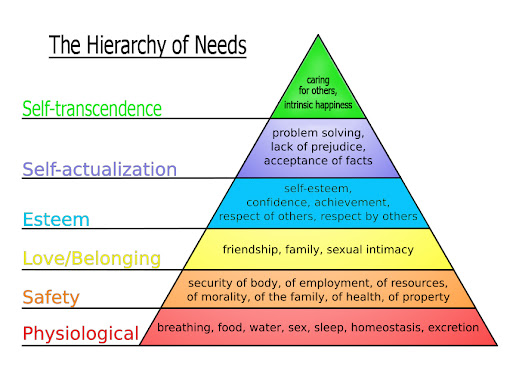
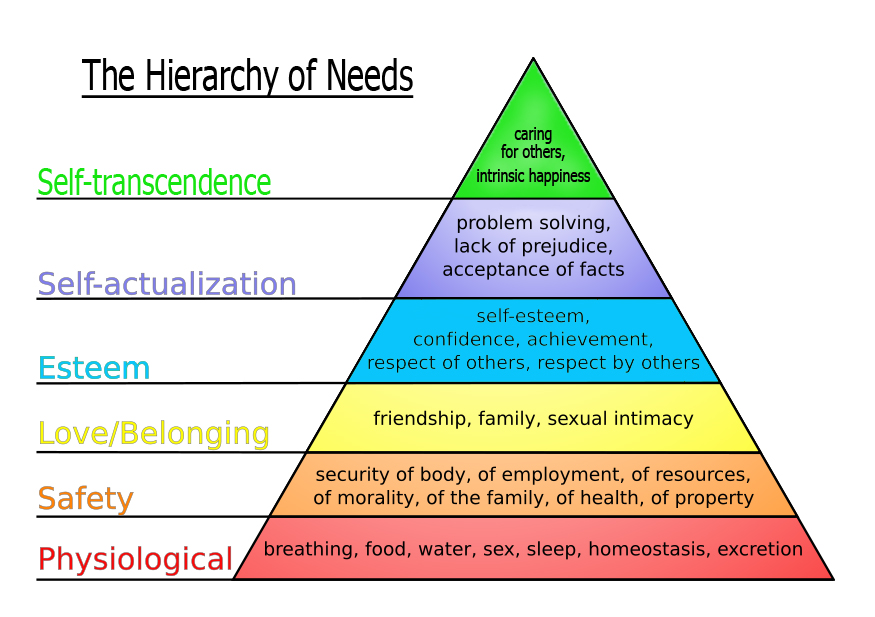
Maslows final version of his famous Hierarchy of Needs


It is significant to note that I owe almost all my knowledge to philosophy, psychology, mysticism,
esotericism, as well as life experiences of course. Yet, to reach such a state I had to come to term with the fact that despite my decent education, I was only starting to fathom how much I didnt know. There was actually quite a bit of incorrect, inaccurate information I had to unlearn, which had been ingested into my mind for three decades. Remember before the mid-late 90s there was no Internet, so double-checking the accuracy of whatever we were taught was tricky business. We therefore believed what we were told and whatever we viewed without much critical thinking.

Fortunately, however, I also knew
deep within that there is this unquenched curiosity and sincere desire to find out the Truth for myself, rather than just settle with mere belief or the vicarious experiences of others. I hence read lots of books and engaged in philosophical and theological conversations whenever I could and with a variety of different people, so one may lean more.
 
One of the things I came across everywhere around me while growing up is “Confirmation Biases”. These are Cognitive biases that involve favouring certain information, which confirms previously existing beliefs or biases, while disregarding the information which does not support them. I was there myself one day.


Another related term used in modern psychology is Cognitive Dissonance: The feeling of disorientation and discomfort resulting from holding two or more conflicting cognitions; as in ideas, beliefs, values, or emotional reactions. It’s a sort of wilful blindness, one could say. For it entails lying to yourself to justify some aspects of your reality. 


People who suffer from Cognitive Dissonance do not rely on reason or common sense to shape their opinions, because they are not ready to have their illusions shattered. So they prefer to convince themselves with preconceived views and biases — whatever is comforting — by overlooking any kind of facts or evidence, and without truly thinking for themselves.

After the Egyptian Revolution of 2010 I had to deal with many of those people, mainly online. We would argue for a bit and then I
d begin noticing a repeated pattern. When I was later introduced to the term, I studied their reactions and it all made sense. Thinking about it now, to some degree I was also equally there at a point in time.

For that very reason, I wrote about it in Arabic in
التنافر المعرفي — Cognitive Dissonance here on One Lucky Soul. This was something rarely if ever done before, that is writing any psychology or philosophy in Arabic. But this time it felt I somehow owed it to the Arabic-speaking world.

Funnily, one day I received a message from a stranger on Facebook, claiming I plagiarised the writing of his Egyptian professor about the topic. Ha, seriously. I simply replied that it is based on a translation of the English version, which was also written by myself, and which was sent back along with the reply to shut him up for good.


— ☙ ❊ ❧ —— ☙ ❊ ❧ —— ☙ ❊ ❧ —— ☙ ❊ ❧ —


You see, most people cognise and interpret information to fit what they already believe. And since they need to believe in something, so they tend to make themselves believe whatever is in tune with their internal worldview while disregarding whatever contradicts it. And traditional religions are full of people with cognitive dissonance who are constantly using cognitive biases to get by by cherry-picking from the dogmatic scriptures. 

For them, it is more comfortable to be numbly adhering to a certain belief system — preserving the old us-and-them model we are born into and going along with it, rather than objecting or rejecting or deserting it. 

Today, religions seem to be political tools used by the ones in charge to control the masses and to distract them from the reality of things in the Here and Now... as it had always been.

The reality is, if more theists truly studied the scriptures, all of them, they will find some good as well as some irredeemable balderdash. But as factual truth, there are many inconsistencies, making the phantasmagorical stories [fables] and the history not add up. Remember, the patriarchal Abrahamic religions are at least 1400 years old and those were notoriously different times. So it is natural that some of the rules and constraints ought to be dropped due to the fact that we know better now as a species. Whatever insults our soul and offends our intelligence should be discarded.
This translates as being true to oneself; it goes hand in hand with ceasing to believe the social conditioning and the indoctrination we were all exposed to as children while embracing our newly-found truths. That, of course, if the intent is to evolve and not become stuck in the past.

Interestingly, recent research in cognitive neuroscience has shown that the brain physiology is directly affected by our inner belief systems. The reason being is that all facts, ideas, and actions take the form of networks of neurons in our brain. While the left hemisphere is responsible for preserving the old model — the existing paradigm, our reality tunnel — the right one is constantly challenging the status quo. When the right hemisphere cannot convince the left one to change its views it ends up by causing narrow-mindedness, almost literally. In essence, it is our neural connections that physically define our belief system.


The good news, however, is that through self-awareness, transformative learning, and neuroplasticity we know that the wiring between those networks can indeed be altered. Once
the long-held beliefs and values reality tunnel change the mind opens up... again, almost literally.


— ☙ ❊ ❧ —— ☙ ❊ ❧ —— ☙ ❊ ❧ —— ☙ ❊ ❧ —


Let us now fast forward to my early 30s after leaving Egypt to Canada in 2010 and transcended an ever more complex label regarding sexual identity and orientation.

There was a pub right across the street from the cosy Davisville studio where I lived in Toronto. These were my early days of taking writing seriously, so sometimes I would go there to write and edit while pleasuring myself with a beer or three. 


One day, I was sitting in the outdoor patio with Caramella my late Cocker Spaniel peacefully by my side, enjoying the rare sun while reading High Priest by Timothy Leary. At some point on my way back from the bathroom inside I saw a guy sitting a couple of tables away get up to take a closer curious look at the book title before swiftly going back to his friend. I pretended not to see and returned to sit.


An hour later, some way or another we started talking. I think it was Caramella whom he began playing with — as it often happened since she was one heck of an adorable dog. After meeting a few times at the same pub I got to know that James is 50-years old and originally from Montreal… and that he’s openly gay.


On the other hand, I naturally opened up in return. I told him about my past addiction years and how they were spent in a relationship with heroin... as a junctional funkie. To my surprise, James, too, had had the same history; although instead of my 7 years, he was into heroin for 12. Usually when telling people my own story I get some kind of advantage
— for lack of a better word regarding what we have gone through. Addiction is addiction; still, a two-year habit on doctor-prescribed muscle relaxant is not the same level of suffering as a decade-long habit of street heroin. One upmanship here, Ladies and Gentlemen.

This time, however, the opposite happened: Waow, 12 years and you got [and remained] clean and healthy and happy now. Good for you. The comparison sort of humbled me and made me think that perhaps I didn’t really screw up that much. His experience was a testament, which equally gave me hope while showing me that there is indeed a life after addiction.

Being both talkative and outgoing, we followed through with opening up and sharing our pasts. Another day James began talking about his ex who got Aids before passing away. How he took care of him till the very last day. And how after a certain age, it’s not about the sex; but rather it’s about having someone to enjoy life and grow old with. 


He also shared that during his heroin years he never stole or did anything illegal to get high — while signalling to his mouth using his right hand and saying: “I gave my services, if you know what I mean.” For a second there I actually didn’t know what he meant; because it wasn’t the first thing to come to mind. Then somehow I remembered Basketball Diaries and an Aha-Moment overcame me.

Speaking of,
Opiated Then Hatin’ It and Addiction Talk: My Correspondence With a 31-Year-Old Reader Before He Passed Away are two related articles.

This was the first time in my life to ever sit and talk about such personal matters with an openly gay man. It was quite the different perspective to be exposed to, or
more likely not exposed to. As mentioned, it had always been me and them. But the guy was so open, fun, honest and just right-down genuine, it felt that if I didn’t like him then it’s probably because there was still a certain degree of homophobia looming on the horizon of my inner being — which I probably ought to start questioning its origin.  


Staying in Toronto for three years, said nearby pub remained the most convenient place to go to whenever needing to work outside of the house for a change — mostly during early afternoons. Other than James, I met other people, mainly older, and we would sometimes share tables and beer pitches. He knew I had a girlfriend then and have met her a couple of times when she would pass by. Even in front of her he would sometimes jokingly catcall me: “Hey handsome”, “Look at that hairy chest”. And surprisingly, I was totally cool with it.

I remember once I was writing there when James later came to my table and said: “You take yourself so seriously” — meaning being so into my writing. This was quite interesting since I rarely ever heard it before. I was frequently called either a joker or crazy or whatever, but never ‘serious’. But, this time it was about my passion for writing and it showed me that, indeed, I can be serious about something I love, which eventually became my life’s vocation. 


I also remember witnessing him get bullied by an old-timer Canadian guys in his 60s. You can sit with us, but dont talk, the man said to him. He told me about it when he then came to sit on my table for a while. He seemed a little troubled by the incident and I sincerely felt bad for him; that at 50 years of age and in Toronto, Canadian gay folks are still discriminated against.

Then one day something happened which led to a fascinating realisation.

As we were sitting at the pub all casually James offered to go back home to give me a blowjob. I smiled at him and calmly said that I’m not interested. Normally, after something like that it could get awkward between two people — let alone with guys, with one being not gay. But it didn’t get awkward. Actually, I even joked about what it would be like that one day I decide to switch. We stayed on the same table and resumed our chatting about sexuality, bisexuality, pansexuality, and polyamory. He said: “You know, many straight guys have things on the side with other guys and it spices up their sex lives with women.” 


I later found out that this side bro play is pretty common around the world nowadays, but also in the past. The official African American slang term for this phenomenon is being on the down low. 

Likewise, more women now are experimenting with same-sex just to know how it feels. It doesnt mean they are gay, which again is just a label. Personally, I hold that sexuality is much more fluid to be boxed and labelled; also that everyone is a bit bisexual, whether they admit it or not and whether they choose to experiment with it or not.

Right after leaving the pub that day I called my then-girlfriend on the phone to tell her what just transpired, and we both laughed. It was a first time, so in a way I still couldn’t believe it happened so genuinely. In another way, I was surprised and actually quite proud of my reaction— or lack of more likely. Because back in the days I would have probably felt uncomfortable. It was then and there when an illuminating realisation came upon me: I am not the same person I had been up until several years prior.

While I wasn’t precisely certain of the reasons behind the change, it seemed it had taken place down deep within my inner being: Was it leaving it all behind to reside in North America for few years, or sobering up, or just maturing? Perhaps a combination of all that. But I was
undeniably glad that this conditioned bigotry was dropped and that I was no longer a knobhead. Growth. Maturity. Empathy. Compassion. Openness.

Contemplating the matter, when some people, notably men, react to notions of homosexuality with what seems to be extreme ‘disgust’ or judgmental repulsion, it is not an actual emotion of disgust or repulsion. Rather, it is their ego’s subconscious way to declare that they do not fancy men. The kink is, if you are secure in your own sexuality and certain that you’re straight, you wouldn’t get that juvenile need to prove that you’re not; you wouldnt care to make an effort.
Oftentimes, it is those who are trying too hard to conceal their latent homosexuality, or even just thoughts about it, who develop homophobic tendencies. Some are afraid to like it so they resort to fantasising about it in secrecy while at the same time hypocritically vilify it in public.

Here as well, fear of the unknown is a major catalyst leading to hate and judgments. On Not Judging Others and Psychological Projection is an article about the topic.


My Journey Towards Self-Transcendence by Omar Cherif, One Lucky Soul

Our only limitation lies in who we think we are — our ego.
 As such, being indoctrinated from a young age is not easy to decondition from. Most people keep believing a significant portion of what they had been taught as kids and identify with it. As we have seen earlier, one example is the preconceived ideas and concepts about what God is and what is allowed and what isnt.

Fortunately [as
French-Jewish philosopher Henri Bergson expressed in the below quote], others develop critical thinking abilities at some point in life, which allows them to question and doubt the incoming information. It further gives them a chance to self-transcend their prior being and embrace a non-judgmental Higher Self. One that is more conscious, more compassionate, more empathetic. 

This is who we essentially are at the core. Not the labelled version we were stamped with as soon as we were born, but the liberated Oversoul.


— ☙ ❊ ❧ —— ☙ ❊ ❧ —— ☙ ❊ ❧ —— ☙ ❊ ❧ —


After the tour across America when relocating to Venice Beach in Los Angeles I came to notice that on top of nationality, creed, and sexual orientation, I have transcended even more schisms, like skin-colour and even gender identity.

 And it happened so organically.

I have a cool next-door long-stayer neighbour at the Jolly Rogers, Rob, who’s in his early 50s and looks a tad like Obama. He has that light chocolate colour and honestly I have never thought of him as a black man, despite the fact that there is absolutely nothing wrong with that. Still, it seems that my newly-enhanced being is not interested in labelling or categorising people. Like, at all.

Three months after moving, the man was telling me once about his parents who live in Boston, mentioning that due to the fact that they’re black they get uncomfortable coming through LAX airport. It was only then that I was overcome by this epiphany: Wait… So Rob is black? Ah yes, Rob is black! Oh well.
Reflecting back, of course I could see his face and body but what is meant is that I had not brought the colour of his skin to my conscious attention, simply because it seemed irrelevant and unimportant. Now that was quite interesting to observe or to catch myself in the act.   


Around the same time I came across a dancer with pretty green eyes at the Venice Beach Drum Circle. We spoke and danced few times before realising one day that she is probably a transgender. Asking a couple of brothers and sisters from the Circle and they proved me right. Now, finding out something like that would have naturally made me back off. But I didn’t. I mean, nothing much eventually happened, but I still liked her/him and her/his green eyes. As a human being, you see. If she identifies as a woman, who am I to tell her No. Not just that, but I will also treat her as a woman. That experience was another first.

Back to my vanishing homophobia...
I became so fine with the idea [that gay people exist and will always do], that now when I see visibly gay guys checking me out, either at the Circle or simply in the streets I may smile, even if internally, instead of neurotically turning my face away as I did for many years. There is absolutely nothing to fear. Be who you are. The same goes for receiving compliments. Which reminds me: A male Facebook follower/fan once wrote You’re so gorgeous, inside and out in a private message as a comment on a photo. And since this was even before the encounter with James at the pub, it got me thinking. After all, I wasn’t even sure gorgeous could be told to men. Ha. So I was excited to write my mother and sister in Egypt to tell them about the new compliment — to share a chuckle just as I was excited to tell the same then-girlfriend. Maybe in a way I was getting her jealous from a whole different gender. Pfff.

As previously noted, the surprise was not about how these things were happening 
for the first times in my mid-30s. But rather, how cool I was when they did.    

I even went further by getting a massage from a transgender girl. Yes. The first time it wasn
t planned. The receptionist just asked me if I wanted a ladyboy. What an unexpected surprise. My heart starting beating pretty fast before asking if the girl is pretty, to which she said yes. So with heart pumping even faster I then agreed to indulge in yet another novel experience.

As for the massage, I loved it because her hands were relatively stronger than a female
s; for my muscles require significant strength. So I did it again, twice, with different girls though. This is how secure I am now about my own sexuality. Im even publicly writing about it herein. Utmost Gratitude for getting rid of these acquired toxic complexes that plague a significant portion of men. 

Strangely, one day while biking on Abbot Kinney I heard someone call my name. By the time I got into a restaurant to have dinner I heard it again. Looking behind, it was the younger compliment guy and a friend who were in L.A for work and who randomly spotted me while visiting Venice. He reminded me of himself as the Facebook fan/friend, then we chatted for a few moments before leaving. Basing her assumption on the interaction, the hostess of the place who was standing right there then asked if I was someone famous. Ha.


My Journey Towards Self-Transcendence by Omar Cherif, One Lucky Soul
After more introspection and self-exploration I came to the conclusion that labels are absolutely nothing but labels. They are cultural constructs which we are born to find and never get the opportunity to choose. Whether it’s nationality, creed, skin colour, social status, sexual orientation, or gender identity, once consciousness evolves to a certain extent you realise the uselessness of all such limiting divisions; that we are all essentially One; that there is much more beyond all such labels and titles and terms. When you develop the empathetic ability to put yourself into others shoes you become everyone and everyone becomes you. This is why we should be more interested in the naked soul, in the inner workings of our true selves. For what matters is the heart the spirit — not appearances or petty tags.
 
An illusion, you see, is a distorted form of perception; and the biggest illusion of all is that your own perspective isn’t distorted. Only when one begins to see through the veil of this self-imposed illusion can they self-transcend and overcome his or her true self — becoming Nietzsche’s Übermensch, or Overman/Superman.  
 
The only things that seem to separate us are flags, books, beliefs, ideologies, fears and egos. Again, thats why we call separateness an illusion. Because the observer is the observed; for he creates the object observed in his mind, which makes this duality one because one wouldn’t exist without the other. Quoting Rumi: You are not a drop in the ocean. You are the entire ocean in a drop.”

Conversely, through us the Universe is exploring itself. Biologically, chemically, atomically, as well as transcendentally and spiritually. We are IT and IT is us. It is an extension of our minds and souls, and it is experiencing itself in infinite ways. But as a physical organism, most of us just happen to experience it in this life in the singular — bound by time and space.

As shared, to free myself from all the baggage the ego brings along I had to look beyond labels, mine and others. Nowadays, it actually happens subconsciously as with Rob. My mind probably began disregarding those us-and-them schisms or categorising people on its own after realising how useless they are regarding our relationship with the world and functioning in it. 

Being a decent human being who has morals and who aspires to do the right things in life has nothing to do with your nationality, ethnicity, religion, skin colour, creed, 
or what you do in your bedroom. It mainly depends on the level of empathy and compassion you possess; how you treat others, including old people, children, and animals, also the weak, the vulnerable, and the less fortunate. To be kind and gracious in one’s interactions and relations without expecting anything in return — be it a divine reward or otherwise — and without fearing retribution of any sort. For it’s not our beliefs that actually matter, it’s our behaviour. Love is all there is.
 
Another conclusion I came to reach is that asking questions is more important than finding answers. For unquestioned answers can be way more dangerous than unanswered questions.

While answers may lead one to think they are done with a certain matter or inquiry, questions lead to more learning — more questions and more answers. Wondering and pondering expand our horizon as they also make us more humble as we grow through life; for the more we understand, the more we realise there is so much more to understand.

A major benefit of a curious, inquisitive mind is allowing us to see other perspectives. This brings upon empathy, compassion, and rationality, which helps us get to know each other on a deeper human level. As such, sometimes I catch myself asking certain shy or reserved people questions I can easily find the answers to just to let them open up while gaining a healthy dose of confidence. And it rarely ever fails.

Questioning is indeed an indispensable element of a full life. Question everything, including yourself, then redefine it accordingly.
Free your mind, get to know your true self, then just BE and enjoy Life. Fully. Madly. Unapologetically. And lastly, remember that unconditional Love is the Tao... not fear.


——————————————————————————————
 
 
Related Posts Plugin for WordPress, Blogger...