Showing posts with label Religion. Show all posts

Friday, 11 September 2026

Not Right: The Ancient Demonisation of the Left Side


The Ancient Demonisation of the Left Side by Omar Cherif, One Lucky Soul


Have you ever wondered why the directional right hand and the concept of correctness share the same word? Why does the left side get a bad rep across centuries, cultures, languages, and sacred texts and manuals? Where does this superstitious belief originate from?


The topic had been in mind for decades. Time to compile the memories and research into this following article. This is for all the lefties out there who ever felt left out in a right-sided world.


As a right-handed schoolboy in Egypt, I remember hearing about certain parents, grandparents, or teachers who tied their kids’ left hands behind their back to force them to use the right one. Aouch — think of someone doing it to your main hand and messing with your inherent neurobiology! Why they did it? Likely because they thought it’s the “right” way to write or draw. Fortunately, this regressive practice wasn’t explicitly emanating from our direct circles; in fact, at Les Jésuites each class of, say, 30 contained several left-handed desks. 


Enter breaking my left arm one summer as a 9-year old in the South of France. Six Nails for My Double-Fractured Arm in Sainte-Maxime tells the full tale.


“A remarkable thing I remember about this whole rigmarole was something a friend of my parents the prominent orthopaedist, Dr. Samir Fanous, had told me when we met by coincidence on the plane back from France to Cairo. After he had a chat with my parents who informed him about what had recently transpired he said: 


‘You know the plate and nails will make your bone and arm stronger; because at this early age bones are still young and haven’t yet fully developed.
 Not too sure if he actually said the second sentence though, or if it was implied, or if my young mind understood it later. 


I nodded while standing there in the aisle in my white socks, listening to him comforting me. But to be honest, down deep inside I truly thought that he’s just saying something nice to this kid who just had a surgery to make him feel better. 

In my mind I was like Yeah Right! 

Surprisingly, two or three years later I began noticing that I use my left hand a lot more than usual. I use it to open jars among other activities that I used to normally do with my right hand. In basketball during my teens, it was easier for me to play with my left hand, which was an added skill I practised on — using Michal Jordan and Magic Johnson VHS videos. 

Years later I researched what Dr. Fanous had said during that flight and it actually is true. Now that I roll and drum — rather perfectly — with my left, I can safely say that I have become ambidextrous. And the surgery along the plate and nails are most probably the reason.
”


Today, whenever the son of a friend or any other youngster I care about breaks his arms or legs, I am compelled to share the above with them as an act of encouragement.  


During those teenager years following the surgery, a friend and teammate in our basketball team, Victor, was left-handed and he was an amazing player; to have a left-handed or two among your team is always an elemental and strategic decision. Then came a left-handed girlfriend, with whom I also played basketball as well as pool. 

It became apparent that all the lefties I knew are not cursed or glitched. They actually have a unique edge, despite navigating a physical reality chiefly engineered for right-handers. So what is the deal behind this deep-rooted cultural, linguistic, and religious stigmas faced by left-handed people across global history? Because there is indeed a certain palpable enmity, antagonism, and discrimination. 

Fast-forward to today when I have gathered enough information about the captivating topic to write about it. To get to the bottom of why the right side came to be preferred to the left one in the human world, let us pull back the curtain on the etymological and historical bahareez — ultimate essence — of how the world rigged the vocabulary against the left side.


The Ancient Demonisation of the Left Side by Omar Cherif, One Lucky Soul
O.C with a jam: Dunkin’ Doughnut, rightly so 
— Gezira Club, circa 1993 

Now as a fact to begin with: Approximately 90% of all humans are right-handed. And my childhood memory about tying kids’ hands to force them into conformity? It turns out it is not an exclusively Egyptian form of abuse. 

In a 2007 study in Taiwan, 59.3 percent of children studied had been forced to convert from left-handedness to right-handedness. The study took into account the economic status of the children’s families and found that children whose parents had less education were more likely to be forced to convert. Even among children whose parents had higher levels of education, the conversion rate was a staggering 45.7 percent. And the thought-provoking part is that the ancient stigma is no longer part of an exhausted superstitious practice from the mid 1900s, but had persisted up until modern times.


Interestingly, however, cats, rats, and mice that were studied show handedness seems to be equally split between right-and left-pawedness.


When you then look at religions demanding you step into a room exclusively with your right foot, ( إدخل برجلك اليمين ) “Edkhol breglak el yemeen” or when the person on the right is invited to enter or exit first while saying “yemeen”, right — as the right preferred “Islamic” way — any inquisitive mind is naturally compelled to ask questions.


After observing the natural world, when we then look at man-made religions demanding you step into a room exclusively with your right foot, (إدخل برجلك اليمين ) “Edkhol breglak el yemeen” or when the person on the right is invited to enter or exit first while saying “yemeen”, right — as the preferred “Islamic” and culturally accepted way — any inquisitive mind is naturally compelled to ask questions. What happens if we enter with our left foot or from the left side?

Across different languages, the word “left” is likewise used as a direct, literal insult — gauche in French and ( شمال ) shemal in Arabic. French words like “droit”, law, as well as “adroit” and “maladroit” carry the same bias. 


The bias behind “the devil’s hand” has equally made it to the English language in phrases and idioms — all of which suggest a negative view of left-handedness. As detailed in the paper Left Handedness, The Bible and The Quran: Implications for Parents and Teachers, from Research & Reviews: Journal of Educational Studies, everyday terminology across English associate the left hand with negative concepts. 


A “left-handed compliment” is an insult; “two left feet” is being clumsy or awkward, especially while dancing; “the left hand doesn’t know what the right hand is doing” describes poor communication and coordination within an organisation.


Moving into the domestic realm, a “left-handed marriage” is an adulterous sexual liaison; a “left-handed honeymoon” means travelling with someone else’s husband; a “left-handed wife” is actually a mistress.


Even more terminology like “left-wing”, and “out in left field”, as well as French (gauche), German (Linkish), Russian (Levja), and Latin (Sinistra) consistently carry negative connotations.

In contrast, English phrases and idioms involving the right side carry positive connotations while implying correctness. 

• “Right as rain”: Standing perfectly healthy, fine, or recovered after a chaotic storm.


• “By rights”: If things were fair and just, this is what should happen.

• “In one’s own right”: Being successful, qualified, or famous based on your own individual merits and abilities.

• “To be within your rights”: Having the legal or moral justification to do or claim something.

• “To be in the right”: Being morally or legally correct in an argument or situation.

• “To make all the right noises”: Saying what people expect or want to hear, often insincerely to gain approval.

• “To set someone right”: To stop someone believing something that is not true, or to correct someone by telling them the truth; also to make someone feel better.

• “Not right in the head”: Crazy, foolish, or mentally unsound. 


The last idiom is an interesting exception that follows the pattern. This semantic twist is a clear nod to how deeply our language equates the word right with correctness, where a state of mental confusion is simply described by saying a mind is literally lacking in rightness.


Dictionaries as well frequently equate left-handedness with clumsiness and incorrectness — a perception that largely stems from navigating tools designed for right-handers, whereas right-handed individuals similarly struggle with left-handed tools. You can find the full analysis and discussion of these linguistic patterns in the referenced study above. 

As such, we aren’t just looking at random quirks. We are looking at an ancient, cross-cultural, and highly systematic campaign to demonise the left side — using language along with an eclectic variety of exhausted superstitions. Sounds strange when you look at how the words, expressions, and even sentiments survived to modern times. But the roots originated from somewhere, from several times and places as we are about to see. 


The Ancient Demonisation of the Left Side by Omar Cherif, One Lucky Soul
The six nails extracted in 1987 Sainte-Maxime next to the unevil, 
covered-in-hair
 left-hand scar today in 2026 


✵ 1. The Global Linguistic Defamation Campaign


The lexicon of human history is heavily weighted against the left side — cutting deep through epochs, continents, and tongues — showing that the collective subconscious has used the left as a generational shorthand for broken, clumsy, forbidden, and evil for thousands of years.

The Latin Betrayal (Sinister): In ancient Latin, the literal, basic word for the left hand or left side was “sinister”. Because Roman soothsayers believed that bad omens and dark spirits always appeared from the left (west) side during rituals, the directional word sinister slowly morphed into our modern English definition: Threatening, ominous, and inherently evil. Meanwhile, their Latin word for right was “dexter”, which natively evolved into dexterity — meaning skilful, blessed, and graceful.


The French Slur (Gauche): In French, the word for left is “gauche”. Because right-handed majorities looked awkward trying to use their left hands, the culture used gauche to define someone who is socially clumsy, crude, tactless, and completely lacking in grace. Ironically, the same can be said about a right-handed person throwing a ball or trying to use a hammer or scissors. 


The Old English Weakness (Lyft): The actual modern English word “left” originates from the old Anglo-Saxon word “lyft”, which literally translated to weak, foolish, or broken.


The Egyptian Street Slang (Shemal): In Egyptian Arabic, when you want to describe someone who is untrustworthy, corrupt, shady, or running a illicit operation, you don’t use a complex legal manual. You look at them and say, “el bet deeh shemal” (this girl is left) or “mashya shemal” (walking left). The direction itself is weaponised as a moral failure.


Because roughly 90% of humans are born right-handed, the prehistoric masses did what the herd always does: it took the minority 10% configuration, got terrified by the unfamiliar movement, and manufactured an institutionalised manual of superstitions to demonise it. The very semantics of human language seem to have likewise been weaponised to ensure the left side remained synonymous with failure — perhaps emerging from a primal, evolutionary reflex.

To understand the sheer absurdity of this statistical tyranny, one only needs to look at what happens when a naturally conditioned right-hander is forced to step off their automated script. Try asking a lifetime righty to shoot a basketball, throw a stone, or swing a hammer using exclusively their left hand. The entire illusion of their majority dominance instantly collapses into pure uncoordinated comedy. We look ridiculously awkward — outright effeminate, as a hilarious viral video once pointed out. The shoulder buckles, the wrist goes limp, and the body movement looks like a data glitch.


Yet for centuries, millions of left-handed children were violently, ignorantly forced to endure this agonising awkwardness in reverse — their natural, creative main hand literally bound behind their desks to appease a campaign of primitive, ancestral indoctrination by a simplistic and perhaps paranoid herd.

To anchor the timeline closer to home, the left-handed uncle I consulted for this enticing piece shared that they tried this [de]programming on him as a child in 1940s Cairo, but eventually gave up.


A doctor of engineering with a sharp scientific mind, he fought the whole war until 1973 before moving to the U.S to take charge of automotive thermosciences. Looking back at my findings, his response cut straight to the bone:


Never had a problem with being a lefty, and actually I was kind of proud of it. Initially, they tried to make me use my right hand, but gave up quickly. The religious part is just fucked up.

Spoken like a true southpaw.


─── ✵ ────── ✵ ────── ✵ ───


✵ 2. The Religious Script Matrix


When the primeval majorities started codifying and organising their tribal religions, they baked this right-handed dominance straight into their cosmic blueprints, creating a rigid moral binary. 

The Judeo-Christian Judgment Line

The right hand is mentioned positively 100 times in the Bible, while the left hand is mentioned only 25 times, all negatively. In the book of Exodus 15:6, Psalm 118;16 of the New International Version (NIV) the Bible presents the right hand as the hand of strength. Sitting at someone’s right hand is considered a position of honour. The right hand is consequently valued over the left hand in the Bible.


In the Book of Genesis, Eve is written as emerging from Adam’s left side, instantly pinning the direction to inferiority and weakness in the mystical texts. By the time you reach the Book of Matthew, the division is total: On the Day of Judgement, God divides humanity like a shepherd separating sheep from goats. The blessed sheep sit on his right hand to inherit heaven, while the cursed goats are banished to his left hand straight into the eternal fire of the devil. Indeed, during the Middle Ages left-handed people were routinely targeted and accused of practising witchcraft — simply because the devil was assumed to be a southpaw!

Medieval Jewish Philosopher Maimonides listed 100 blemishes a Jewish priest could not have, and being left-handed was one of them. According to tradition, an itchy left-hand indicated you will lose money. An itchy right-hand indicates you will receive money.

The Middle Eastern Practical Origin

In Islam and ancient Middle Eastern traditions, the demarcation between the hands was reinforced by a practical survival baseline. 


Long before toilet paper or modern sanitisation existed, the left hand was strictly reserved for cleaning oneself after using the bathroom, while the right hand was exclusively reserved for eating, greeting, and shaking hands. Because the left hand was literally handling the waste, the culture naturally labelled it as “unclean”; it was a social, behavioural script that eventually hardened into religious laws — regarding which foot to step with or which hand to eat and handle sacred books with — lasting in the collective subconscious to this day. 


It is haram to eat with your left hand, the devil will be sitting next to you,” was another belief heard left and right as a young boy. Not that I believed it myself, but I instantly thought of my left-handed friends among all others and realised the flaw in the logic. 

So an All-Knowing, All-Powerful God creates left-handed people and gay people and all sorts of colourful people only to then begin demonising these minorities — deeming them evil. What nonsensical codswallop is that. The more you mature, the more these man-made superstitions stand exposed as mere centuries-old stories, opinions, and religious views that cannot be taken seriously, certainly not literally. 


To get to a truer meaning behind the religious scriptures and spiritual truths, they often must be understood metaphorically, as parables and fables. The secret lies in the allegories and analogies. This brings us back to what a metaphorical truth is: How the implications of a story can be accurate whether or not the details had physically occurred.


Echoing with the words of Egyptian-born Hypatia of Alexandria (350–370 – 415 AD), the Hellenistic Neoplatonist mathematician, astronomer, inventor, and philosopher:

Fables should be taught as fables, myths as myths, and miracles as poetic fancies. To teach superstitions as truths is a most terrible thing. The child mind accepts and believes them, and only through great pain and perhaps tragedy can he be in after years relieved of them. In fact, men will fight for a superstition quite as quickly as for a living truth — often more so, since a superstition is so intangible you cannot get at it to refute it, but truth is a point of view, and so is changeable.”


Just like many seers before and after her, the brilliant Hypatia was brutally murdered by a religious mob. Simply because her free thinking was a threat to the established paradigm of the time.


I think this whole left and right polarity could have very well been the metaphorical narrative used in ancient times to embody the duality and totality of man: Microcosm and Macrocosm, Mind and Heart, Matter and Spirit, Pain and Pleasure, Right and Left, “Good” and “Bad”, “Right” and “Wrong”; they are everywhere. Here, it was never a literal truth about one side being better or more correct than the other. Think about it. Our entire language is dualistic in nature and we do learn by means of opposites.

While these outdated societal norms and biases may be crucial blueprints of human history as historical artifacts shaped by human perspective our morals, laws, and scientific understandings ought to evolve with time.


Engraving by Isidore-S. Helman after Charles Monnet depicting the French National Constituent Assembly in Versailles, 4 August, 1789 - Not Right: The Ancient Demonisation of the Left Side by Omar Cherif, One Lucky Soul
The split in action: The National Assembly inside the Menus-Plaisirs hall at Versailles — where biological hand traits were permanently projected onto the global political canvas.


✵ 3. Origin of the Political “Right and Left: The Seating Chart of 1789


Did you know that the actual political labels of “Left” and “Right” were born entirely by a spatial accident in Versailles assembly hall during the French Revolution of 1789?

The French didn’t choose the seating arrangement based on modern network television scripts. They chose them because human brains are structurally wired to project our deep biological hand traits directly onto our environments. 

During the Estates-General, later transforming into the National Assembly, the deputies seated themselves based on their political affiliations.

The defenders of the absolute hierarchy sat on the right hand of the Assembly’s President — housing the supporters of the traditional monarchy, the aristocracy, and the established church.

The smashers of the status quo gathered on the left — uniting the champions of the revolution, systemic social change, and a direct limit to royal power.


Natively, the French called the Left the “party of movement” and the Right the “party of order”. It was a fluid, philosophical description of human behavioural mechanics.


The terms evolved seamlessly with time. Newspapers and journalists in 19th-century France began utilising “left” and “right” as rapid shorthand labels for progressive and conservative views. The terminology then spread across borders throughout the early 20th century, cementing itself as the standard way to map the global political spectrum.


Today, the core configuration of both definitions inside the political realm has hardened into a rigid binary:


Right: The domain of tradition, social hierarchy, state authority, and free markets with limited government intervention.


Left: The domain of social equality, structural reform, collective progress, and an active government role in society.


Centuries later, this universal biological projection remains weaponised by ruling establishments worldwide to keep the population polarised and fractured into tribes easier to control. Divide and Conquer. 


Such a divisive machine of modern indoctrination forces citizens to identify with the mere presentation of a political ideology — the label — while turning global governance into a corporate team sport between Republicans and Democrats, Red versus Blue. Naturally extremes are reached on both sides of the spectrum. 

For a more in-depth analysis, check my piece from last July, A Superpower on the Couch: Reflections from the Ten-Year North American Trip.

A Dialectic With Myself: Practical Yin Yang Approach to Coincidentia Oppositorum is an earlier psychophilosophical piece dealing with the topic. “The problem with black-and-white thinking is that you never get to see the rainbow.

The Intertwining of Pain and Pleasure is yet another exposé about the peculiarly mysterious relationship between the two states 
― neurobiologically, psychologically, and philosophically.    


The Ancient Demonisation of the Left Side by Omar Cherif, One Lucky Soul
Suntimental Sinai Sunrise with the local woof pack — Dahab, June 2026


✵ 4. The Solar Alignment: Facing The Sunrise


There is an ancient, non-local astrological pattern behind the right-left duality.

In ancient Indo-European traditions — long before the birth of modern theology and secular politics — when a priest or shaman stood up to pray, they always aligned their physical body facing the rising sun in the East.


When you stand facing the East, your right hand typically points toward the warm, bright, and life-giving South, while your left hand points toward the cold, dark, and frozen North.
 The right became natively associated with light, life, and correctness; the left became the dark path of the shadow, the sunset, and the unconditioned unknown.


It seems subsequent religions simply inherited this primitive solar sentiment, integrating the old framework straight into their own dogmas using their own tailored reasons.


─── ✵ ────── ✵ ────── ✵ ───


✵ 5. The Sokhna “Hermit Phase” and the Hand-Switching Djembe Experiments


Following five years of playing religiously at the Venice Beach Drum Circle every week and at Full Lunacy once a month, I resided by a different beach in El Ein el Sokhna by the Red Sea for two and a half years. 

This time, I was almost all alone in the entire area. Naturally, I was missing the whole vibe of sharing the tunes — and energy, time, essence — with others. This solitary existence was reflected on my drumming. 

I then had all the time in the world to experiment on the djembe. Different hand positions, a variety of fingers positions, taking advantage of “Rhythmical Space”, or the silence between the beats, often involving split seconds. Sometimes even play with Chopin or Baroque music in the background. I would also record myself to watch later and analyse. It was when Unshackled by the Red Sea — Free-Form Djembe Jam: The Lysergic Recordings [video] came to being. 


The Ancient Demonisation of the Left Side by Omar Cherif, One Lucky Soul
Right hand-left brain for the orderly base beat and left hand-right brain for the chaos
— Captured in the Zone by Oliver Rossberg, Venice Beach Drum Circle  


One realisation from that solitary time involved the left and right hemispheres of the brain: You see, the left side controls the right hand and it is the one into analysis, logic, and facts; one that guards the traditional status quo — the ancient root of the political right. As it turned out on the hide, my right hand was usually the one playing the repetitive, orderly base beats.


On the other hand, the right hemisphere of the brain is the creative, intuitive, artistic side rooted in imagination. This translated directly to my left hand — which was far more playful and unconditioned with its slaps and tones, constantly trying to push past the boundaries of the restrictive status quo, much like the original, revolutionary political left — breaking through the “shoulds”, “musts”, and “can’ts”.


For months, I would make it a habit to stop my hands whenever I know it is about to play a repetitive beat coming from muscle memory, instantly choosing to play a rather distinctively different sound, sometimes by switching hands mid playing. Then take it from there. This attempt to hack my own brain was an effort to break the subconscious habit of playing from memory.

Playing from the past, you see, is simpler and more “safe and comfortable” — the path of least resistance. Conversely, forcing yourself to delve into unknown beats and tunes allows you to improvise on the spot, honing your skills while enriching you with an added level of sensitivity. A certain Random Precision is birthed out of the moment to add a method to the madness, an order to the chaos. It likewise keeps your music fresh and always, always new, sometimes outright weird. 


To be able to observe the two sides of the brain communicating, one needs to rise above their dialogue. With practice, you can learn how to reconcile the binary duality of the left with the right — thoughts with emotions, mind and heart, order and chaos, preservation and liberation — while creating balanced melodies played by both hands. The outcome may then seem or sound like it is more than one player. 


The novelty was probably my way to entertain myself amidst the solitude and to deal with missing playing with others. I remain grateful for those two+ years because they turned out to be highly educational. Creativity is already therapeutic, but digging into your own inner neurobiology to understand why you do what you do — in both hands — remains illuminating.


There is some confusion as to what magic actually is. I think this can be cleared up if you just look at the very earliest descriptions of magic. Magic in its earliest form is often referred to as ‘the art’. I believe this is completely literal. I believe that magic is art, and that art, whether that be music, writing, sculpture, or any other form, is literally magic. Art is, like magic, the science of manipulating symbols, words or images, to achieve changes in consciousness... Indeed to cast a spell is simply spell, to manipulate words, to change peoples consciousness, and this is why I believe that an artist or writer is the closest thing in the contemporary world to a shaman.” 

Alan Moore


─── ✵ ────── ✵ ────── ✵ ───


✵ 6. The Psychology of Left-Handedness 


To finalise the article, let us see what science has to say. 

A breakthrough study published in the prestigious journal Scientific Reports completely flips the historical “devil’s hand” superstition on its head.


Scientists in Italy analysed over 1,100 individuals to decode the precise psychological makeup of handedness. What they discovered is a devastating evolutionary blueprint that validates the “outsider edge” philosophy.


Another interesting discovery regarding Self-Developmental Drive: Lefties showed an intensely high personal development-oriented competitiveness — meaning they actively use challenges to upgrade their internal motherboard and evolve their consciousness. 


Low Anxiety Avoidance: While right-handed individuals showed a strong, statistically significant tendency to avoid competition due to anxiety, left-handers face conflict head-on. They don’t shy away from the friction.


The High-Velocity Mental Profile: The data shows that strongly lateralised left-handers — pure southpaws — possess a radically different, high-velocity psychological cadence compared to the right-handed majority.

Hyper-Competitive Orientation: Lefties scored significantly higher on “hypercompetitiveness”. This isn’t just wanting to do well; it is a profound, relentless internal drive to outperform, win, and break past established boundaries.

 Remembering Victor, the teenage ex, and my 80-year-old uncle, I can safely concur.

The Evolutionary “Fighting Hypothesis”: The researchers used game theory and the Evolutionarily Stable Strategy (ESS) to explain why left-handedness (a mere 10% minority) has stubbornly persisted throughout human evolution instead of being wiped out by the majority.

The Surprise Edge: Because right-handers are deeply accustomed to facing their own familiar patterns, they get completely disarmed when encountering the unexpected. In hand-to-hand, boxing, or antagonistic sports (like fencing), a left-hander delivers a high-velocity “surprise effect”. The same can be said about left-handed baseball pitchers today, as well as in tennis and ping pong; the trait may also be encouraged in combat soldiers to give them a strategic advantage in fighting against right-handed opponents who are unaccustomed to fighting ‘Lefties’.


Our right-handed brain simply cannot react or predict the movement fast enough. I can totally relate when remembering myself playing ping pong against left-handed players — It is certainly noticeable as the angles are different.  


The Frustration Fuel: The scientists noted that lefties spend their entire existence navigating a physical world engineered exclusively for right-handers. Not just that, but they are often discriminated against by social, educational and religious institutions. Social customs and even language alienated and antagonised the left-hander as being “glitchy”, “different”, and even “bad”.


This continuous structural friction breeds a healthy, baseline frustration that acts as premium fuel, pushing them to compete harder, think more strategically, and maintain a high-alert antenna just to survive the layout. I guess knowing that you are a minority can do that. 


Some scholars actually regard left-handers as the last unorganised minorities in society, because they have no collective power and no real sense of common identity.


The Victory Mindset 


Here lies the most brilliant alchemical punchline: When the researchers put the volunteers through the Pegboard Task — a classic lab test measuring literal physical hand dexterity — there was absolutely no difference in physical skill between lefties and righties. So we can put that to rest. 


This means the left-handed edge is not some mechanical physical advantage — it is a purely psychological mindset. Their advantage simply lies in their sharper appetite for challenge, their comfort with conflict, and their unconditioned, unpredictable strategy.


A lighthearted fact I just came across to bid you farewell with: International Left-Handers Day is held annually every August 13th, mere few weeks ago. The coolest part? The 13th was chosen to poke fun at superstitions surrounding left-handedness — like Triskaidekaphobia and, when you add Friday to the fear, Paraskevidekatriaphobia.

Well played, lefties, well played. 


Because beneath the historical biases, the scientific data, and the playful superstitions lies a much grander, universal equation.


Order and Chaos: Destruction and Creation. Preservation and Liberation. Yin and Yang. Left and Right. Both sides are equal elements in one wholesome dance under the waterfall. They breed, feed, define, and rely on each other. Nothing can truly transcend or grow without unity.


——————————————————————————————


ALSO VIEW:


✵ THE SPIRITUAL INTEGRATION, PHILOSOPHY, AND SOLITUDE

The Millennium Eve Spent Alone at the Mosque
(2015)

The Parable


 of the Nugget of Truth (2022)

OLS Reflections — The Spiritual Edition

Who Are We?

My Journey Towards Self-Transcendence

Dance With Your Demons (2023)

Theory of Mind: Thinking About Thinking and the Benefits of Observing the Observer (2020)

A Dialectic With Myself: Practical Yin Yang Approach to Coincidentia Oppositorum (2020)

The Healing Powers of Storytelling: A Personal Experience (2026)

A Superpower on the Couch: Reflections from the Ten-Year North American Trip (2026)

Losing It 𝘉𝘳𝘪𝘦𝘧𝘭𝘺 At Full Lunacy: First Burst of Anger in Over 12 Years (2026)

The Ashram Sweeper Who Blocked Me on Facebook Over the Topic of Psychedelics

Connecting the Dots — a Storyteller Way of Seeing the Big Picture

Dreaming That The Buddha Was Not Fat

The Parable Of The Cow: You Are Not Your Thoughts

Out-of-Body Experience and Ego Death on a “Heroic Dose” of Mushrooms

Dealing with High Awareness and Empathic Accuracy


✵ ORIGINS AND ETYMOLOGIES

The Archaic Origin of the Swastika Symbol [with Photos]

The Origin of ‘Wishbone’ and the “Yadas - Fi bali” (يدس - في بالي) Game

The Origin of “Checkmate”

What The Heck are Vocal Fry and Upspeak?

From Hebrew ‘Tzedakah’ to Arabic ‘Sadaqah’: A Linguistic Tale of Origin of Charity and Righteous Giving in Judaism and Islam

The Joy of Giving

The Real Origin of “It Will Cost You an Arm and a Leg”

How ‘XOXO’ Came To Mean Hugs & Kisses

Why Many Place Names End with ‘-Stan’

Words With Italian Origin That Are Still Used Today In Egypt

Unusual English Words learned Later in Life

Some Arabic Sayings and Their Translations — أمثال عربية و ترجمتها

Some Egyptian Arabic Expressions and Their Translations — مصطلحات مصرية و ترجمتها

A Trip Through Egyptian Royal History with 92-Year-Old Sa’id Zulfikar

Words With No Direct Translation To English

More Words With No Direct Translation To English 


Related Posts Plugin for WordPress, Blogger...

Monday, 22 March 2021

From Hebrew ‘Tzedakah’ to Arabic ‘Sadaqah’: A Linguistic Tale of Origin of Charity and Righteous Giving in Judaism and Islam


‘Tzedakah’ and ‘Sadaqah’, One Lucky Soul

I happened to be watching an easy-going movie called Wish I Was Here. At some point, the lead character who’s also the director, Zach Braff, mentioned the Hebrew or “Judaic” word: Tzedakah. The word instantly rang a bell and sounded highly familiar. Like the Arabic or “Muslim” word ‘Sadakah’ (صدقة), meaning righteousness as well as charity and benevolence; from the three-letter root ‘Sedk’ ( صدق ), honesty. The same root gives us ‘sadeek’ ( صديق ), friend. 


Before going further into the comparative languages and linguistics as well as comparative religion aspect, the context began making even more sense. So in the movie, the struggling actor’s father gets ill and cannot pay for his grandchildren’s school as he had been doing, so his son begins to wonder if he could convince the Rabbi to keep his kids in school as an act of Tzedakah. Aha. It began to seem that they are almost the same word, even concept, in both Hebrew and Arabic as in Judaism and Islam.

Tzedakah (n.) [/tsɛˈdɒka/] on one hand means charitable giving among Jewish people, typically seen as a moral obligation. One common form of tzedakah was to allocate a portion of the harvest for the poor.

On the other hand, the Arabic Sadaqah in the modern context has come to signify “voluntary charity”. According to the Quran, the word means voluntary offering, whose amount is at the will of the ‘benefactor’.


Taken from an article titled Tzedakah 101: The Jewish Law of Philanthropy:

Tzedakah (pronounced suh-dack-uh) is the Hebrew word for righteousness or justice — also “fairness”. The word relates to tzaddik,” the name for a righteous Chasidic spiritual leader. Both words come from the Hebrew root word tzedek’, meaning justice. Tzedakah is an ethical obligation that the Torah mandates, also known as a mitzvah or law. Many Jews give tzedakah before Shabbat (the sabbath) and festivals such as Purim and Shavuot. Its intention is to show the Jewish people’s determination to improve the world.

Though many Jews typically perform tzedakah by giving money, many do volunteer work to pay their dues. Examples include volunteering at a soup kitchen, participating as a school field trip chaperone or visiting the elderly or sick. The Jewish sages of the Mishnah taught that every Jew has something to contribute, whether it be money, time, or attention.

Perhaps Mr. Tzaddik was a great friend. 
 
In actual fact, Tzadik (צַדִּיק) [tsaˈdik], as in “righteous or holy one” — also zadik, ṣaddîq or sadiq — is a title in Judaism, rather than name, given to people considered righteous, such as biblical figures and later spiritual masters. The root of the word ṣadiq, is ṣ-d-q (צדק tsedek), which means ‘justice’ or ‘righteousness’. When applied to a righteous woman, the term is inflected as tzadeikes/tzaddeket.

A
Tzadik/Sadik is equally defined as a servant of God and of other people as well as someone who loves people, as explained in this 6-minute YouTube video titled TZADIK - Secrets of the Hebrew Letters, kindly sent by a reader.

Parallelly, Sadaqah in Arabic literally means righteousness and refers to the voluntary giving of alms or charity. In Islamic terminology, sadaqah has been defined as an act of Giving something without seeking a substitute in return and with the intention of pleasing Allah”. Meanwhile, according to Ar-Rageeb al-Asfahaani, sadaqah is what the person gives from what he possesses, like Zakah, hoping to get closer to Allah.

Just as
Tzedakah is not solely about giving money, Sadaqah also can include other acts such as administering justice between two people, removing harm from a road/removing thorns, bones and stones from paths. A good word. Guiding the blind. Supporting the weak with the strength of your arms. Cooking for and even smiling at others.


The following is taken from Wikipedia:
 
The term 'sadaqah' stems from the Arabic root word ‘sidq’ (s-d-q) ص د ق, meaning honesty, truthfulness, and sincerity and it is considered as a sign of sincere faith. The three-letter root of this word, S-D-Q, also means, “to speak the truth”, “to be sincere”, and “to fullfill one's promise”. All of these aspects of honourable behaviour indicate the links between generosity and a healthy society. Some modern researchers also try to etymologically link the word sadaqah to the Hebrew צדקה‎ sedāḳā (almsgiving). Some experts hence conclude that sadaqah is a loanword.


Aha. Knowing that charity and giving is spread throughout most religions and even philosophies, perhaps the very concept has been borrowed as well and not just the word.


Sadaqah in Quran
Taken from the Quran
 
By then throughout my search, another Arabic “Muslim” word came into play: ‘Zakah/Zakat’ (زكاة). 

Apart from their similarities as words [just visually remove the middle ‘da’], ‘Zakah’ is likewise one of the cornerstone foundations of Islam as well as an ethical obligation — one of its five pillars, actually. 
 
Then I was left with a mix and match between these three uncannily similar words: ‘Tzedakah’, ‘Sadaqah’, and ‘Zakah/Zakat’. 


Zakah (Arabic: زكاة zakāh translates as “that which purifies”. There is a more specific form that is Zakat al-mal ( زكاة المال ), “Zakah on wealth/money”, is a form of almsgiving treated in Islam as a religious obligation or tax, which, by Quranic ranking, is next after prayer (salat) in importance. As the second of the five pillars of Islam, zakah is a religious duty for all Muslims who meet the necessary criteria of wealth. It is a mandatory charitable contribution, often considered to be a tax.

You see, charitable gifts or givings to relieve the poor is common with the teachings of most other faiths and more particularly the biblical traditions, the Quran repeatedly emphasises the moral value of giving. While the term ‘almsgiving’ may suggest a somewhat simple and unfocused act of charity directed at the poor and needy, the Quran articulates through a variety of terms, especially Sadaqah and Zakah.


Wooden tzedakah box from Amazon and sadaqah/zakah jar, One Lucky Soul
Wooden tzedakah box from Amazon and sadaqah/zakah jar
 
Personally, however, as a human being, I’ve always regarded Zakah as The number one priority. Ever since our school at Les Jésuites in Cairo used to teach us through Cours de Vie/Cours Spirituelles to habitually give to the poor, to the sick and elderly we used to visit at nearby hospitals or hospices, or to the leprosy populations. It made more sense to my developing mind as it does today three decades later. Simply because the act of sharing goes beyond the me-trip encapsulated in praying — namely the number one pillar in Islam — or even meditating, to actually doing something constructive and useful for others; be it on a personal level, or on the level of the community, or society, or humanity as a whole. Beyond the wishful “Thoughts & Prayers”. You feel you really are making a difference. In fact, I would argue that giving to someone who can probably never pay you back is the best source of fulfilment and gratitude. There is also a spiritual empathetic angle in the equation. 

While born Muslim in a liberal family, at some point during my early life I fortunately freed myself from the musts and the rules and the dogmas. You can read more about my spiritual experience in My Journey Towards Self-Transcendence.

But giving to others remained with me to this very day. Be it money, food, clothes donations, even organising free Full Lunacy drum circles part of the One Lucky Soul community, of which goers vary between 8 and 92 years old. Giving becomes a way of life. Giving, I might add, without expecting anything in return, neither blessings nor damnations. Because let us be honest, if one is doing it because they’re expecting to be rewarded or due to fears from some deistic retribution — or simply to be seen — then their ego is just trying to make a deal to benefit itself. This is actually the case of countless number of religulous folks, for whom fear becomes the name of the game. In Islam, however, this behaviour has a name, Reyaa ( رياء ), which is worshipping just so that people see them. It is, in fact, one way to ruin any Sadaqah or Zakah one gives.

Fear, as you know, breeds hate, fanaticism, xenophobia among many other ailments of our times. Thanks, but no thanks. If your religion is teaching you fear and absolute submission, well, good luck trying to decondition yourself from such a mindset. Some spend years and years trying to unshackle themselves.   

While religion tends to be fear-based, spirituality tends to be love-based. One of the most liberating experiences one can go through in life is unlearning the fear and embracing the love — as a driving force. You see, we are not responsible for the conditioning we were exposed to during our childhood. But as adults, we are fully responsible for fixing it. Truly, confusing religion with spirituality is like confusing education with intelligence.


Echoing with Leo Buscaglia’s piercing words: The fact that I can plant a seed and it becomes a flower, share a bit of knowledge and it becomes another’s, smile at someone and receive a smile in return, are to me continual spiritual exercises.

Garlic bread to anyone hungry by Omar Cherif, Venice Beach
From Italian restaurant take out in Venice Beach which I use to leave on a
bench at the Washington Blvd bus stop.


Linguistically, Arabic and Hebrew both belong to the Semitic language family, making them similar languages. Both found under the tree of the BiDi “Bidirectional“ languages, written from right to left. Words, pronunciations, and sentence structures resemble one another. Being language cousins — like Romance languages such as French, Italian, and Spanish — both share a variety of similarities, including words, words that sound similar like numbers, some common grammatical concepts, alphabets that look reminiscent, and similar vocalisations, such as the tendency to utter ‘kh’ ‘خ’.

They also both rely on systems of three-letter consonant roots; groups of “triliteral roots”, which are the foundations of verb and noun forms. Remember ‘S-d-k’


. Despite the similarities, however, both languages are not mutually comprehensible.
 
So yes, it is not really a surprise. But it was certainly a delightful educational Aha-Moment regarding Comparative Languages and Linguistics as well as Comparative Religion. When you come to think about it, learning multiple languages allows us the opportunity to understand how language influences people’s sense of reality while bridging some gaps.

 Mayhap more importantly, it reminds us that we’re all essentially One. 


The movie turned out to be pretty decent, too.


Similarities between Hebrew and Spoken Arabic by Discover Discomfort
 

After finalising the article I decided to Google ‘Tzedakah’ and ‘Sadaqah’ together, just to see what had been written before, perhaps if any. Man, am I happy I hadn’t done it at the beginning, because probably I wouldn’t have written any of this. Here they are for additional information on the topic.

The first is a link titled Tzedakah-Sadaqah: A Series of Intercultural Service Projects by the Faith and Spirituality Centre of the University of Calgary. This only includes a broad definition of both terms.

The second is an article, Tzedakah and Sadaqah: Charity tradition gets Jews and Muslims together by Medill Reports Chicago - Northwestern University.

Then finally an actual comparison in Tzedakah and Sadaqah… the laws of charity in Islam and Judaism by Judaism-Islam.com.


Now here is a fun note to end this article with: As a kid I had no idea what a bar mitzvah is. Slowly I began to get a clearer understanding of what it might be: When a teenager has finally become a man, so his family takes him out to a bar for celebration. Yep. I kid you not. It
’s not too far out, though. Thank Djod for education. Of course, Thank You, Internet as well. Actual bar mitzvah is Hebrew for “son of commandment”; and it is a coming of age ritual for boys, whereas bat mitzvah is the equivalent for girls.

All this Tzedakah/Sadaqah-
Tzadik/Sadik business discussed herein made me remember Tzatziki (cacık), the dip, soup, or sauce found in the cuisines of Southeast Europe and the Middle East; it is made of salted strained yogurt or diluted yoghurt mixed with cucumbers, garlic, salt, olive oil, sometimes with vinegar or lemon juice, and herbs such as dill, mint, parsley and thyme. And how the first time I ever heard the word at a shawerma shop in Toronto, I thought the guy behind the counter was asking me if I was his sadiqi, or friend. Or that I was ordering the sandwich to my sadiqi. Bwahaha. The more language we know, the more these peculiarities increase in numbers.


I hope you enjoyed reading this as much as I did researching and writing it. Learning can be intrinsically fun when we're not forced or coerced to do it. Knowledge is free — and it frees you rather than freezes you.


Salam and Shalom, consanguineous Brothers and Sisters. Now spread the Love.


Sources:

Tzedakah 101: The Jewish Law of Philanthropy, Borgenproject.org
Tzedakah, Wikipedia
Sadaqah, Wikipedia
What similarities are there between Hebrew and Arabic?, Quora
Similarities between Hebrew and Spoken Arabic, Discover Discomfort 
TZADIK - Secrets of the Hebrew Letters, YouTube
 

ALSO VIEW:

A Dialectic With Myself: Practical Yin Yang Approach to Coincidentia Oppositorum


Connecting the Dots — a Storyteller Way of Seeing the Big Picture

Unfollow The Crowd  

Why We Should Not Fear Death 

Change Is The Only Constant

Things I Got Rid Of To Become Happier

The Intertwining of Genius and Insanity

Out-of-Body Experience and Ego Death on a “Heroic Dose” of Mushrooms 

The Archaic Origin of the Swastika Symbol [with Photos]

OLS Reflections — The Spiritual Edition

The Millennium Eve Spent Alone at the Mosque

The Ashram Sweeper Who Blocked Me on Facebook

Dreaming That The Buddha Was Not Fat

Words With Italian Origin That Are Still Used Today In Egypt

The Origin of ‘Wishbone’ and the “Yadas - Fi bali” (يدس - في بالي) Game

The Real Origin of “It Will Cost You an Arm and a Leg”

How ‘XOXO’ Came To Mean Hugs & Kisses

The Story of Eric Clapton and Majnun Layla

From English as a Third Language to Author — How I Expanded My Vocabulary

Words With No Direct Translation To English

More Words With No Direct Translation To English

Unusual English Words learned Later in Life

Some Arabic Sayings and Their Translations — أمثال عربية و ترجمتها

Some Egyptian Arabic Expressions and Their Translations — مصطلحات مصرية و ترجمتها

The Difference Between Mandarin, Tangerine, and Clementine


Why Many Place Names End with ‘-Stan’

Why Hippies Are Sometimes Called Bohemians


Related Posts Plugin for WordPress, Blogger...

Monday, 19 June 2017

My Journey Towards Self-Transcendence


My Journey Towards Self-Transcendence by Omar Cherif, One Lucky Soul

Transcendence

tran·scend·ence
/tran(t)ˈsendəns/

Transcendence (n): Existence or experience beyond the normal or physical level.

Synonyms: Excellence, supremacy, incomparability, matchlessness, peerlessness, magnificence; rare: paramountcy.
 

In everyday language, “transcendence” means “going beyond”; with “self-transcendence” meaning going beyond a prior form or state of oneself. Mystical experience is thought of as a particularly advanced state of self-transcendence, in which the sense of a separate self is abandoned.


Being born and raised in a certain place makes us prone to be heavily affected by its environment. Parents, preachers, school, religion, society, culture are all components of what influences our personality and shapes our character. We simply are a product of our upbringing. While we are not responsible for this conditioning we were exposed to during our childhood, as adults we are fully responsible for fixing it. I had previously shared my philosophical views about self-transcendence in Who Are We? as well as in the list-article Things I Got Rid Of To Become Happier. The following is a more thorough and detailed account of how it all transpired.


— ☙ ❊ ❧ —— ☙ ❊ ❧ —— ☙ ❊ ❧ —— ☙ ❊ ❧ —

Having been born in Egypt I was naturally affected by all that. My parents were liberal, well-educated, and well-travelled, yet one cannot escape the overall paradigm in which they found themselves into. My first deconditioning was realising that my country of birth, Egypt, was not the greatest country in the world as some repeated and still do about their own countries. A few trips to the U.S and France during my childhood were enough for young me to reckon that there are other more advanced countries where decent and healthy citizens live. Later in life, I noticed that most people who hold that childish kind of love for their country have never left it
— be it in Egypt, Canada, the U.S or anywhere else.

It is perfectly normal to love one’s country, healthy too. But on the bigger scheme of things, nothing good can come out from believing that yours is superior to the rest; which brings us to nationalism. It is a flawed, childish attitude and mindset to believe that the place where you happened to be born is better than all the rest of the other places — assuming you have seen all other places, which is rarely the case. It means you chose to use the small, egoic mind to view the world. Unlike the big-picture view of the Higher Self, this way you are separating themself from all the rest of humanity by believing you are better than them, which is a mere delusion. With that in mind, let us ascertain that there are neither master races nor superior or inferior humans.

You know
Einstein called nationalism an infantile disease and the measles of mankind for a reason. We don’t really see any borders from space, do we. 

On a parallel note, there is patriotism, which is a mere feeling of admiration for a way of life of a country, as Orwell once explained it. It is believed by some to be based on affection and is considered passive; while nationalism is rooted in rivalry and resentment and considered a little aggressive.

One can say that nationalism is militant by nature and patriotism is based on peace.”

Both terms, however, are cleverly woven together and are frequently believed to mean the same thing; but they don
t as it is more than mere semantics. That is why they are two distinct words. Yet both seem like an attempt to separate ourselves from others; to feel proud that we are better than them — when we clearly aren’t. This ideology breeds as well as feeds on fear of the others, them, and more generally fear of the unknown.

The feeling of patriotism — It is an immoral feeling because, instead of confessing himself a son of God . . . or even a free man guided by his own reason, each man under the influence of patriotism confesses himself the son of his fatherland and the slave of his government, and commits actions contrary to his reason and conscience.” 


Leo Tolstoy had to say in Patriotism and Government.


— ☙ ❊ ❧ —— ☙ ❊ ❧ —— ☙ ❊ ❧ —— ☙ ❊ ❧ —


The following transcendence began through some doubts about religion; or perhaps the actual divinity of religions.

At 14-years old I had a question that no one seemed to know the answer to: If God is omniscient
all-knowing, all-wise, all-seeing in an absolute and unlimited sense as we were made to believe, then he knows in advance what all our choices will be in this life: Past, present, and future. So what is, then, the point of existing if it is all predetermined? Where would our choices and freewill fall into this equation? 


I asked teachers, uncles, and aunts, and no one was able to give me a direct answer. Some tried, though, with
Its all a test. But then when taking their proposed argument further, asking why create a test if you know its final result, I could see it in their eyes that most had absolutely no idea what they were talking about.


With age, said confusion perceived in older people led to additional inquiries: If they don’t know the answer to a question a teenager is asking, then probably there are more unanswered questions. This simple logic compelled me to want to find out more. 

For example, why would ‘He’ create us, determine our whole lives, then sit back and watch? If all is known as it is widely claimed, then why are we here? Where is the choice? Where is the freedom? Where is the freedom of choice?

Oh, and Why He not She? Why not IT’?

Another thing that didn’t make sense to me was what school children were taught about gay people ending up burning in hell on the hand of vicious ghouls  — according to the Quranic story of the People of Lot who were destroyed by the wrath of God for engaging in carnal acts between men. The sentiments are somewhat similar in Christianity more than in Judaism.  


Additionally, according to the Quran a man can beat his wife/wives (four are allowed) to discipline her
— though only lightly — as he can also beat his children to force them to pray.

Despite this early exposure, it didn’t take long for teenage me to question some of the incoming information and the exhausted atavistic ideologies it represents. We actually had a closeted gay relative in the family whom everyone loved and who passed away around the same time; and the idea of him going to hell despite the fact that he was a genuinely great person who actually prayed five times a day made no sense. This naturally led to some pondering:

Let me get this straight (not intended, but I like it): So you mean God, who’s omniscient — knows every single thing — created all these homosexual folks, whether they were born ‘gay’ or became it later in life, then he promises to throw them in hell because they are not like everyone else? If it is such a sinful abomination to like someone from the same-sex, why can’t He ‘fix’ them if He’s omnipotent — all powerful and can do anything? Why create them in the first place then lay his everlasting wrath upon them? What kind of reasoning is this? And most importantly, how come many mature adults believe it?

The same logic can be used about why create sick children and extreme poverty while allowing evil to somewhat thrive if He’s Omnipotent. 

Do they wholeheartedly believe that God favours some over others according to what they do in their private bedrooms and not just according to a geographical haphazard coincidence? That is quite the petty, nosey, judgmental God they are talking about. 


No wonder that some atheists often repeat the phrase:
Your God is too small” [A Guide for Believers and Skeptics Alike]. This actually is the title of a book by J.B. Phillips.

Along with Omnipotent and Omniscient, there is another
omni” attribute pertaining to God: Omnibenevolent all good, all loving. But paradoxically, this very omniscience seems to contradict the vengeful entity mentioned above.

The fourth and last and, for some reason, less used member of the family is: Omnipresent
all present; available everywhere all the time.   


Further, there is the good ol
Logical Problem of Evil. First attributed to the Greek philosopher Epicurus and his argument (modern version), it highlights the problematic issue with the concept of the Abrahamic anthropomorphic creator God:
  • God exists.
  • God is omnipotent, omniscient, and omnibenevolent.
  • An omnibenevolent being would want to prevent all evils.
  • An omniscient being knows every way in which evils can come into existence, and knows every way in which those evils could be prevented.
  • An omnipotent being has the power to prevent that evil from coming into existence.
  • A being who knows every way in which an evil can come into existence, who is able to prevent that evil from coming into existence, and who wants to do so, would prevent the existence of that evil.
  • If there exists an omnipotent, omniscient, and omnibenevolent God, then no evil exists.
  • Evil exists (logical contradiction).


Let us remember that a distorted truth or half-truth is much worse than no truth.
That is to say that false knowledge is worse than ignorance. 

More on spirituality can be found in these earlier pieces: The Millennium Eve Spent Alone at the Mosque, Unfollow The Crowd, and OLS Reflections — The Spiritual Edition. Also in the more recent The Parable


 of the Nugget of Truth.

This should be enough regarding theism, for now. The rest is in the book, in which there is a full chapter titled God Between Spirituality and Religion
 which begins with the following quote by
Joseph Campbell:
 
Every religion is true one way or another. It is true when understood metaphorically. But when it gets stuck in its own metaphors, interpreting them as facts, then you are in trouble.


— ☙ ❊ ❧ —— ☙ ❊ ❧ —— ☙ ❊ ❧ —— ☙ ❊ ❧ —


During my time at the American University in Cairo studying Journalism and Mass Communication, psychology, and philosophy I used to travel to London, UK for short winter holidays. This was when we got into clubbing and dancing. It didn’t take long to realise that the scene was full of gay people — men and women. So I began loosing up my slight homophobia. Nevertheless, my thinking was: I don’t have anything against them, and to each his own, as long as they don’t approach me. Still, there was this toxic and divisive ‘us’ and ‘them’ component to the mentality. Obviously I was not comfortable enough to let go of the conditioning... yet.

The following years by the end of 1990s in Egypt, a few gay people from my generation began being known throughout that close-knit society. In fact, three guys we all knew got busted through something related to the Internet… for being homosexual, which until today in 2017 is still an offence punishable by law in some countries, which itself is based on the Islamic Sharia law. Remember that Saudi women cannot drive! Exactly. And people are just going about their lives not giving a flying hoot that this is even permissible. But one thing is apparent, these man-made
laws’ cannot be taken too seriously.


In general, in repressed societies not many talk about the topic of homosexuality. And whenever they did, it is never anything good. Though the truth remains, like everywhere else around the world, gay men and women existed, exist, and will keep existing and there is absolutely nothing to do about it. What people do in their private lives and bedrooms should never concern anyone but themselves.


As such, deeming homosexuality, or LGBTQ rights in general, illegal in some countries will only increase the taboos and stereotypes around it, making people engage in whatever it is in secrecy. A look at the underground gay life in Saudi Arabia and Kuwait among other nations in the region is enough evidence. Just like the war on drugs, it
is a terribly lost cause.

When kids attending school in the year 2117 will be taught about the state of our current world in history class they will certainly wonder how humans allowed this
social ostracism, prosecution, and discrimination against women and said communities for all this time or against anyone different for that matter. Where was love, the compassion, the acceptance and open-mindedness? Where was the brotherhood and sisterhood of humanity?

Speaking of, for those who are not aware of the meaning of the recently added Q, it
s short for Queer and/or Questioning. While queer was originally used pejoratively against those with same-sex desires until the late-1980s, queer scholars and activists began reclaiming the word. Then there is the Questioning of one’s own gender, sexual identity, sexual orientation, or all three is a process of exploration by people who may be unsure, still exploring, and concerned about applying a social label to themselves for a variety reasons. 

On a personal level, however, I was always that masculine guy who was dating girls and women left and right. So despite the occasional curiosity — about why religions vilify same-sex and about the topic itself — I didn’t think much about it.   


— ☙ ❊ ❧ —— ☙ ❊ ❧ —— ☙ ❊ ❧ —— ☙ ❊ ❧ —


As I matured even more, my intellect as well as philosophical mind matured with me, so did my questions, wondering and pondering. This was when I sort of
awoke” and began thinking for myself, one could say. 

So as a species, we’re stuck to a 4.5 billion-years-old rotating rock that is orbiting a star, which itself is orbiting the centre of the Milky Way galaxy; this galaxy is travelling through the limitless space of the Universe at a staggering rate of 600 Km/s — that’s 2.2 million km/h — and what we do with our own genitals and body is what matters? Uhm, Come the right on. Or more fittingly: Cum On! 


A further notion which stopped making sense to me is the ‘hell’ idea that people spend their entire lives fearing. This concept of a dreaded ‘place’ full of fire and wicked demons who will torture you for ever and ever if you didn’t listen to certain rules — including playing with your genitals the not-so-right way. 


“But hey, He LOVES you
,” quoting George Carlin.
Heaven and hell are as much locations as God is a person.


Following some digging, I found that it is established between thinkers that religions were initially against homosexuality because it doesnt produce babies, hence less followers and less armies and less workers. Thats pretty much it summed up in one sentence. So it became against the norm and the law. The argument that it is unnatural can be debunked by the fact that homosexual/bisexual behaviour have been observed in more than 1500 species from tiny worms to large primates. 

My Journey Towards Self-Transcendence by Omar Cherif, One Lucky Soul
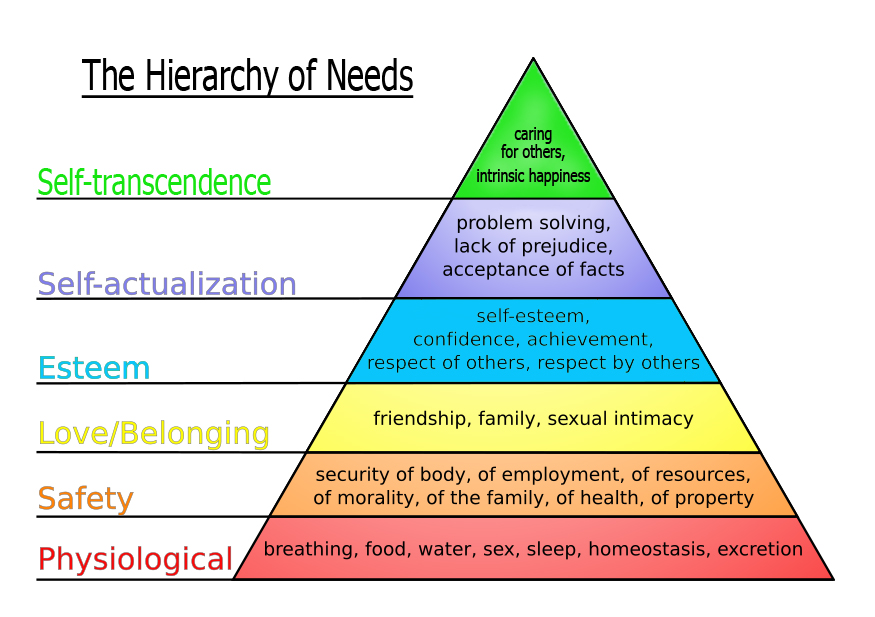
Maslows final version of his famous Hierarchy of Needs


It is significant to note that I owe almost all my knowledge to philosophy, psychology, mysticism,
esotericism, as well as life experiences of course. Yet, to reach such a state I had to come to term with the fact that despite my decent education, I was only starting to fathom how much I didnt know. There was actually quite a bit of incorrect, inaccurate information I had to unlearn, which had been ingested into my mind for three decades. Remember before the mid-late 90s there was no Internet, so double-checking the accuracy of whatever we were taught was tricky business. We therefore believed what we were told and whatever we viewed without much critical thinking.

Fortunately, however, I also knew
deep within that there is this unquenched curiosity and sincere desire to find out the Truth for myself, rather than just settle with mere belief or the vicarious experiences of others. I hence read lots of books and engaged in philosophical and theological conversations whenever I could and with a variety of different people, so one may lean more.
 
One of the things I came across everywhere around me while growing up is “Confirmation Biases”. These are Cognitive biases that involve favouring certain information, which confirms previously existing beliefs or biases, while disregarding the information which does not support them. I was there myself one day.


Another related term used in modern psychology is Cognitive Dissonance: The feeling of disorientation and discomfort resulting from holding two or more conflicting cognitions; as in ideas, beliefs, values, or emotional reactions. It’s a sort of wilful blindness, one could say. For it entails lying to yourself to justify some aspects of your reality. 


People who suffer from Cognitive Dissonance do not rely on reason or common sense to shape their opinions, because they are not ready to have their illusions shattered. So they prefer to convince themselves with preconceived views and biases — whatever is comforting — by overlooking any kind of facts or evidence, and without truly thinking for themselves.

After the Egyptian Revolution of 2010 I had to deal with many of those people, mainly online. We would argue for a bit and then I
d begin noticing a repeated pattern. When I was later introduced to the term, I studied their reactions and it all made sense. Thinking about it now, to some degree I was also equally there at a point in time.

For that very reason, I wrote about it in Arabic in
التنافر المعرفي — Cognitive Dissonance here on One Lucky Soul. This was something rarely if ever done before, that is writing any psychology or philosophy in Arabic. But this time it felt I somehow owed it to the Arabic-speaking world.

Funnily, one day I received a message from a stranger on Facebook, claiming I plagiarised the writing of his Egyptian professor about the topic. Ha, seriously. I simply replied that it is based on a translation of the English version, which was also written by myself, and which was sent back along with the reply to shut him up for good.


— ☙ ❊ ❧ —— ☙ ❊ ❧ —— ☙ ❊ ❧ —— ☙ ❊ ❧ —


You see, most people cognise and interpret information to fit what they already believe. And since they need to believe in something, so they tend to make themselves believe whatever is in tune with their internal worldview while disregarding whatever contradicts it. And traditional religions are full of people with cognitive dissonance who are constantly using cognitive biases to get by by cherry-picking from the dogmatic scriptures. 

For them, it is more comfortable to be numbly adhering to a certain belief system — preserving the old us-and-them model we are born into and going along with it, rather than objecting or rejecting or deserting it. 

Today, religions seem to be political tools used by the ones in charge to control the masses and to distract them from the reality of things in the Here and Now... as it had always been.

The reality is, if more theists truly studied the scriptures, all of them, they will find some good as well as some irredeemable balderdash. But as factual truth, there are many inconsistencies, making the phantasmagorical stories [fables] and the history not add up. Remember, the patriarchal Abrahamic religions are at least 1400 years old and those were notoriously different times. So it is natural that some of the rules and constraints ought to be dropped due to the fact that we know better now as a species. Whatever insults our soul and offends our intelligence should be discarded.
This translates as being true to oneself; it goes hand in hand with ceasing to believe the social conditioning and the indoctrination we were all exposed to as children while embracing our newly-found truths. That, of course, if the intent is to evolve and not become stuck in the past.

Interestingly, recent research in cognitive neuroscience has shown that the brain physiology is directly affected by our inner belief systems. The reason being is that all facts, ideas, and actions take the form of networks of neurons in our brain. While the left hemisphere is responsible for preserving the old model — the existing paradigm, our reality tunnel — the right one is constantly challenging the status quo. When the right hemisphere cannot convince the left one to change its views it ends up by causing narrow-mindedness, almost literally. In essence, it is our neural connections that physically define our belief system.


The good news, however, is that through self-awareness, transformative learning, and neuroplasticity we know that the wiring between those networks can indeed be altered. Once
the long-held beliefs and values reality tunnel change the mind opens up... again, almost literally.


— ☙ ❊ ❧ —— ☙ ❊ ❧ —— ☙ ❊ ❧ —— ☙ ❊ ❧ —


Let us now fast forward to my early 30s after leaving Egypt to Canada in 2010 and transcended an ever more complex label regarding sexual identity and orientation.

There was a pub right across the street from the cosy Davisville studio where I lived in Toronto. These were my early days of taking writing seriously, so sometimes I would go there to write and edit while pleasuring myself with a beer or three. 


One day, I was sitting in the outdoor patio with Caramella my late Cocker Spaniel peacefully by my side, enjoying the rare sun while reading High Priest by Timothy Leary. At some point on my way back from the bathroom inside I saw a guy sitting a couple of tables away get up to take a closer curious look at the book title before swiftly going back to his friend. I pretended not to see and returned to sit.


An hour later, some way or another we started talking. I think it was Caramella whom he began playing with — as it often happened since she was one heck of an adorable dog. After meeting a few times at the same pub I got to know that James is 50-years old and originally from Montreal… and that he’s openly gay.


On the other hand, I naturally opened up in return. I told him about my past addiction years and how they were spent in a relationship with heroin... as a junctional funkie. To my surprise, James, too, had had the same history; although instead of my 7 years, he was into heroin for 12. Usually when telling people my own story I get some kind of advantage
— for lack of a better word regarding what we have gone through. Addiction is addiction; still, a two-year habit on doctor-prescribed muscle relaxant is not the same level of suffering as a decade-long habit of street heroin. One upmanship here, Ladies and Gentlemen.

This time, however, the opposite happened: Waow, 12 years and you got [and remained] clean and healthy and happy now. Good for you. The comparison sort of humbled me and made me think that perhaps I didn’t really screw up that much. His experience was a testament, which equally gave me hope while showing me that there is indeed a life after addiction.

Being both talkative and outgoing, we followed through with opening up and sharing our pasts. Another day James began talking about his ex who got Aids before passing away. How he took care of him till the very last day. And how after a certain age, it’s not about the sex; but rather it’s about having someone to enjoy life and grow old with. 


He also shared that during his heroin years he never stole or did anything illegal to get high — while signalling to his mouth using his right hand and saying: “I gave my services, if you know what I mean.” For a second there I actually didn’t know what he meant; because it wasn’t the first thing to come to mind. Then somehow I remembered Basketball Diaries and an Aha-Moment overcame me.

Speaking of,
Opiated Then Hatin’ It and Addiction Talk: My Correspondence With a 31-Year-Old Reader Before He Passed Away are two related articles.

This was the first time in my life to ever sit and talk about such personal matters with an openly gay man. It was quite the different perspective to be exposed to, or
more likely not exposed to. As mentioned, it had always been me and them. But the guy was so open, fun, honest and just right-down genuine, it felt that if I didn’t like him then it’s probably because there was still a certain degree of homophobia looming on the horizon of my inner being — which I probably ought to start questioning its origin.  


Staying in Toronto for three years, said nearby pub remained the most convenient place to go to whenever needing to work outside of the house for a change — mostly during early afternoons. Other than James, I met other people, mainly older, and we would sometimes share tables and beer pitches. He knew I had a girlfriend then and have met her a couple of times when she would pass by. Even in front of her he would sometimes jokingly catcall me: “Hey handsome”, “Look at that hairy chest”. And surprisingly, I was totally cool with it.

I remember once I was writing there when James later came to my table and said: “You take yourself so seriously” — meaning being so into my writing. This was quite interesting since I rarely ever heard it before. I was frequently called either a joker or crazy or whatever, but never ‘serious’. But, this time it was about my passion for writing and it showed me that, indeed, I can be serious about something I love, which eventually became my life’s vocation. 


I also remember witnessing him get bullied by an old-timer Canadian guys in his 60s. You can sit with us, but dont talk, the man said to him. He told me about it when he then came to sit on my table for a while. He seemed a little troubled by the incident and I sincerely felt bad for him; that at 50 years of age and in Toronto, Canadian gay folks are still discriminated against.

Then one day something happened which led to a fascinating realisation.

As we were sitting at the pub all casually James offered to go back home to give me a blowjob. I smiled at him and calmly said that I’m not interested. Normally, after something like that it could get awkward between two people — let alone with guys, with one being not gay. But it didn’t get awkward. Actually, I even joked about what it would be like that one day I decide to switch. We stayed on the same table and resumed our chatting about sexuality, bisexuality, pansexuality, and polyamory. He said: “You know, many straight guys have things on the side with other guys and it spices up their sex lives with women.” 


I later found out that this side bro play is pretty common around the world nowadays, but also in the past. The official African American slang term for this phenomenon is being on the down low. 

Likewise, more women now are experimenting with same-sex just to know how it feels. It doesnt mean they are gay, which again is just a label. Personally, I hold that sexuality is much more fluid to be boxed and labelled; also that everyone is a bit bisexual, whether they admit it or not and whether they choose to experiment with it or not.

Right after leaving the pub that day I called my then-girlfriend on the phone to tell her what just transpired, and we both laughed. It was a first time, so in a way I still couldn’t believe it happened so genuinely. In another way, I was surprised and actually quite proud of my reaction— or lack of more likely. Because back in the days I would have probably felt uncomfortable. It was then and there when an illuminating realisation came upon me: I am not the same person I had been up until several years prior.

While I wasn’t precisely certain of the reasons behind the change, it seemed it had taken place down deep within my inner being: Was it leaving it all behind to reside in North America for few years, or sobering up, or just maturing? Perhaps a combination of all that. But I was
undeniably glad that this conditioned bigotry was dropped and that I was no longer a knobhead. Growth. Maturity. Empathy. Compassion. Openness.

Contemplating the matter, when some people, notably men, react to notions of homosexuality with what seems to be extreme ‘disgust’ or judgmental repulsion, it is not an actual emotion of disgust or repulsion. Rather, it is their ego’s subconscious way to declare that they do not fancy men. The kink is, if you are secure in your own sexuality and certain that you’re straight, you wouldn’t get that juvenile need to prove that you’re not; you wouldnt care to make an effort.
Oftentimes, it is those who are trying too hard to conceal their latent homosexuality, or even just thoughts about it, who develop homophobic tendencies. Some are afraid to like it so they resort to fantasising about it in secrecy while at the same time hypocritically vilify it in public.

Here as well, fear of the unknown is a major catalyst leading to hate and judgments. On Not Judging Others and Psychological Projection is an article about the topic.


My Journey Towards Self-Transcendence by Omar Cherif, One Lucky Soul

Our only limitation lies in who we think we are — our ego.
 As such, being indoctrinated from a young age is not easy to decondition from. Most people keep believing a significant portion of what they had been taught as kids and identify with it. As we have seen earlier, one example is the preconceived ideas and concepts about what God is and what is allowed and what isnt.

Fortunately [as
French-Jewish philosopher Henri Bergson expressed in the below quote], others develop critical thinking abilities at some point in life, which allows them to question and doubt the incoming information. It further gives them a chance to self-transcend their prior being and embrace a non-judgmental Higher Self. One that is more conscious, more compassionate, more empathetic. 

This is who we essentially are at the core. Not the labelled version we were stamped with as soon as we were born, but the liberated Oversoul.


— ☙ ❊ ❧ —— ☙ ❊ ❧ —— ☙ ❊ ❧ —— ☙ ❊ ❧ —


After the tour across America when relocating to Venice Beach in Los Angeles I came to notice that on top of nationality, creed, and sexual orientation, I have transcended even more schisms, like skin-colour and even gender identity.

 And it happened so organically.

I have a cool next-door long-stayer neighbour at the Jolly Rogers, Rob, who’s in his early 50s and looks a tad like Obama. He has that light chocolate colour and honestly I have never thought of him as a black man, despite the fact that there is absolutely nothing wrong with that. Still, it seems that my newly-enhanced being is not interested in labelling or categorising people. Like, at all.

Three months after moving, the man was telling me once about his parents who live in Boston, mentioning that due to the fact that they’re black they get uncomfortable coming through LAX airport. It was only then that I was overcome by this epiphany: Wait… So Rob is black? Ah yes, Rob is black! Oh well.
Reflecting back, of course I could see his face and body but what is meant is that I had not brought the colour of his skin to my conscious attention, simply because it seemed irrelevant and unimportant. Now that was quite interesting to observe or to catch myself in the act.   


Around the same time I came across a dancer with pretty green eyes at the Venice Beach Drum Circle. We spoke and danced few times before realising one day that she is probably a transgender. Asking a couple of brothers and sisters from the Circle and they proved me right. Now, finding out something like that would have naturally made me back off. But I didn’t. I mean, nothing much eventually happened, but I still liked her/him and her/his green eyes. As a human being, you see. If she identifies as a woman, who am I to tell her No. Not just that, but I will also treat her as a woman. That experience was another first.

Back to my vanishing homophobia...
I became so fine with the idea [that gay people exist and will always do], that now when I see visibly gay guys checking me out, either at the Circle or simply in the streets I may smile, even if internally, instead of neurotically turning my face away as I did for many years. There is absolutely nothing to fear. Be who you are. The same goes for receiving compliments. Which reminds me: A male Facebook follower/fan once wrote You’re so gorgeous, inside and out in a private message as a comment on a photo. And since this was even before the encounter with James at the pub, it got me thinking. After all, I wasn’t even sure gorgeous could be told to men. Ha. So I was excited to write my mother and sister in Egypt to tell them about the new compliment — to share a chuckle just as I was excited to tell the same then-girlfriend. Maybe in a way I was getting her jealous from a whole different gender. Pfff.

As previously noted, the surprise was not about how these things were happening 
for the first times in my mid-30s. But rather, how cool I was when they did.    

I even went further by getting a massage from a transgender girl. Yes. The first time it wasn
t planned. The receptionist just asked me if I wanted a ladyboy. What an unexpected surprise. My heart starting beating pretty fast before asking if the girl is pretty, to which she said yes. So with heart pumping even faster I then agreed to indulge in yet another novel experience.

As for the massage, I loved it because her hands were relatively stronger than a female
s; for my muscles require significant strength. So I did it again, twice, with different girls though. This is how secure I am now about my own sexuality. Im even publicly writing about it herein. Utmost Gratitude for getting rid of these acquired toxic complexes that plague a significant portion of men. 

Strangely, one day while biking on Abbot Kinney I heard someone call my name. By the time I got into a restaurant to have dinner I heard it again. Looking behind, it was the younger compliment guy and a friend who were in L.A for work and who randomly spotted me while visiting Venice. He reminded me of himself as the Facebook fan/friend, then we chatted for a few moments before leaving. Basing her assumption on the interaction, the hostess of the place who was standing right there then asked if I was someone famous. Ha.


My Journey Towards Self-Transcendence by Omar Cherif, One Lucky Soul
After more introspection and self-exploration I came to the conclusion that labels are absolutely nothing but labels. They are cultural constructs which we are born to find and never get the opportunity to choose. Whether it’s nationality, creed, skin colour, social status, sexual orientation, or gender identity, once consciousness evolves to a certain extent you realise the uselessness of all such limiting divisions; that we are all essentially One; that there is much more beyond all such labels and titles and terms. When you develop the empathetic ability to put yourself into others shoes you become everyone and everyone becomes you. This is why we should be more interested in the naked soul, in the inner workings of our true selves. For what matters is the heart the spirit — not appearances or petty tags.
 
An illusion, you see, is a distorted form of perception; and the biggest illusion of all is that your own perspective isn’t distorted. Only when one begins to see through the veil of this self-imposed illusion can they self-transcend and overcome his or her true self — becoming Nietzsche’s Übermensch, or Overman/Superman.  
 
The only things that seem to separate us are flags, books, beliefs, ideologies, fears and egos. Again, thats why we call separateness an illusion. Because the observer is the observed; for he creates the object observed in his mind, which makes this duality one because one wouldn’t exist without the other. Quoting Rumi: You are not a drop in the ocean. You are the entire ocean in a drop.”

Conversely, through us the Universe is exploring itself. Biologically, chemically, atomically, as well as transcendentally and spiritually. We are IT and IT is us. It is an extension of our minds and souls, and it is experiencing itself in infinite ways. But as a physical organism, most of us just happen to experience it in this life in the singular — bound by time and space.

As shared, to free myself from all the baggage the ego brings along I had to look beyond labels, mine and others. Nowadays, it actually happens subconsciously as with Rob. My mind probably began disregarding those us-and-them schisms or categorising people on its own after realising how useless they are regarding our relationship with the world and functioning in it. 

Being a decent human being who has morals and who aspires to do the right things in life has nothing to do with your nationality, ethnicity, religion, skin colour, creed, 
or what you do in your bedroom. It mainly depends on the level of empathy and compassion you possess; how you treat others, including old people, children, and animals, also the weak, the vulnerable, and the less fortunate. To be kind and gracious in one’s interactions and relations without expecting anything in return — be it a divine reward or otherwise — and without fearing retribution of any sort. For it’s not our beliefs that actually matter, it’s our behaviour. Love is all there is.
 
Another conclusion I came to reach is that asking questions is more important than finding answers. For unquestioned answers can be way more dangerous than unanswered questions.

While answers may lead one to think they are done with a certain matter or inquiry, questions lead to more learning — more questions and more answers. Wondering and pondering expand our horizon as they also make us more humble as we grow through life; for the more we understand, the more we realise there is so much more to understand.

A major benefit of a curious, inquisitive mind is allowing us to see other perspectives. This brings upon empathy, compassion, and rationality, which helps us get to know each other on a deeper human level. As such, sometimes I catch myself asking certain shy or reserved people questions I can easily find the answers to just to let them open up while gaining a healthy dose of confidence. And it rarely ever fails.

Questioning is indeed an indispensable element of a full life. Question everything, including yourself, then redefine it accordingly.
Free your mind, get to know your true self, then just BE and enjoy Life. Fully. Madly. Unapologetically. And lastly, remember that unconditional Love is the Tao... not fear.


——————————————————————————————
 
 
Related Posts Plugin for WordPress, Blogger...