Showing posts with label Find yourself. Show all posts

Sunday, 19 January 2020

Theory of Mind: Thinking About Thinking and the Benefits of Observing the Observer


Theory of Mind: Thinking About Thinking and the Benefits of Observing the Observer by Omar Cherif, One Lucky Soul

The following piece emerged during the two and a half years spent alone on the beach. It was a time of utter solitude and quietude, of deep reflections and of processing the entire previous decade spent On The Road in North America.  


One day some weeks back I spent an entire 55 seconds on my knees in the bedroom looking for a single nail clipping after it flew and landed somewhere. “Why?” would be a reasonable question to ponder, especially that this is no one time thing; for I had repeatedly done the same in the past while cutting my nails outside the bathroom. In fact, I sometimes do it in the bathroom as well. Why not let go of finding that microscopic human claw, one may wonder. You know, it vanished, now life goes on. But non, Monsieur. Oftentimes the decisions our minds make are not as simple, straightforward, or black-or-white. For there is a vast grey area in which they roam. 

While the nail clipping is an example, the following is a thorough psycho-philosophical, psychonautic investigation into the enigmatic and formidable tool we call the human mind, by none other than one of its own kind. That is what’s mind-boggling in the equation: Can the brain attempt to fathom itself and the very fabric of the thinking process as objectively as possible, away from all judgements and preconceptions, or a bias of some sort will likely always exist?

This line of thinking resonates with the witty words of Emerson M. Pugh: “If the human brain were so simple that we could understand it, we would be so simple that we couldn’t”

Until that one day a different race of beings produce writings about the human mind, we can certainly have a go at it — trying to answer one of the most fundamental question there is: What makes us think, act, and behave in certain ways? What are our choices built upon? In other words, what is the thought process or strategy(ies) adopted by the brain whenever it chooses one option over another? Find the nail clipping versus forgetting about it and carrying on with my day. An existential question with no simple answer.  

Looking for answers to the above queries, I added herein several quotes by some mammoth spirits who have mastered the elusive quest of understanding Human Nature as well as the Human Condition, giving us a unique chance to reflect upon them. Many of which are by none other than mastermind Carl Jung.

By the end of this exposé you may look at your own mind in a different light. Hopefully, adding you, too, with one or more novel perspective or self-insight to help you be better acquainted with yourself, while also sharpening your decision-making skills. Simply by digging into this fascinating asset of ours.


Before diving in, let us first identify that which we are discussing herein: Theory of Mind. 

Now, Theory of Mind is defined as the ability to think about mental states to predict behaviour, those of others as well as our own. Not only does it include attributing mental states, emotions, desires, beliefs, intentions, knowledge, but also refers to understanding that the mental states, emotions, desires, beliefs, intentions, knowledge may be, and most probably are different from our own. 

Theory of Mind is likewise regarded as the innate potential ability to put ourselves in people’s shoes. While some are born slightly more attuned to their fellow brethren, it usually takes a significant amount of inner work but also life experiences in the form of social and emotional interactions to be able to do so. 

Apart from the psychological aspect, this “Observing the Observer” is what mystics and philosophers often speak of, highly. For it is regarded as the most advanced form of wisdom.

As for Thinking about Thinking, known as Metacognition, it is the ability to monitor and regulate one’s own thought processes. Recent neuroscientific and psychological research identifies it as a foundational and highly sophisticated form of intelligence. This is because it enables the individual to consciously observe, understand, and intentionally improve their own cognitive processes, rather than merely using raw mental power. Hence wisdom — which transcends intelligence and lies beyond mere IQ. 

Metacognition represents a shift from just knowing facts to managing how knowledge is acquired and applied, directly impacting learning speed, decision-making, and emotional resilience.
By enabling us to pause, reflect, consciously steer our thoughts, it catalyses adaptability as well as emotional intelligence. It also allows us to make decisions that break old patterns, hence improve and evolve.

Anyone can think about their thinking. Though it takes practice to translate the awareness and observations into something tangible and practical to be applied to one’s life, for the sake of enhancing it. Wisdom after all is essentially applied knowledge. 

So while Theory of Mind and Metacognition are related cognitive processes, they remain distinct concepts. The first is more about understanding others’ mental states, focusing externally on social cognition; while the latter is about reflecting on one’s own thinking processes, focusing internally on self-regulation.


Consider those times you “catch yourself” doing something — as I just did — then proceed to wonder, ponder, and reflect upon the action or the moment itself. Observing the observer, then, means to become aware of our own awareness, which entails thinking about our own thinking.


Note that some of our actions operate on the subconscious level. Given the subconscious, the intuitive emotional mind, is in charge of the brain during a staggering 95 percent of the time, while its conscious counterpart is in control of only five percent, becoming aware of how it operates becomes imperative if we want to lead a balanced and wholesome life. Simply noticing our breath during breathwork exercises is an example of one such activity that enables us to be aware of one autonomic aspect of our existence. 

Another closely related concept is Empathetic Awareness. While Theory of Mind is cognitive perspective-taking, empathy is considered emotional perspective-taking. You can read about it in length in my previous exposé: Dealing with High Awareness and Empathic Accuracy.

When fully developed, a healthy combination of both Theory of Mind and Empathic Accuracy allows one to relate to others on a much deeper level; for it involves “reading” people’s thoughts as well as emotions. It is like seeing their naked self; beyond the mask, cloak, persona we all tend to wear when dealing with the outside world. 

Objectively observing how we think and feel — our state of being — leads to become aware. Observing through impartial eyes without prejudice, judgement, condemnation, evaluation, calculation, expectation, justification, or conceptualisation leads to awareness. This “Unprejudiced Objectivity”, as named by Carl Jung, is the essential point behind practices like meditation, yoga, and again, breathing exercises among other meditative, psychotherapeutic activities: Awareness. 


With awareness and observation we come to learn how to detach from the thoughts and emotions; how to simply BE. We learn how to allow them to flow through unobstructed before letting them go. As observers, this detachment, this equanimity is a fundamental preliminary for mastering the mind. 
Because if we don’t master it, we will identify with all the pollution it is constantly generating, hence the mind ends up mastering us; or someone else may do it for us.

The same goes for the emotions: Choosing not to be led by yours does not mean you’re cold or heartless; it means you’re wiser. Be reflective, not reactive.

Theory of Mind: Thinking About Thinking and the Benefits of Observing the Observer by Omar Cherif, One Lucky Soul
May you always value and cherish the simple little things in Life. 
For they make a significant difference and hence are the most essential. 
Simplicity, in actuality, tends to be deeper than complexity. 
‘Tis the reason why that which is simple often passes unperceived by the complex. 
If we look around us, we’ll find that the more one masters a certain domain, 
the more simplification they will strive for.


Now, it appears that the voice of my conscience is loud and has obsessive-compulsive tendencies. So the part of me that knows I shouldn’t have been trimming my nails while dancing naked to Janis Joplin kind of wants to prove to itself — or to the other parts, also of myself — that it had been ‘right’. It does so to please the status quo; to fit into a preconceived mould of how things are or are ought to be done, which has been ingrained into our collective consciousness and subconscious since childhood, through parents, school, culture, society, and the establishment. I think this need to be right and conform, along with the lack of flexibility it entails, remains unhealthy and causes significant amount of suffering in life. Even when the source is one part of the self.  

Thankfully, you know what else is also loud? My other rebellious “Fuck it. I do what I want.” part. Most of us spend our entire lives flickering between these two poles. However, and I can only talk about myself here, the rebellious counterpart still bases his stances and choices upon certain calculations. In our featured example, what’s the worst that could happen? A single nail clipping forgotten behind a desk, possibly for weeks or even years. Since it is not food nor something valuable, there is no substantial damage. Yet, I was still on my knees looking for a minuscule organic specimen. In fact, not just that, but I caught myself a different time quirkily counting ten nails before picking them up from the sink so they don’t block the drain... because they do, especially when mixed with long hair. Again, this had transpired almost fully subconsciously until I caught myself in the moment. 

Other times, higher risks are involved, as different possibility-probability rates. The following question we should ask ourselves is: Is it worth it? That is to inquire if it would support the kind of life I am manifesting. For at the bottom of it all, it remains vital to remember that: We are not responsible for the conditioning we were exposed to during our childhood. But as adults, we are fully responsible for fixing it.


This is where it gets even more interesting...

The human brain is known to consist of about 100 billion cells — neurones — each connected to 10,000 others, leaving us with a staggering 10 trillion nerve connections. Recent research in cognitive neuroscience has shown that this brain’s physiology is directly affected by our inner belief systems. All facts, ideas, and actions take the form of networks of neurones in our brain. While the left hemisphere is responsible for preserving, even pleasing the old model — the existing paradigm, our reality tunnel — the right one is constantly challenging the status quo. It is the attitude of “Do now and worry about it later”.

When the creative right hemisphere cannot convince the analytical left one to change its views, it ends up by causing narrow-mindedness, almost literally. In essence, it is our neural connections that physically define our belief system. And beliefs can be so limiting, that calling them the death of intelligence by Robert Anton Wilson wouldn’t be a stretch. “As soon as one believes a doctrine of any sort, or assumes certitude, one stops thinking about that aspect of existence.” You carry on with your life taking it for granted, believing that what you know must be right and correct. But you know what: The biggest fool of all is he who cannot change his mind. 


The good news is, nothing is cast in stone. Through transformative learning and Neuroplasticity we know that the wiring between said networks of the brain can indeed be altered.

Neuroscience shows that when we repeatedly perform a certain activity, learn a new fact, or practice a skill the corresponding neurones consistently keep stimulating each other. Over time, the wiring between them becomes stronger, which can make the connection last an entire lifetime. The neurones become more sensitive to each other and are more likely to synchronise their firing time in the future. All this takes place in the brain to support learning. In other words, whatever we do we are always physically modifying the brain to become better at it. What a remarkable feature that is. 

So, practising usually leads to improvement; the reason being is that our brain changes physiologically to adapt to the novelty. Change your thoughts and you change your reality.


Neuroplasticity has equally shown that it works both ways: Neurones and connections which are not used stop being hardwired.

Changes can also be induced through Epigenetics. For a similar fluidity can be said about changes in our gene expression. Once the long-held beliefs and values — reality tunnel — change, the psyche and entire body open up; again, almost literally. 


As explained by developmental biologist Bruce H. Lipton in a video titled Your Body Is An Illusion, the brain is through which we perceive and interpret the signals coming in from inside as well as outside the body. It then sends the processed information to the cells to dictate their behaviour and genetics. So it is indeed our own thoughts that create our reality. Saying like that may sound like New-Age Hocus Pocus, but it’s not. One example Lipton mentions in the same video is the queer phenomenon that is the Placebo Effect; how our brain — and perception — have a profound effect on our body chemistry, and hence on our physical health and reality in general. 

Speaking of, in his book titled “You Are The Placebo” author and researcher Dr. Joe Dispenza shares that from the 60-70,000 thoughts we get in our brains each day, 90 percent are the same as the day before. As such, thinking the same thoughts leads to making the same choices; same choices means same behaviours; same behaviours lead to same experiences; same experiences translate as same emotions; and same emotions then leads to same thoughts again — back to completing the loop. What does this mean? Well according Dispenza, our biology, our neural circuitry, neural chemistry, neural hormones, even as previously mentioned our genetic expression reflect how we think, act, and feel — that which constitute our personality, which in turn creates our personal reality.

Further, without letting go or healing from the past, including all the unwanted thoughts about it — that which we had labelled ‘negative’ — every time we think about it/them our body responds by producing the very same chemicals as when it first happened. In other words, we simply keep physically and emotionally reliving the experience while becoming neurotically fixated on, and consequently stuck in certain thought patterns. This is essentially the basis of most mental health issues people suffer from. 


Theory of Mind: Thinking About Thinking and the Benefits of Observing the Observer by Omar Cherif, One Lucky Soul
This actually happened one day, hick


To create a new personal reality, a new life, one has to think differently. By doing so we change the chemistry of our very brain, literally. A new insight or perspective or a novel angle can indeed help us get there. Where to get those from? Look no further than your own being. That is precisely what I am sharing with you herein: Observing our unconscious thoughts in order to wake up — as much as possible — from our automatic existence. 

Once you start training your mind by catching yourself in the act regarding the little things, when the big things arrive you will be able to have a clearer outlook before making a decision instead of [re]acting on your impulses like you did in the past. The very awareness tends to disrupt old patterns.

In life, the decisions we have to take on daily basis are often deeper and more complex than trimming nails in the bedroom — or not. 

Consider this other example: The “fuck it” right hemisphere wants to partake in something daring, like have unprotected sex with multiple partners, say in a debauched orgy. Lucky fictional you. But its left status quo counterpart is saying: Look, you’re really gambling with our luck here, buddy. It’s actually ‘life’, our life, mind you. Statistically speaking, by doing that your chances of contracting an STD are much higher. So what’s the alternative? Ah, “protected sex”. Alright, I can live with that, one voice says. Let’s have fun! Or, decide that you will not go for it. 

You simply sort it out with yourself — possibly through an inner dialogue. You convince yourself using certain methods, as with arguments, reasoning, patterns deciphering. It goes without saying that being able to do so as efficiently as possible takes some mastery.

A thing to remember whenever delving into your own thought-process: We must be honest with ourselves when dealing with the polarity of those two wolves. That is, if we wish to integrate the right and left sides while reconciling the polarity. Can mind and heart coexist peacefully?

The thing with the cunning mind is that it so wickedly imaginative, it is capable of using a wide variety of elaborate excuses, comforting justifications, and bullshit stories to try to convince us with whatever it wishes. As such, many of us choose to tell ourselves lies — often in the form of elaborate stories — to justify our inability, inaction, or lack of courage. Therefore feel better about the actual reality of certain things. Nevertheless, more often than not, down deep inside in our inner being, at the soul level, we usually know the actual truth; for inner truths are universal. Yet, if it is uncomfortable or inconvenient, wilful blindness may occur as a defence mechanism.
 

A related term used in modern psychology for this one mischievous trick the mind plays is Cognitive Dissonance. It is used to explain the feeling of disorientation and discomfort resulting from holding two or more conflicting cognitions; ideas, beliefs, values, or emotional reactions. It’s a sort of wilful blindness, one could say. For it entails lying to oneself, often by using a quagmire of logical fallacies, confirmation biases, and cherry-picking to justify certain aspects of one’s reality.

Another equally important piece of information to note is that it is not right-side of the brain or left-side; as in reason vs emotion, or mind vs heart. But rather, it is right-side and left-side; as reason and emotion, mind and heart. Both elements exist, and are not antithetical or incompatible. For they constitute the very essence of our inner being. To the realised individual, the relationship between both poles is not based on fighting, but it is more like dancing.

Determining someone’s personality or character appears to be much more complex than labelling a logical number person “left-brain dominant” and a creative free-spirited one “right-brain dominant”. While indeed each side of the brain specialises in specific tasks, the whole functionality is not that simple. For both hemispheres tend to connect, cooperate, and intermingle in many more ways than previously thought.

In actual fact, this infamous dichotomy of being either right-brained or left-brained has been called a myth by science — largely thanks to brain imaging technology. Because one can simultaneously be creative as well as analytical, emotional, and reasonable. These characteristics are not opposites, and can indeed coexist. Personalities are multi-layered and more complicated than to be classified as black-or-white. Remember the first paragraph: There is a vast grey area.

Speaking of common brain misconceptions — which I one day used to believe — is the myth that we only use 10 percent of our brains. We don’t. We use the entire 100 percent. In truth, we use it all the time, even while sleeping, just different parts of it.    
 
 
Theory of Mind: Thinking About Thinking and the Benefits of Observing the Observer by Omar Cherif, One Lucky Soul
Get into yourself and you’ll discover wonders


Now back to the nails...

So, the moment I caught myself on the bedroom floor looking for a single clipping, I instantly reckoned it was great “writing material”. Interesting one, too. Because everyone thinks. But despite having the ability, a significant number of people are not used to thinking about their wandering minds or even pay attention to what goes on inside — its very essence in the form of “Why and How?” questions. As a consequence, they often act by repeating certain irrational habits and behaviours almost mindlessly, without ever pausing or reflecting upon their choices. Needless to say, this results in an automatic kind of existence; similar to being in a hypnotic trance, during which the choices made are rarely the best nor most optimal. They become impulsively dependent on their reflexive senses rather than logic or reason, or even intuition. 

You see, when people are not conscious and self-aware their minds are not present. Their actions then become impulsive, which makes then live in deep torpor. They become groggy and numb and unquestioning as if they are sleepwalking through life. Even when busy, they don’t seem to be ‘aware’ of the moment, just like they were hypnotised. “Consensus Trance” is a term which describes this automatic state of consciousness.

According to the Philosophy of Mind and Perception, another term to describe people living in such modes of existence is a “philosophical zombie” — or p-zombie —  which is a hypothetical being that is indistinguishable from a normal human being except in that they lack conscious experience, qualia, or sentience.

While not everyone is plagued by a philosophical mind or destined to become a psychonaut, understanding our own thinking is a step forward towards our evolution and illumination. What we do with such knowledge differs from one person to the next. Yet it remains knowledge.

Whenever dealing with situations that require us to make a choice and decide, the fascinating mind remains flickering between the two aforementioned hemispheres. Echoing with Carl Jung’s famous words: “The pendulum of the mind oscillates between sense and nonsense, not between right and wrong.” 
 
So whenever facing life ask yourself that one question: Does it make sense? Is saying “Fuck it” worth it? Be it your well-being, health, energy, time, and sometimes even your very Life.

As noted, if not mastered, the monkey mind will be the one mastering us — controlling our lives in the process. In Buddhism, Taoism/Daoism, and Neo-Confucianism, the monkeys are a metaphor for the source of all our restlessness, confusion, and lack of control in life.

One of the insights learned through self-observation is that there really is no need to prove anything, neither to yourself — your own brain — nor to others. There is also no need to convince anyone with anything. Once you liberate yourself from the confines of these attachments and expectations, the world shall be transformed before your eyes. 


In terms of behaviour, the way we handle ourselves and our minds with all the circus going on up there naturally affects how we interact with the outside world and everyone in it. It also dictates the type of relationships we have with that world. Whether within our own family, between lovers and friends, at work, even with how we deal with people on daily basis. So it remains imperative to understand why we think, say, and act as we do; what are the drives and motives which often have their roots planted in the subconscious. With the Big Picture in mind, it is only through thoughtfulness and self-observation — along the self-knowledge they bring about — can we begin to ameliorate from ourselves; that is in order to evolve as a species. Resonating with the words of the Russian mystic and philosopher George Gurdjieff: 


“Self-observation brings man to the realisation of the necessity of self-change. And in observing himself a man notices that self-observation itself brings about certain changes in his inner processes. He begins to understand that self-observation is an instrument of self-change, a means of awakening.”


Without radical and psychological change on the personal level, we cannot expect to change the world, our world. 

For anyone looking to learn, grow, and evolve by enhancing and self-potentiating their quality of life, I suggest you read up upon Theory of Mind. The vital benefits of getting into yourself seem endless.


Theory of Mind: Thinking About Thinking and the Benefits of Observing the Observer by Omar Cherif, One Lucky Soul


Lastly, there is no such thing as knowing yourself too much. Truly. Observing the observer remains a higher step in the conscious experience, which allows you to zoom out and see the bigger picture of things, while also stopping you from acting out on impulses — like a restless child who’s in a constant state of reaction to all that which has been ingrained into them ever since they were teeny tiny toddlers through “the system”: Parents, school, society, culture and so on.

A mindful state of existence, including Metacognition, offers you the chance to pause and reflect; to “come to term with things” and to “reach closures”. So they don’t keep floating on the horizon of your subconscious mind as a background noise, possibly forever. Because whether you’re aware of it or not, any undealt-with issues will keep repeating themselves through your psyche as toxic, cyclical patterns while directing your relationships and entire life to a considerable degree. And you will likely keep projecting it all on the outside world, by blaming it for whatever happens to you.  

Resonating with another of Jung’s quote, which is the introduction of one of the sub-chapters in my book: “Until you make the unconscious conscious, it will direct your life and you will call it fate.”

With that being said, many people seem to go about their lives having absolutely no idea why unpleasant things keep happening to them or why they tend to be attracted to dysfunctional relationships. The simple answer lies within their own thought patterns along the vibrations they produce. It is them who attract that which aligns with the frequencies they emit — especially those originating from the subconscious. Because unless they come out from the darkness toward the light, they will remain unknown to us and hence will keep materialising as recycled experiences. Time after time after time. Until we get it.  

If, for instance, we see ourselves as victims who need to be saved, we’ll likely keep attracting people offering to help. While this is not necessarily a bad thing, but it keeps us depending on others; hence stuck in a disempowering cycle of the victim mentality.

Truth is, once you save yourself the universe will somehow conspire to help you out. The work, however, must be ignited from within. The person you will become will always be the one you decide to be. We do have that choice. When it comes to accepting instead of resisting and reflecting instead of reacting, we always, always have a choice. Taking a deterministic approach and leaving it all to “fate” or “destiny” is nothing but the easy way out, as it’s a disempowering way of thinking.  

At the very end, we are our own victim as well as our own saviour... the rest are mere excuses.


Observing our own mind and the thoughts it generates results in pure awareness, which in turn leads to self-realisation. This includes transformative Aha-Moments of clarity and illumination; of waking up; of wait a minute... . Reaching conclusive statements like: So that is why I have been getting into relationships that are bound to fail. Or, that is why I’ve changed jobs 14 times in the past 20 years. Aided by the novel, enhanced perspective, only then can we do something about it and modify that which has not been working for us; that which is pulling us backward. Time to do the inner work and to recognise that following the same neural pathways will not get us very far. Time to let go of whatever does not serve us or serve our evolution. Time to modify and refine, to become better versions of ourselves. For Change Is The Only Constant.  

Truthfully, there is no moving forwards without letting go. We do so by unlearning and relearning, which results in changing the pathways our brains have been repeatedly using. Hence our views, values, beliefs, and behaviour also change. As we have seen, it is through neuroplasticity that we know the brain has a remarkable capacity to alter existing pathways as well as create new ones. And it is through epigenetics that we know our gene expression can likewise change. We, with our very fabric made of neurones and genes and consciousness, do have that power.

Speaking of, The Significance of Letting Go is an earlier piece showing the benefits of doing so. Mind you, letting go follows self-observation. Because otherwise we have no way of knowing what is it that needs discarding.


Theory of Mind: Thinking About Thinking and the Benefits of Observing the Observer by Omar Cherif, One Lucky Soul


The more we understand this dynamic between the different counterparts of our inner being, the more we’ll reconcile the seemingly different polarity into Oneness. Bringing our inner darkness to the light, we therefore become a more balanced, centred, grounded, and wholesome individual. Someone who knows their true worth and what they deserve as much as they know their wants and needs; for whom decision making is actually fun rather than anxiety-provoking. Naturally, this all translates into a better, more refined quality of life. The key lies in being a witness to the voices without ever allowing them to drag us along the chatter they are constantly having. Because with intensive digging one can easily go mad. And by mad here I don’t mean the fun, creative, ingenious craziness; but rather, losing grip on reality with confusions, illusions, delusions. 
 
The truth of the matter is, You Are Not Your Thoughts. What you are is a sage as well as a lunatic. You are also the One who rises above both and chooses which to side with the most.

Much more to this eery relationship is explored in The Intertwining of Genius and Insanity.

Further reading about Theory of Mind in less theoretical terms is A Dialectic With Myself: Practical Yin Yang Approach to Coincidentia Oppositorum.


Now that you know the power of that mystifying tool you carry within your own skeleton — with all with its colourful nuances and subtle characteristics — time to inquire and to get into yourself: only to find a plethora of mesmerising wonders awaiting your heightened awareness to discover them.

By become aware of your true inner self on such a deep level, following others’ experiences will then seem futile. Through direct experience, self-knowledge becomes the journey during which our inner truth is found and owned. Other than being educational, the ride is also highly entertaining. Of course, it all depends on our perception of life and the outside world, which in turn stems from our conception of it. That is why each and every experience is unique.

Beside all the self-knowledge you’d likely amass, you’ll get to better understand your fellow brethren and the Human Condition. In that regards, learning about ourselves and others, including the thoughts and emotions, makes it incredibly hard to ever get upset from anyone. Since you understand their reasons for doing whatever they do, perhaps even relate to some degree. And for that, we must be grateful for psychology and philosophy for enlarging our circle of empathy and compassion. 

With knowing oneself also comes loving oneself. The deeper you dig, the more falling in love with yourself comes naturally. Without self-love we are not equipped with the proper capacity or tools to love others. Even if we do fall in love it will never be actual love; but rather, attachment. Because we will always be trying to compensate our lack of self-love and self-acceptance, by seeking their love and acceptance. Again, by projecting it on the relationship and the partner, affecting our choices and disrupting our behaviour in the process. So love remains another major benefit of digging into oneself and following the inward journey.

I will end this enticing piece with a final reminder: Know that the inner work has no end. For the Rabbit Hole is a bottomless pit, an everlasting endeavour guiding the soul as it keeps spiralling closer and deeper towards its inner core. For the only way out is in, my Dear Ones.


Related Posts Plugin for WordPress, Blogger...

Friday, 21 July 2017

Choosing Art Over Corporate and Academia


Choosing Art Over Corporate and Academia by Omar Cherif, One Lucky Soul

Leaving Egypt to Toronto in September 2010 I had absolutely no idea what life would lead me to. After ten years of exposure, I knew I had no real intention of rejoining the corporate race or the mental, emotional, or psychological toxicity it brought along. But with moving from the Old World to a different continent like North America it seemed that there wasn’t much of a choice. The following piece is about the different roads I had to first explore in order to reach where I am today; all of which have taught me one thing or the other, either about myself or about the world we live in.


The option facing almost all immigrants is to get a “Canadian Experience”, which for me sounded quite silly. Not because of the idea itself, but on a personal level and with the languages I speak and the experiences I have gained by the time I was 32, it didn’t seem right — or fair — to accept about any job just to get “my foot in the door”, as you would often hear. If I was 20 or even 26 it might have been the case, but honestly I wasn’t that desperate.
 Also, my life in Egypt was pretty comfortable. One could say my dream was different by then.

Yet at the time I was still trying to make it work, searching all over. So I decided to reach out to some of my connections. The two most notable people to write were Gamal Aziz, the President & CEO of MGM Hospitality who put me in touch with Ivan Goh, the Senior Vice-President of Four Seasons worldwide for many years who had later moved to MGM. Goh encouragingly ended one of his e-mails with: 


“Good luck, immigrating to Canada for a new immigrant like yourself is challenging to get a fresh start but even more so in today’s economy but your luck will change sooner than later. Keep on pounding the pavement to knock on every hotel and you will find something.”


Through them I was kindly connected to the Regional Vice President & General Manager of the Four Seasons Yorkville, Dimitrios Zarikos. Interestingly, as I was searching for his name I came to find out that he is currently the Regional Vice President & General Manager of the Four Seasons Hotel Cairo at Nile Plaza, which is where I was working in 2005-2006. After some time it was set to meet someone for an interview at the Four Seasons Headquarters in Toronto. 


However, even with my VIP connections, that “foot at the door” catch-22 was a must. This meant that instead of the middle management level already reached in Egypt, I needed to take a somewhat lower post just because of the bureaucracy. It didn’t seem right, so the idea was dropped altogether. 


But in actual fact, even though I had an immigration lawyer, I never went on with the process of immigration. So paper-wise without a work permit, getting any job in Canada was actually a considerable dilemma, almost impossible. The option of marrying my then-girlfriend was looming on the horizon as it seemed like the smarter but also only option. Nothing ultimately happened and I’m quite grateful for that.


After recanting the hospitality industry alternative, I began searching for myself — my true inner being. This self-realisation led me to writing and photography, which further became my life’s vocation. But then and there I was clueless of the outcome. I was just following that gut instinct and things just took off from there.


Around the same seeking time, I joined the School of Continuing Studies at the University of Toronto for a Creative Writing Certificate. Apart from training (Train The Trainer) at work, it was the first time to be back to the class setting since graduating in 1999-2000. I ended up taking two courses, Copywriting and Logic, and befriended both teachers.

As previously shared in From English as a Third Language to Author — How I Expanded My Vocabulary, those two classes were a major boost for my confidence and self-esteem. I had just come out of a seven-year hazy period of self-medication, so mingling again with people in such a setting was quite the invigorating experience.


Choosing Art Over Corporate and Academia by Omar Cherif, One Lucky Soul
At The University of Toronto in 2012

I also did some volunteer work for Canadian Journalists for Free Expression (CJFE) — once standing in the street in front of major publications to give out handouts, while the other I was some kind of usher/security guard during a film screening. It was a great way to peel off some layers of the ego.

Since I already knew that I love digging and researching and finding truths, Academia then came to mind. Actually, a few people met there in TO told me that I look like a scholar or professor, which probably cemented the possibility in my mind. A couple of years into writing I was still frequently asked by readers if academic writing is my field.

Besides, higher education was one legit way to legally stay and be able to “work” in Canada.


The reality though, is that I was still in that phase when I felt the need to belong to or be part of an institution in order to show a certain legitimacy and to reach “success”. Who would blame me. After all, I grew up on that. My dad was a General Manager for Sheraton, and I began working for Hyatt, the Four Seasons, Emaar, and Teleperformance, thinking that this is the natural evolution of things: The bigger the name, the fancier the job, position, and status. 

You alone are not enough. My paternal grandfather was also Ambassador. So there was no blueprint to follow. 

As such, after seven years of steadily climbing up the ladder in hotels, I decided to leave it all to join another multinational Real Estate company. Those two years were followed by a last year in another multinational before I came to terms that the matrix is not for me. 


Then, I had to take a leap of faith — in myself — to be able to leave these vapid jobs which were sucking my soul, forcing me to lead that inimical, toxic life. The problem with fakery and inauthenticity is that they always require you to wear some kind of mask, to appease to society, culture, and family. To be honest, I was actually pretty good in pretending to give a fuck about that which I didn’t give a fuck about. Naturally, this self-deception — more colloquially, all this Bullshit — brought countless unhealthy drawbacks.

But what about me? I would ask. What about what I really want? Isn’t this my life after all? I was already approaching my mid-30s, almost “half my life”, and such questions were constantly being replayed in my mind. 

My loved ones at the time humorously called it a second wave of mid-life crisis — succeeding the one at 27 when I chose to leave the hotel industry. 

Choosing Art Over Corporate and Academia by Omar Cherif, One Lucky Soul

Back to the academia option, the first person I thought to consult is a studious niece of mine who had been a professor in Cambridge, England for almost ten years. She is only few years older, though in actual fact she’s the daughter of my same-generation cousin, Djenane. My dad being the youngest of ten half-brothers and sisters, that’s how my paternal family goes. So I have been an ‘uncle’ since the day I was born. 


As mentioned, I knew I love knowledge and like to engage with others. I equally knew that I had the means — in terms of language and communication skills as well as presence. so was confident of being capable of teaching. Finally, I wrote Shima from Toronto, asking her opinion.


The young woman was as truthful as she could be and she eloquently shared the following in our correspondence:


“Being able to speak in front of an audience is a bonus, being able to engage them and actually enjoy it yourself is a competitive advantage. So, now in terms of content: I am a firm believer in doing what you love — that’s the only way of being able to do great things. This is particularly important in academia where the line between the personal and the professional are very blurred. Late night and weekend working is the norm and vacations are conferences are sometimes the only time off you’ll get. You live and breath your subject all day, every day. And students have the most incredibly ability to sense if you are not totally passionate about what you do and that gets reflected in the feedback.”

She carried on, “Working with a prof is very much an option. In fact most academics are desperate for help. Try to get paid as that is often possible but a lot of the times, academics have interesting projects that they have no funding for as they are too early stage or too new/novel that regular funding channels won't touch them. And these are usually the most exciting projects actually. Finding yourself a prof and a project that suits your interests as well as your personality could turn out to be your intellectual foundation for many years to come. By that i mean it could develop into a PhD and/or a research and writing relationship that lasts for years. You could apply for fund and get your first research job on the back of this project etc etc etc.”

I was grateful for her encouraging input, which gave me a better outlook on the idea. 

I was also totally ready for the blurred line notion. From Confucius to Alan Watts to Mark Twain among other mammoth souls, work and play have been indeed thought to be the same thing under differing conditions. It is all in how we look at it. Are you forced to do it or do you find joy in doing it? This very perspective is la crème de la crème of the crop. 

Fortunately, when I chatted with another academic who happens to be a friend, they asked me if I would be fine with teaching the same subjects over and over again, class after class, year after year?


Hmm. I left corporate because for me it was monotonous; because there is not much novelty or creativity. Would teaching be monotonous as well? Coming from them, I took their question seriously. There was obviously a reason why they asked it. Either they couldn’t see me fit in the academia model, or they were naturally projecting an issue they had been facing. This got me thinking.

Fast-forwarding to seven years later when recently I posted the following engaging question on Facebook: Would you rather have less stuff to do in life or more stuff you actually enjoy doing? I deliberately didn’t use the word ‘work’ since it means differently to everyone. 


Shima was one of those who commented: “I am getting to an age where I want to do more of what I love and almost none of what I don’t. Collectively though, I’d like to do less and have space to sleep and reflect on the things I am doing instead of always doing.”


It seems that at a later stage in life she is now consciously seeking more peace of mind.


Then back again to this time of metamorphosis, the ideology that one needs to belong to and depend on an institution to “adopt and take care of you” was alive and well everywhere around me. Parents, family, friends, most ex-partners, my then-girlfriend and, last and least, her own parents. This is how you make it and become a respectable person. The mantra is summerised as follows: No one can survive alone because you are not enough.

The common shared idea is to be “working” within a certain system or institution that you are not in control of. That is just the old model that is being preserved by the brain’s left hemisphere. You are just a replaceable brick in the wall. Then in your mid-50s or even younger, they have every right to tell you one morning: Thank you for your effort, time to go home. More so in corporate than academia. When through my short life I saw how devastating this feeling of being discarded by that same organisation you gave all your life to is on a few people, I only knew one thing: I never wanted to end up in their shoes. Ever. 


I had already experimented with the corporate world for ten years, while for academe, well, I was aware of quite a few truths.


First, I knew that if I did become a faculty member it means going back to certain “rules and regulations”; to tenure, routine, structures, political correctness; dealing with some exhausted ideologies, ego issues, assignments, exams, deadlines, conformity, competition, funding, and certainly some lack of real-world experience. I have spoken with many professors in my life, and as much as we often communicate well together, there seems to be a bit of an overall cluelessness about real life in some. They likewise do not like to take risks, and being associated to an institution gives them that sense of safety. Once one becomes a specialist in a certain field they tend to forget about all other fields of life. This is not to say that every scholar is lacking life experience, but I personally didn’t see this for my future self. This is even worse in corporate. 

You see, Niels Bohr once said: “An expert is a person who has made all the mistakes that can be made in a very narrow field.”

Indeed, there is a price to pay for being referred to as an ‘expert’ or ‘specialist’ in a certain field, which is spending your entire life learning more and more about less and less. They seem to be stuck in one reality tunnel. Naturally, they come to know it quite well. But it’s still one tunnel. Starting my early 30s  I came to eclectically reckon that there are many more colours to life than that. 


It is always remarkable to come to know some good people who excel in their professional fields yet have almost zero knowledge in other more human fields. Like how to cook, how to dance, how to create, how to talk and woe and flirt. It appears many of those experts and specialists are exceptionally good at following that which has already been established, playing within a limited framework. But stepping outside these realms doesn’t seem to concern or even interest them. Because they have always existed within the safety of a certain perimeter. Thereby possibly missing out on living life in its most general sense. And usually for what? Titles, positions, money, possessions, a certain standing in the society, and again safety. Quite the mundane stuff.

Further, even though you can intrinsically love your line of work, but doing the same thing over and over again, year after year, eventually becomes dull. Routine can be lethal; and it is through change, novelty, adventure, and some uncertainty that us humans remain captivated by keeping the magic alive. Not by accumulating knowledge and repeating it, but rather, by thinking and experimenting for oneself. For this is how we grow through life.

I equally knew that such scholastic life has the potential of isolating me from experimentalism. Being constricted in such a way — again — was not an option. All the patterns throughout that decade were enough to show that I was through with following. I knew I needed more freedom as I knew I have had enough of systems, organisations, and establishments in general. From now on, I shall do what I want. 

Choosing Art Over Corporate and Academia by Omar Cherif, One Lucky Soul
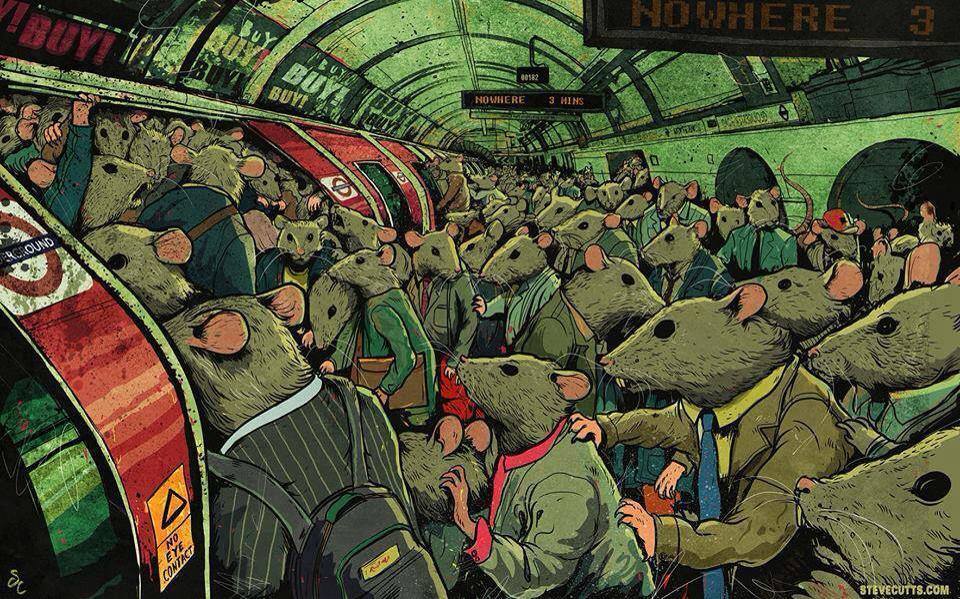
“Rats” by Steve Cutts

On a parallel note, when you come to think about it, some of the people who haven’t had enough life experience tend to compensate by hiding in books. Those book-smarts can be intelligent and educated, but the intellect is not the way to lead a full life. As mentioned, acquiring, accumulating, and memorising knowledge can make the mind dull, somewhat mechanical. Because it is relying and even living in the past. Ask many religious clerics who rarely seem to be able to think for themselves.

Conversely, having experience — being street-smart — gives you situational awareness; the wisdom and the needed skills to survive in the real world, rather than following more abstract knowledge which is largely based on the experiences of others.

Sometimes, though, one kind of ‘intelligence’ can induce the other and a certain balance is manifested. Being “world-smart” as well as “word-smart” would then lead to astounding achievements.  


Generally speaking, another thing to consider when pondering the topic of today’s education is that education does not equal intelligence. Repeating what we are told to memorise and being tested on it is not the best way to learn. As I came to reckon, nothing worth knowing can be taught. Or as Isaac Asimov expressed, “Self-education is the only kind of education there is”. Indeed, how can we love learning if someone is telling us what to learn? We can’t. How can we see beauty in growing through learning if we are forced to? We don’t. 


If you take notice, taught material rarely ever stays in our minds and almost always evaporates after exam time. And that is certainly a major flaw in today’s education system; most of what the youth are taught is not designed to be useful or practical for the rest of their lives. What to think is more important than how to do it when the very opposite should be true. 


This kind of enforced learning is limiting as it is disempowering, because you only get to learn what you have been taught. Just repeated, recycled information which someone thought is a good idea that you — a student — should memorise. But there is so much more to learning and the experience should be fun before anything. Echoing with a quote by Ludwig von Mises that serves as a reminder of why education should not be confused with intelligence: “Many who are self-taught far excel the doctors, masters, and bachelors of the most renowned universities.”


All that said, eventually I chose uncertainty with a chance of happiness over certainty with guaranteed unhappiness. I chose non-affiliation, non-association. I embraced arts in all its forms and become my own independent researcher. I write about whatever engages me without having to worry about guidelines or political correctness or some patriarchal institution. Thank you very much. I can keep learning and develop my intellect and overall being all by myself. Also, most knowledge is now free on the Internet. 

Speaking of affiliation, a publisher who actually paid me for two well-researched pieces told me once: “You write for an intelligent audience. This is not what the masses want. The goal is to create fear. The doom and gloom. End of the world. Make them feel that.

They also wrote: “This may sound counter-intuitive, but we need to make this mid level or low. We’re not looking for readers who want to learn anything, we want the same people that visit tabloid magazine sites. 

Reduce the research, reduce the references (it’s not even necessary), just make the article sound and have the affect I’m looking for. Here you have to SOUND like you know what you’re talking about inside out. This is different from actually knowing what you’re talking about inside out. Just sound like it. Sound like a professor teaching a bunch of students. 

A different time they said: Try to write on topics people love to read about. Hollywood gossip and music videos are excellent places to start.” Uhm... say what?

 Wrong address, man. I will not sell my credibility for some dollars. I never will and that is to stay.  


Another publisher wanted me to use clickbait titles for my pieces. Stuff like “12 Ways Your Mind Lies to You.” or “How to Reclaim Your Anxious Mind Through These 8 Tips.” I obviously refused, because it felt I am addressing school children. After a period of introspection I finally had to sent them the following:


“Educating the readers and letting them connect the dots about themselves and their lives is not useless. This is what psychology is all about; it teaches you about yourself and about others, which empowers you because you come to KNOW yourself.

I wanted to share my views with you earlier when you had mentioned the titles some time ago. The link you sent me was full of clickbait titles which do not suit what I usually write about. In fact, they are too mainstream, too sensational. If you read left and right on the Internet, you
’ll find that a large portion of these articles are reworded, re-edited, and paraphrased from earlier articles found on different publications; many of which are New-agey/Astrology, ‘Spirit Science’ kind of stuff.

Perhaps because my writing often entails psychology, philosophy, and research, there is a certain level of intellectual endeavour which I cannot seem to be able to go beneath.”


Ultimately, I stopped contributing to both publications. Now I freely write whatever I please in my own One Lucky Soul. Actually, now other publications often share my writings from there, usually with my approval. I’m not getting much or any payment though, because I’m not trying to please someone or the other. But one certainly becomes free and happy when knowing they are true to themselves.

Once again, just like what I previously wrote doesn’t concern all scholars, this also does not concern all publishers. Only that this had been my own experience with those I have dealt with. 

Choosing Art Over Corporate and Academia by Omar Cherif, One Lucky Soul
“Matrix” by Zackary

The final nail in the coffin during those fateful times of change came in the most unlikely way: Spending 5-6 nights at the Don Jail in Toronto for an alleged DUI.

My then girlfriend was out of town and I was all alone in Canada yet her parents chose to not bail me out, despite sharing a family. So they knew my parents well and were aware that I left all the comfort and abundance I had in Egypt in hope of a newer life with their daughter, which they themselves had previously encouraged. But then as soon as something so casual happened, they just sold me out and forbade the girl to see me. The heartless father even waited till after the weekend to go to court and watch me on video from an adjacent room while the judge was explaining what I should be doing.

“He doesn’t look remorseful,” that smarmy man later told his daughter. Perhaps he expected to see me cry my eyes out and beg the judge... just because I was driving with half a drink above the legal in me blood. 

After six full days of incarceration in a real jail such a The Don, my ex-brother in law had to fly all the way from New York just to come pay my bail.

Note that, out of decency, I had previously chosen not to mention the ex’s parents and what they did, or did not do — writing that they were also out of town which is nothing but a flat lie. So this is the first time I publicly come clean with the full story which, minus that specific part, can be found on here: Banged Up Abroad — My Few Days @ The Don Jail.


Gratefully, however, the experience ended up being an enlightening turning point in my life. For it reminded of more things I did not want. It also convinced me even more that I should pursue art as a vocation while at the same time teaching me a whole lot about myself, human nature, and how people can be infected with fear. After all, we do learn by means of opposites.


Now, to hold such a seemingly radical life view against all the surrounding mainstream, you cannot help but feel slightly alienated. The feeling of being different is certainly challenging and not always easy to deal with. Because you don’t feel you belong to the same reality tunnel as the majority, leading you to withdraw from that frivolous race they are so embroiled in. Using Robert Anton Wilson words in Promethius Rising, “In our terminology, they are mechanically hooked to their original imprints.”

More questions invaded my transfigured mind: Is it me or them? Am I the loony one who sees the absurdity and uselessness of wasting your life away, doing things you don’t have passion for, or everyone else is? 

Then came the sobering realisation that in today’s world, any conscious, aware lifestyle change to that which isn’t related to the production-consumption culture, which is largely built upon the notions of acquisitiveness and possessiveness, will always be followed by a hullabaloo.

Nevertheless, when down deep inside you know what is best for you, you come to gain the needed courage that empowers you to keep going against the current and disregard the hullabaloo. Knowing that you’re not the only one to do so is an inspiration as it is a relief.


Another realisation to come along was that everyone creates their own reality. When you delve deeper into the inner reaches of such statement you will find how utterly true it is. Whether from the point of view of physics, biology, neuroscience, metaphysics, spiritually, in addition to philosophy of course, it will blow your mind away — almost literally.

After going through everything else, the very last challenge to overcome was how to make it work logistically. If I don’t work for some institution or the other, I won’t be getting a monthly pay check. Then again, that pay check is another addiction, at least for the majority of people. But every still need money for food and shelter.

Besides, many of my previous pay checks were fully spent on getting high, yet I did survive. So without the highs, I ought to survive as well, no? Even better than just survive. If I was getting promoted and life was still flowing when I was wearing a mask, then without the mask and with much more health and truthfulness, life should flow even better.

That was my own rationalising mantra when taking the final step of choosing independence by getting into the Arts. And Life has been getting notoriously much more exciting ever since.


A friend and I were recently having a related chit-chat when she said that she needs $4000 a month to be able to live in L.A where I ended up after Egypt and Canada.

I told her that does not NEED that much, she just conditioned herself that she does. “Do you want to know how much I spend?” I asked. 


“But you simplified your life,” she responded defensively. 


“Yes I did, which means anyone can if they really want to.”

This simplification catalysed enough freedom needed to research and write about any topic I wish without having to wait for funding or for approval from an editor or publisher. It may not be the easiest way, but we’re not here to lead an easy existence — for that is a waste of life and potential. Rather, we’re here to lead a life that is worthwhile; one that is full of purpose, meaning, and growth.

Another mantra that developed later is: Transcend the social ladder; choose to levitate. While at it, transcend all bullshit as well, especially your own.


In summation, part of the experience of growing up and facing the real world, I happened to go through corporate employment, drug addiction, relocating several times, and yes, jail, before finding my true calling. By then, I was being slowly but surely introduced to more things — and people — I did not want in this life. Until I followed my heart and found my Meraki, those were all crucial steps towards what my soul is inherently yearning for. For knowing what we don't want is a significant step towards what we do what. And as you can see, that’s precisely what transpired.

Dear ones, by looking back at this eventful dérive I’d like to suggest not to be in a hurry to try to uncover all the answers. Instead, cherish the different possibilities and probabilities. When the time comes, and when you are ready, what you need to know will reveal itself to you... one after the other. Just flow with the natural, cosmic order of things with clear intents and most likely everything shall be adjusted.

Lastly, whatever is to come, or not come, will always be a mystery. Do not worry or obsess about the future. The past is already gone and the future does not exist yet. For what will be will be. The present Here & Now is all that matters.

Be true to your heart. Do what you love. And reckon that — perhaps unknowingly — you can inspire others just by being yourself. The universe will somehow deal with the rest. Life, my friends, is to be lived fully and unapologetically.


Choosing Art Over Corporate and Academia by Omar Cherif, One Lucky Soul
Artification Happy Nation on Abbot Kinney by #sart9


ALSO VIEW:


Related Posts Plugin for WordPress, Blogger...

Sunday, 13 September 2015

The Millennium Eve Spent Alone at the Mosque


The Millennium Eve Spent Alone at the Mosque by Omar Cherif, One Lucky Soul

During my senior year in university I was taking three philosophy courses and one psychology to complete both minors. Two of the philosophy were taught by a Professor Stelzer; one was Contemporary Philosophy, the other Ibn Arabi. 


Being 21, I was captivated by the rather unique input received through this professor. Something about witnessing a middle-aged
German man pronounce Quranic Arabic and explaining it philosophically enchanted me; it made those three hours every Monday/Wednesday quite different. Unlike the cherry-picked religion we were taught in school, which we often had to memorise almost blindly, my thinking here was challenged. This left me curious to know more. 


Around the same time, I was introduced to the basic notion of Sufism — the mystical, ascetic branch of Islam. Sufism is often considered to be a sect of Islam. It may be otherwise described as an aspect or dimension of the religion. Sufi orders (Tariqas) can be found in Sunni as well as to a lesser extent in Shia, among other Islamic groups and traditions. The word tarika / tarik originally means way or path in Arabic, which holds metaphorical meaning in Sufism.

According to Ibn Khaldun, the 14th century Arab historian, Sufism is:

Dedication to worship, total dedication to Allah most High, disregard for the finery and ornament of the world, abstinence from the pleasure, wealth, and prestige sought by most men, and retiring from others to worship alone.


With the growing interest in psychology and philosophy, esotericism led me to delve more into the depth and to read more. This was a time when I began pondering the inner reaches of the human mind; how far and deep one can venture to explore what God may really be — whether as an entity outside of us or as concept — and understand their inner selves along with it. What is death or what happens after we die was another existential query.  

My developing mind was seeking to widen its horizon, to investigate different modes of consciousness. So when a friend once mentioned a Sufi Zikr (Dhikr) in a nearby city outside Cairo, I didn’t hesitate to go with him and his driver who was from there and knew the way.
 A Zikr is a ceremony-like remembrance circle where attendees repeat short phrases or prayers like mantras, reciting them silently or aloud.

As planned, we reached our destination at around 7 pm and entered a ‘zawya’ — a room usually used for prayer. There was a group of men sitting on the floor, many had water pipes in front of them. This was not the usual ‘shisha,’ but the ‘goza’
.

Rounds and rounds of water bongs fixed with small pieces of hashish would circle the room as the blue smoke filled the air. In the corners of the zawya, a few men were playing hand drums while most attendees were already in some state of trance. I recall there was one older lady sitting on a chair, also smoking up. 


After maybe 30 minutes of this preparation, the lights were dimmed, the bongs removed, and the chanting began. Standing up and moving from side to side, the room echoed with either Allah, or Allah Hay — which translates into God is Alive. The Zikr lasted about 45 minutes before we said goodbye and went back to Cairo.


Even though hippie-minded me enjoyed the unusual experience and the different set and setting of the high, I knew this wasn’t the Sufism I was interested to examine. After all, all I did during the previous years was using substances to get there, so one could say I needed some novelty.

The Millennium Eve Spent Alone at the Mosque by Omar Cherif, One Lucky Soul


For as long as I can remember I have always been full of questions. Constantly fascinated by that which is different and ambiguous in life as well as in the universe in its entirety: The odd and the mysterious, the peculiar and the eccentric, the occult and the forbidden, the unexplainable and the paradoxical, the paranormal, supernatural, and metaphysical. These anomalies often defy explanation and seem to violate the agreed-upon laws of physics, even transcend logic and rationality. The thirst for such subjects has always been there, complemented by a certain Orphic desire to dig deeper in order to extend my knowledge beyond the usual and ordinary.

One of my earliest sincere reading into said realm of forbidden knowledge was a collection of books titled the Supernatural Series by Danbury Press (1975). In general, I tend to do my best to take in the unknown with wonder and curiosity rather than
based on preconceived beliefs; to keep an open mind. Later, however, a healthy dose of doubt, scepticism, and critical thinking had to be added to the equation. Simply because there are as much unfalsifiable claims floating around as there are outlandish superstitions and New-Age-type of woo-woo.

Whether it was telepathy, spirits and UFOs, alchemy and magic, or any arcane knowledge for that matter, all Psi phenomena of mind over matter found in the series fascinated me like no other. Why? Because, these fairly outrageous and controversial occult subjects are considered somewhat secret and unknown, making them more attractive to one
’s eyes. 


Another substantial reason for the attraction is that, whether we believe in it or not, the mystery shrouding such otherworldly stuff entertains the imagination and enhances creativity like nothing else. The exposure therefore changes the way we perceive what we tend to call ‘reality’. One can indeed entertain ideas and contemplate information without having to fully accept or believe them.


— ☙ ❊ ❧ —— ☙ ❊ ❧ —— ☙ ❊ ❧ —


Then came one remarkable event by New Year’s Eve of 1999-2000, which happened to be during the month of Ramadan. Many were celebrating the once-in-a-lifetime Millennium at the Jean Michel Jarre concert by the Pyramids, my parents and sister included. Others spent it at house parties. My few friends and I, though, had quite the different plans.

By 10 p.m, I left the buddies at my room at the Cairo Sheraton to go to the historic 
Al-Sayeda Zainab Mosque in Old Cairo. While two of them were tripping on LSD and one on mushrooms, I was to spend midnight in seclusion, meditating and reading the Qur’an. Fully sober. Yep.


For those who may not know,
Zainab is the grand daughter of prophet Muhammad who is known to have been buried at the spot where the mosque was later built some hundreds of years of ago. Al Sayeda, meaning lady, is a honorific title.

I was the only one inside the ancient mosque except a man who works there. Finally by 1:00 am I went back to join my tripping buddies. I’m not sure what was
exactly going through my head at the time, but it seems I was looking for deeper spiritual truths. As mentioned, the young psychonaut in me had been experimenting with altered states of consciousness, he was thereby seeking existential answers to all the queries [and contradictions] elsewhere.

Another major life event is that I was about to graduate in less than a month, so facing adulthood and the unknown was coupled with many question marks about my coming life and future.
And what occasion signifies a new era more than the Millennium Eve. 

Following reading — and studying — the Qur’an about 15 times throughout the years, the Bible, and parts of the Torah, my curiosity towards the intellectual tradition of Sufism further led me to the writings of Rumi, Omar Khayyám, and Al-Ghazali (Algazel) among other Sufi literature. Many of which have greatly influenced Western philosophers, writers, and theologians alike.

I had equally started reading about Buddhism. The first introductory book for some reason was Chogyam Trungpa’s The Myth of Freedom.


Another noteworthy milestone is finding out about Salman Rushdie
’s book The Satanic Verses. The title itself is already provocative and captivating. The fact that the book was banned in oh-so-many countries, that it led to many bombing and assassinations was inconceivable. All this for a book?! Waow. I MUST read this book. I did acquire it from London and it was indeed an enjoyable poetic read. 

The Satanic Verses Controversy, also known as The Rushdie Affair, showed me the pen may very well be mightier than the sword 
— beyond the mere expression. How powerful mere words and thoughts can be and their magnanimous effect on hearts and minds as well as on cultures and civilisations. 

It was also a sobering reminder of how fanatics and religious fundamentalism function in the modern world, incorporating matters like control, censorship, politics, but also on 
beliefs and ideologies.


The Millennium Eve Spent Alone at the Mosque by Omar Cherif, One Lucky Soul
Al-Sayeda Zainab Mosque captured in 1884-1885

During this same soul searching period I became interested in mysticism and spiritually, still looking to explore what it is to be a human being. I wanted to know for myself, rather than merely and unquestionably believe. I joined a centre in a Zamalek flat, Time Out For The Soul, to learn Tai Chi and to group meditate. I was one of the youngest members and thoroughly enjoyed what those few weekly hours of peace and quietude did to me; a sort of mini holiday from that mundane city life.


Unlike the growing
“healing industry” found today, these type of centres and gatherings were almost unheard of in Egypt then — true pioneers. Never was there any more than six or eight people at a time. By then I had already started working, mostly in shifts, so this weekly cleansing activity was always something to look forward to with great anticipation. 


A couple of years have passed before the owner of the centre, Randa, moved to the U.S. So naturally, my indulging was fully re-focused on drugs. I have been experimenting with all sorts of substances, but then when I got hooked on a drug of choice, that was when things drastically changed. Addiction turned out to be a whole different cauchemardesque experience. The resulting suffering remains highly educational nevertheless and, paradoxically, also empowering. Nothing like it teaches you more about yourself; travel and psychedelics may follow. 


— ☙ ❊ ❧ —— ☙ ❊ ❧ —— ☙ ❊ ❧ —


To my good fortune, I was yet again to encounter Sufism. This round on a deeper and perhaps more sincere and traditional level.

The first time I went to a truer Zikr was with my older cousin who had been before. This time there was no hashish smoking, but it was more of a serene and meditative experience. We went in, prayed, dimmed the light, and had the Zikr, which consisted of much more chanting and prayers than the sole “Allah / Allah Hay”.

Afterwards, we sat on the floor to share a simple meal. 

Then we listened to some reading — in English — by Stelzer who is otherwise known by his first Muslim name [Sheikh] Abdul Jalil and who is ranked number two in the hierarchy of this specific tariqa sect in Egypt, the Naqshabandi Sunni Sufi order. Today, it is said that around 72 different Sufi orders exist, with the Naqshabandi being one of the major and more international four. 
 
The attendees of the Zikr were made up of an eclectic variety of multicultural men. Many looked like they come from different backgrounds and nationalities. Few non-Egyptian teachers from the American University in Cairo where the ones who led the Zikr, starting with Abdul Hay Holdijk, Abdul Jalil, as well as Osman Andrew Young — my English 112 teacher in 1996 who became a close friend ever since.

They were also few 
other expats, some students, and some older men from all over. Every now and then there would be a visiting murid from a different country. Once again here, being in my mid-late 20s I was usually one of the youngest if not the youngest.

Despite the mix, our fraternal union during those few hours every Thursday night transcended any seeming differences. We were there for one thing only: Sharing an enriching, soul-cleansing experience. The closest I could relate to at the time, as a point of reference, was taking ecstasy at a rave or festival. Only that the intoxication was not chemically induced, and natural highs don’t have lows.

On certain occasions — mainly on Islamic holidays —  females joined the gatherings and they would sit on the outer side of the circle. 


The group receives a weekly e-mail with the time and location, in which we’re all addressed as “Dear Muhebeen” — meaning lovers. This is a metaphor Sufis use to describe the state in which Zikr in particular, and being a Sufi in general leaves them. 


Amid the battle with drug addiction in my final years in Egypt, these evenings became the sole light I was still holding on to, which seemed like my only outlet, so I tried not to miss. Gatherings were held at different people’s homes as each week someone would volunteer to have the Brothers over. We always listened to some reading afterwards and we always shared a meal. 


— ☙ ❊ ❧ —— ☙ ❊ ❧ —— ☙ ❊ ❧ —


Time has passed before relocating to Canada in my early 30s then to the U.S — for a full decade. Quite a lot has changed since then, as it ought to. There, I got clean from the years-long toxic lifestyle, went back to exercising, eating well, communing with nature, and leading a conscious creative existence in general. In other words, I was back to loving myself.

It also a time of questioning everything,
including myself. The clarity and freshness motivated me to put all views, beliefs, biases, privileges that we tend to take for granted to the test. Leaving the comfort zone with all the “known” was a catalyst for unlearning and deconditioning from all that which does not serve the evolution of my being, which basically means growth.  

I actually recall reaching out to Professor Stelzer for a letter of recommendation for University of Toronto, which he kindly sent.  

Despite the fact that my early philosophy has been fairly inspired by Sufism, [Zen] Buddhism, and later Taoism among other schools of thought, as I matured throughout life I found that there is a fundamental difference between scripturalism and experimentalism — in terms of depth of knowledge as well as in terms of Truth; between imitating older paradigms and creating newer ones; following others’ paths and daring to explore uncharted territories while forging our own trails. 


Losing oneself in the collective identity of the crowd ― the herd ― or standing out. 

Experience, you see, cannot be studied or bought, and that’s why it is the mother of all wisdom. It is also why knowing remains different than mere believing.


Following all the years of reading and studying, the soul search eventually led me to myself. For it was my truth that needed to be discovered and not anyone else’s. I then felt compelled to learn through direct experience rather than, like many, build my entire reality on the personal beliefs, metaphorical fables, opinions, foundations of others, which have been absorbed since childhood. 


The truth is, 
the majority of people pass through life without coming to know their true selves. Without removing the veil of illusion and awakening to the conscious experience, they tend to compensate by following the experiences of others. While we can learn from the wise as well as from the fool, making a habit to always look outside oneself for answers, directions, wholeness, spiritual significance does lead to anywhere worth going, certainly not to self-actualisation. 

Having your hand held at all times also 
impairs growth, as much as it threatens freedom, independence, autonomy, and critical thinking. The need is a disempowering crutch that does not serve the evolution of our consciousness nor the development of mere resilience.

But I absolutely had to go through it all to reach where I am today. And for that I remain truly and wholeheartedly grateful.


After the extended period of searching, seeking, questioning I found my inner light — true being — and, apparently, it has been within me all along. You see, when we go through our own hell and survive it, when we evolve to a certain frequency and fully know ourselves, there seems to be no need to follow, belong to, associate with any isms or schisms. You are finally enough. For the Kingdom of Heaven is nowhere but within you.

As recounted in Who Are We?,
Why We Should Not Fear Death, The Ashram Sweeper Who Blocked Me on Facebook, OLS Reflections 42 — The Spiritual Edition, then more personally in My Journey Towards Self-Transcendence, you come to the realisation that using labels, be it spiritual or otherwise, to try to fit in by separating oneself from others goes against the Human Condition. It is the ‘Us’ and ‘Them’ tribal and hostile ideology, aggressive even. 

Another realisation is that it is not our beliefs that matter in the end, but our love, empathy, and compassion; how we treat others. One can indeed be a decent human being just by being themself. Because down deep inside, at the very core, we are all One — unlabelled. 

A different piece to follow in later years is The Parable


 of the Nugget of Truth, which remains in a category by itself in terms of storytelling and topic. 

Verily, if one is still waiting for some leader, guru, middleman, partner, or even certain institutions, strategies, methods, rituals,
rules, books to offer them spiritual significance and to make them feel whole and safe and protected, they have not yet discovered the Tao to their full potential. For as educational as they could be, those means, like lighthouse beams, are mere tools which could only point to the entrance of the cave, but one must enter by themselves; so that they may own their truth, leading them to actual liberation and self-actualisation.
 
Attempting to relive and mimic the stories of the past in order to gain a reward in the future or in fear of retribution can only get us so far. Because it takes us away from the authenticity of the present moment, often causing anxiety and restlessness from wanting to be good and to do the right thing... yet according to a past that no longer exists and in hope for some unknown future that hasn’t existed yet. 

It likewise implies to our every nerve ending that we, as we are, are not enough; that we need to depend on a source of authority, again an entity outside ourselves, to show us how to navigate our own waves of lives and regulate our own emotions; 
to lead us to salvation, enlightenment, the Promise Land, or whatever is it one may be seeking. This infantilising fear-based dependence tend to render people meek, mushy, and overly fragile. Fear of death that is, of the unknown it represents ― or the end of the known.  

The same dependence deny people from having their own mystical experiences. As in awaken to their true nature by having a direct communion with the Ultimate Ground of Being, Nature, God or whatever you want to call it; 
a direct perception of truth. It is an untaught, non inferential Knowledge of the Soul, which in fact makes it an integral element of mysticism, rendering the role of the mediators and the whole organised religions establishment obsolete. 

To Know Thyself, as the Ancient Egyptians knew, is the key to illumination 
― as simple and as much of a cliché as it may sound. This of course made mystical experiences regarded as dangerous knowledge, which had to be demonised and concealed by the few who wanted control the masses along with their God fables and narratives. 

As such, each realised man and woman ought to be a light unto themselves. Depend on no one in matters of the heart. And to know thyself is what it takes. Doing the inner Work using the findings comes next.
The more you know yourself, the more following others will seem futile. Through direct experience, self-knowledge then becomes the journey during which our inner truth is found and owned. This Rabbit Hole is a bottomless pit ― an everlasting endeavour guiding the soul as it keeps spiralling closer and deeper towards its inner core. In the words of Carl Jung, “We meet ourselves time and again in a thousand disguises on the path of life.”

The 
Hero’s Journey may very well be challenging, uncomfortable, and solitary, but to those who can bear it it is certainly worth it. The more illumination on the individual level, the more illumination on the human collective. For everyone and everything are interconnected in this universe. In the same way, the bigger the fire the more darkness it reveals.

I still meditate, alone. I still go to circles, drum circles, where one can freely and genuinely express themselves through music and dancing without having to consider preconceived beliefs, traditions, ideologies. A different, less formal, more improvisational type of unifying circle... still a circle O. I actually went on to found Full Lunacy Drum Circle out of sheer passion for drumming and for the full moon, first in Los Angeles then in Dahab. 

One can say I live to the beat of my own drum in the present Here and Now and have never felt more at peace. Spiritual truth is a pathless endeavour, my Dear Ones.  


The divine spark you seek is already within you. Allow it to shine through you unobstructed and it will eternally light your way. Truly, get into yourself and investigate and you may come to realise that you are the Consciousness of Mankind.


Related Posts Plugin for WordPress, Blogger...