Showing posts with label Expand Your Horizon. Show all posts

Thursday, 24 September 2015

Why Flamingos Are Pinkish-Orange


Why Flamingos Are Pinkish-Orange by Omar Cherif, One Lucky Soul

The short answer is, flamingos are pinkish-orange because they eat shrimps.


As for the longer answer...

Living by lakes, swamps and wetlands, flamingos feed on algae and small crustaceans — like shrimp and mollusks — that contain pigments called carotenoids. These strong coloured pigments are mostly found in brine shrimp and in red and blue-green algae.


Shrimps live off of algae, which makes the flamingo’s diet full of carotenoids. 

This nutritious, natural chemical, which is an organic compound, contained in their food is called beta carotene — a type of carotenoid — and it is the cause that the flamingos’ feathers, bills, and legs turn pink. Turn, because when flamingos hatch, their feathers are actually a drab light gray the colouring takes place as they mature. If the birds were to stop eating food containing carotenoids, their new feathers would begin to grow in with a much more pale shade while the existing pinkish-orange pigment will eventually vanish.

Note that there are six different species of flamingo, spread across the Caribbean and South America, Africa, India, and the Mediterranean. Depending on the amount of pigment present in the birds' diet, flamingos’ colours can range from pale pink to crimson. The reason is that carotenoid levels in algae and crustaceans vary in different parts of the world. So for example, flamingos of Lake Nakuru in central Kenya are pale pink while the ones found in the Caribbean are more bright redish-orange. 

Being the building block the bodies of humans, animals, and birds use to produce Vitamin A, beta-carotene is an extremely vital compound. It is the same chemical which makes carrots orange. The same goes for salmon and trout who equally owe their unusual pink colour to carotenoids deposited in their body fat.


Why Flamingos Are Pinkish-Orange by Omar Cherif, One Lucky Soul


Interestingly, this bit of information reminded me of a story my mother used to tell us. Specifically when around 17 years of age I used to have carrots and yoghurt for dinner almost every night — as part of a somewhat strict diet to go along with exercising in the gym six times a week.

Once when younger and trying some kind of diet, she ate lots and lots of carrots. So her skin turned orange. When she consulted a doctor, he almost automatically knew what it was about and told her that what she had is called Carotenemia; and it is a clinical condition characterised by yellow pigmentation of the skin (Xanthoderma) and increased beta-carotene levels in the blood. In most cases, the condition follows prolonged and excessive consumption of carotene-rich foods, such as carrots, squash, and sweet potatoes.


Apart from learning why flamingos are pinkish-orange, now if you ever meet an orange person you may have an idea why. Make sure to watch their remarkable mating dance in the video below for a quick giggle. 


Why Flamingos Are Pinkish-Orange by Omar Cherif, One Lucky Soul

Why Flamingos Are Pinkish-Orange by Omar Cherif, One Lucky Soul
Lake Nakuru located in the middle of Kenya is home for millions of flamingos


ALSO VIEW:


Why Do Cats Give Massages? 

Animals Getting High: Weird Nature ― Peculiar Potions [Documentary]

Animals That Are Not To Be Confused

Big Cat Hybrids

Extinction

What Nomad Lions Can Teach Us About Growing Through Life 

Things I Wish All Dog Owners Would Understand

Why Do Ants Carry Their Dead?
 
Ants Carry Other Live Ones As Means of Transportation: Further Evidence That They Must Be Communicating [Video]  

Why Japanese Females Have Bowlegs

Why Hippies Are Sometimes Called Bohemians 

Why the “No-Smoking” Sign is Still Used by Airline Companies

Why Americans Don’t Travel Much

Why NOT a Bidet?
 
Related Posts Plugin for WordPress, Blogger...

Tuesday, 15 September 2015

Why the “No-Smoking” Sign is Still Used by Airline Companies


Why the “No-Smoking” Sign is Still Used by Airline Companies by Omar Cherif, One Lucky Soul
During my last several flights I was reminded by an unanswered query which had been on my mind for quite some time. Isn’t it understood by now that all flights are non-smoking, so why do planes still have the non-smoking sign next to the fasten-seat-belt one as well as on the boarding pass?

I kept brushing the thought off until that last trip from Los Angeles to Cairo when I saw the sign on the plane and on the featured boarding pass, and once again recalled the matter. 

So I consulted Google. To my convenience, I found the questions and the possible answers right there in articles and forums.


The first restrictions on smoking aboard commercial aircraft in the US began in 1973 by the Civil Aeronautics Board. The current statute was enacted in 1989 and significantly upgraded in 2000, which ended with a Civil Law banning smoking in the same year. For the UK, it was the mid 90s when the smoking ban was introduced. Other nations then followed suit.

However, up until 2010, Air Algeria, Cubana, Iran Air, Garuda still allowed smoking on their planes.


That said, the lifespan of commercial airlines is long, and most planes still in service today were designed and certified in the 80s when they still had smoking and non-smoking sections. Changing anything on a plane would require a detailed approval process, so the companies probably thought it’s not worth it. Thats of course besides the expenses.
In newer airplanes, apparently, the sign has been re-purposed with “Please turn off electronic devices”, which remains on when the plane is below 10,000 feet.


On a related note, the same could be said about ashtrays that are still found in all airplane bathrooms and in-between the seats in some others. But it appears that
since it involves safety, the issue here is more serious than the sign.

The continuing problems that airlines have with people who ignore the 'no smoking' signs that are liberally scattered throughout the cabins. As planes have come down in the past due to people stubbing out their cigarette in a bin of paper towels, the thinking is it's better to have something in place on the chance that someone breaks the rules. The alternative— not having ashtrays —risks the safety of the whole plane.

So until today, it is required by law
to have ashtrays outside the bathrooms. Though it is still common to also find them inside, as well as in-between the seats in older models.


Google did answer my question concerning the sign on the plane. However, it didn’t really answer why there is a printed “non-smoker” on the boarding pass. Actually I didnt have a choice between smoking or non-smoking as I was making the reservation. But I don’t think changing this would require a detailed process, since it’s just a printing thing.

So I Googled even more.

Apart from stopping those
who ignore the rules, the only slightly convincing reason I found on Reddit as to why some boarding passes still have a “no-smoking” option’ is the following:

Some airlines still permit smoking, though these are almost all domestic airlines in countries in Africa and the Middle East. Since it is possible that reaching your final destination may involve a leg on one of these flights, it is still possible that, even when checking in at a US airport, a smoking option will be available to you at some point and needs to be allowed for on the boarding passes that are printed out when you first check in.


Well, you live you learn. So the next time you travel and see any of those signs don't be startled. Just remember that some things take decades to change.

You can also read Why Americans Dont Travel Much to find out the answers.


ALSO VIEW:


Why Flamingos Are Pinkish-Orange

Why Do Cats Give Massages? 

Why Americans Dont Travel Much

Why NOT a Bidet?


Related Posts Plugin for WordPress, Blogger...

Monday, 7 September 2015

Why Many Place Names End with ‘-Stan’


Why Many Place Names End with ‘-Stan’ by Omar Cherif, One Lucky Soul

Have you ever wondered why the names of so many countries, cities, and regions end with the suffix ‘-stan’? Well, some of us did. Let me share the findings with you.


There are seven countries in Central and South Asia which names end in ‘stan’: Kazakhstan, Tajikistan, Uzbekistan, Kyrgyzstan, Turkmenistan, Afghanistan, and Pakistan. It is also common in Caucasus and Russia — areas where significant amounts of Persian culture were spread or adopted. 


Linguistically speaking, the Persian root stan originates from the Indo-Iranian peoples also referred to by scholars as Indo-Iranic peoples who used it to mean place or “place of”. Later, its meaning included ‘land’, ‘nation’, and ‘country’. So ‘-stan’ is a location and place suffix.

In Russian, -stan means ‘settlement’; in other Slavic languages it means
‘state’ or ‘apartment’. The root was then borrowed in English to come up with ‘stand’ ‘state’, ‘stay’ among other words.


Therefore, Afghanistan means ‘homeland’ of the Afghans, or place of the Afghans.

Turkmenistan
, “Land of the Turkmen”.


Pakistan
, “Land of the pure”.

Kazakhstan
is the “Land of the Kazakhs” — Kazakh is derived from a Turkic word meaning ‘independent’. 


Tajikistan is the “Land of the Tajiks” — Tajik was used historically by Turks to refer to “non-Turks” who spoke Iranian-related languages.

And so on. 


The suffix, however, extends far beyond those seven countries, as it abundantly appears in the names of many sub-national cities and counties. 


Out of the 31 Iranian provinces, there are ones named Golestan
or place of flowers and gardens, Khuzestan, Kurdistan, Lorestan, Sistan and Baluchestan (the latter two represent one province).

In Pakistan, there are Balochistan and Gilgit–Baltistan.

In Russia, there are republics like, Bashkortostan, Dagestan, and Tatarstan.
There are also areas in Iran called: Ardestan, Chamestan, Dashtestan, Khalajastan.

In Afghanistan there is Shahristan; in Kazakhstan there is Turkistan. 


The suffix can be equally found in the names of dozens of regions. Arabistan, Balawaristan, Frangistan, Hindustan, Kurdistan, Pashtunistan, Registan, Tabaristan, and Zabulistan, to name a few.
 

Interestingly, during my search I came across the word morostan’, which, through old Arabic movies as well as through family members, I already sort of knew meant a madhouse. So when my mother wants to describe a chaotic and/or noisy place, she would say morostan.

I wondered if it could be related to what we
re discussing here and further researched, in English and Arabic. Apparently the words Morostan or Muristan ( مورستان ) is a variation of Bimaristan ( بیمارستان ), which is a Persian word meaning hospital; with Bimar- from Middle Persian (Pahlavi) of vīmār or vemār, meaning sick’, plus -stan, our famous suffix. So more or less, it originally meant the place of the sick. 
 

Why Many Place Names End with ‘-Stan’ by Omar Cherif, One Lucky Soul

I found out that THE historical morostan/bimaristan hospital of Egypt we often heard of was established by Sultan Al-Mansur Qalawun in 1287. It is located in El-Moez Street in the district of Bayn al-Qasrayn; and is part of The Qalawun Complex, which some of its massive structure still survives in the heart of Cairo to this very day. The complex also included a madrasa and a mausoleum.

Borrowed from Persian to the Arabic language, in the medieval Islamic days the word Bimaristan meant a hospital where the ill were cared for by qualified staff.

Later in contemporary Egypt, for some reason the word Muristan took the place of Bimaristan, despite being exclusively used to refer to a psychiatric hospital a lunatic asylum.


Through Google, I also found that Muristan is a complex of streets and shops in the Christian Quarter of the Old City of Jerusalem. The site was the location of the first hospital of the Knights Hospitaller.

Finally, in one of the articles I consulted, a commentator humorously mentioned that since now we know that states originated from ‘stan’, then USA was originally the United Stans of America. Well played. 


I hope you enjoyed this historical comparative linguistics lesson as much as I did.


ALSO VIEW:


Words With Italian Origin That Are Still Used Today In Egypt

The Real Origin of “It Will Cost You an Arm and a Leg”

How ‘XOXO’ Came To Mean Hugs & Kisses 

Words I Made Up

Iran As Never Seen Before 

Unusual English Words learned Later in Life

Some Arabic Sayings and Their Translations — أمثال عربية و ترجمتها

Some Egyptian Arabic Expressions and Their Translations — مصطلحات مصرية و

Words With No Direct Translation To English 

More Words With No Direct Translation To English  

Terms That Have Resonated With Me


Related Posts Plugin for WordPress, Blogger...

Sunday, 5 April 2015

Why I Share Stuff


Why I Share Stuff by Omar Cherif, One Lucky Soul


“I think the joy of art is trying to convey what you perceive so that other people will perceive it more or less the same way. Art is a form of seduction. I mean, there are rapists in the intellectual world: they become politicians; the seducers become artists: we try to seduce people into our reality tunnel instead of leading them there with a gun.”

— Robert Anton Wilson


Only recently have I started to ask myself this question. Whether it’s stories, quotes, reflections, random information or photos, some of us do love social sharing. Now with the Internet and social media, it literally takes us seconds to do so. But what motivates us to share? What are the driving forces behind such habit?


Since some of what I share is created by myself while the rest is content I enjoy, I reckoned that to understand why I personally share, I first have to reach the source to understand why I initially create.

It is said that only when one is in love with life do they get inspired to create something which has never existed before. To add a bit of colours to the world. I tend to agree.

For photos, sometimes I would be sitting somewhere, perhaps in nature, when I spot a beautiful sight. Something internal then happens, compelling me to make the effort to get the camera out and capture that beauty. I see the shot in my head first then proceed to capture it, or attempt to capture it.

Likewise with writing, thoughts simply invade my mind. So noting them down becomes the natural, and possibly also the therapeutic thing to do. I also write to explore my thoughts and comprehend my psyche.

While writing, I get into an intoxicating state when time seems to stop. Yet, I’m ecstatic, inspired and motivated beyond measure. I find myself in some sort of a trance, during which I forget to eat and to take my daily shower. This was something I have never experienced before, especially not naturally. It was when I realised that I had just found my true calling and vocation and that I should keep writing for life.

As I came to find out, in psychology this transcendental state of complete immersion in an activity is called Flow State. Also known as The Zone, it is defined as “optimal state of consciousness, during which we feel and perform our best.” During Flow, action and awareness merge, allowing the person to fully concentrate on the present moment — their Here and Now. Nothing else matters at the time. The reason why it was called ‘flow’ is that people described their experiences using the metaphor of a water current carrying them along.

Apart from writing, I recently learned how to tap into The Zone while drumming as well. And since music activates, stimulates, and uses the entire brain, I am always left with an ethereal experience. You can read more about it in this earlier piece: How Drumming Changed The Way My Brain Processes Music.


Sometimes, however, the creation initiative could be cumbersome. I actually spoke to myself about it on certain occasions: Can’t you just forget the camera or notepad and just enjoy? You know, to relax and lie on the grass without interruption, without worrying about getting sand into your somewhat expensive camera or having to reach your notepad to scribble a reflection.

I would be sitting, alone or with someone, and I just quirkily jump up to capture this shot or to write that thought. It feels a little weird, yet, again, I cannot help it. When I encounter those moments, it is usually when the best inspiration come unto me.

Other times, depending on the nature of the topic, I lock myself in for 10 days or two weeks until I finish what I’m working on. I can never fully enjoy something else till I am done with the ‘project’. Solitude then becomes key; without it, I would have never been able to finish writing a book. Somehow, the compulsion that drives me further ahead is always present. 


Then, when the content has been created, the next step is to share it. Because, as an artist, what’s the point of keeping your creation to yourself? There is absolutely no good reason to do so. And today's technology is making the sharing part ridiculously easy and convenient.

Through my sharing, I always like to add something of value to my readers and followers; whether it is a new perspective, knowledge, inspiration, or a smile. Though I never share my thoughts to convince anyone with anything. I particularly share them so that others may enjoy my point of view — and my confusion. I share to keep my insanity. I share so that those who think alike know that they are not alone. I share for others to think for themselves; for them to question everything; for them to find their own Truth. For I am them and what I see is me.

Remembering Maya Angelou’s words: A bird doesn’t sing because it has an answer, it sings because it has a song. I found that this is how my artistic creativity sets me free. Fortunately, what I currently do in life from writing, photography, and blogging is all about passionately sharing that creativity.

You can find much more about The Writing Process and the Creative Block in this other exposé of mine. Even more on For The Love Of Storytelling, Different Shades of Passion, and the latest Creativity Shall Set You Free.


Raising the question herein of why I share stuff made me remember how back in the days before the digital era or the Internet, I was the guy with the camera among my small group of friends. When we travelled, I would take the 36 photos x two or three Kodak rolls. Then once back from the trip, I would develop them at the nearby photo shop, sometimes making copies for my buddies.

No wonder that years later I’m left with over 80 photo albums kept in my flat in Cairo. During my last visit, I actually digitalised 55 of them and now they are on here, again, to share. It truly seems like a waste to keep all these beautiful memories in dusty drawers and forgotten boxes. 

The same inquiry also made me think of how some of my 900 + Facebook friends never share. Others, rarely posted anything in those last eight years. Those two groups are on a “read-only” mode. Then there are those who don’t really use Facebook that much and the account is just there. Only a few of my virtual friends are in constant sharing mode like myself. And something I have noticed is that most of those folks are happy, positive people who have had their fair share of hardship in life. 

Why I Share Stuff by Omar Cherif, One Lucky Soul
“A creative person has little power over his own life. He is not free.
He is captive and driven by his daimon.”― Carl G. Jung


Wanting to know more about the psychology behind this social sharing habit, I checked a few articles about the topic. As the above infograph shows, people share for different reasons. This wide variety is why I deliberately chose to title the article “Why I Share,” rather than “Why We Share”. Simply because it is too broad and I can only speak for myself if I were to get into details.

According to Jonah Berger, the author of the New York Times bestseller, “Contagious: Why Things Catch On”, as well as a study published in Psychological Science, the sharing of stories or information may partly be driven by arousal. When people are physiologically aroused, whether due to emotional stimuli or otherwise, the autonomic nervous is activated, which then boosts social transmission. In other words, evoking certain emotions can help increase the chance of a message being shared.

So, whenever I occasionally wonder why I care about sharing stuff instead of selfishly enjoying them alone, I simply remind myself that I am certainly enjoying, but making that extra effort and sharing that enjoyment allows me two things:

First, to enjoy it even more when others enjoy it with me. In psychological terms, I’m already aroused and I’ll get even more aroused when others join in with their own arousal. Sounds quite sexual, doesn’t it.

Well, in actual fact, researchers have found that learning new words activates the same parts of the brain as sex and drugs. So in case language gets you horny, high or both, worry not, it’s completely natural. You can learn more about the science behind it on Here.

Second, sharing offers me, and others, a chance to enjoy the experience again at a later time, especially when it’s my own creation. Resonating with what Anaïs Nin said: “We write to taste life twice, in the moment and in retrospect.


In conclusion, I like to create art because I fell in love with the creator mindset. As Jung words it, in a way I am a captive of my inner daimon. That’s why, as noted earlier, I often feel that I cannot really help it. I actually now feel unsettled and “not right”, for lack of a better word, if I stopped creating and sharing. Not that I’m complaining, I can actually confidently say that these have been the best days of my life so far.

I also sincerely believe that we are here on Earth to learn, grow, and create stuff that hasn’t existed before. That is how we evolve. Whether it’s love or knowledge, sharing has always been a major catalyst to the evolution of mankind throughout history. It naturally stems from wanting to increase and better that love or knowledge. For sharing is truly caring.


“The fact that I can plant a seed and it becomes a flower, share a bit of knowledge and it becomes another’s, smile at someone and receive a smile in return, are to me continual spiritual exercises.”
Leo Buscaglia


ALSO VIEW:


Related Posts Plugin for WordPress, Blogger...

Monday, 23 March 2015

Why Japanese Females Have Bowlegs


Why Japanese Females Have Bowlegs by Omar Cherif, One Lucky Soul

Have you ever noticed how a large number of young Asian women — and some men — tend to have crooked lower legs that curve outward? Well, you’re not the first to inquire about such peculiarity. People are actually asking this same question all over the Internet. 
And this is what I found.


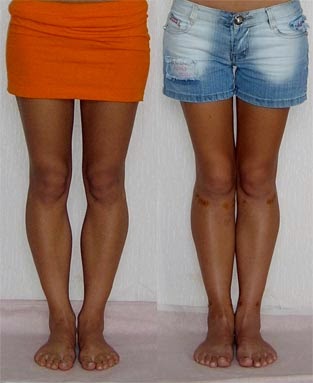
Bowlegs is a condition in which the knees stay wide apart when a person stands with their feet and ankles together. Certain cases are more extreme than others, normally forcing the person to walk in a somewhat strange way.

Medically speaking, Bow-leggedness is called Genu Varum. Also known as Bandiness, Bandy-leg, and Tibia Vara, it is a physical deformity marked by outward bowing of the lower leg in relation to the thigh, giving the appearance of an archer’s bow. Usually a medial angulation of both femur — the thigh bone — and the tibia — the larger of the two leg bones located below the knee cap — is involved.

Due to the folded position in their mother’s womb, being mildly bowlegged is considered normal in infants below 18-months old. As the child starts to walk and the legs begin to bear weight, the legs are typically straightened, resolving the issue without any type of bracing or treatment.

However, the condition may persist if the child is in poor health; mainly if sick with rickets (bone disorder caused by vitamin D deficiency) or suffering from any ailment which prevents the due ossification of the bones, or is improperly fed. Once older than three and a half years old and the legs and still notably crooked, then treatment is advised.


But why Japan? Well, bow-leggedness

 is particularly widespread in Japan where it is believed that a staggering 90% of women are bowlegged. According to a Japanese folklorist, Kunio Yanagida, in Japanese culture the crooked legs were once “known as beautiful woman’s attraction”, seen as cute and endearing. A similar idea lies behind China’s foot binding — a cultural symbol of femininity.

On a parallel yet more sensual note, check Why Some Women Point Their Feet When Aroused on this other article. 

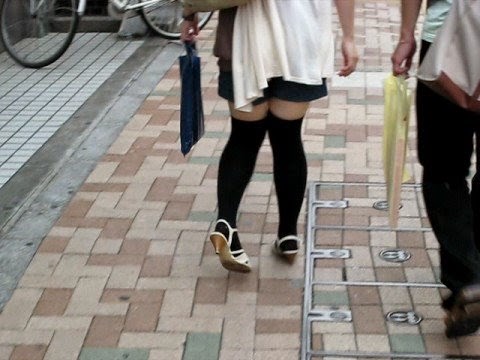
Young females with visible bowlegs. Why Japanese Females Have Bowlegs by Omar Cherif, One Lucky Soul
Is it still considered attractive?

It is believed that the origin of bow-leggedness may have stemmed from the days of wearing kimonos. Since it’s easier to walk in them if you turn the toes slightly inward. “That also produces what has long been considered a graceful, attractive gait.

According to other popular theories, bowlegs could result from how girls sit on the floor as children; either with both legs bent outwards at the knees (called Onnanoko-zuwari in Japanese) or seiza, which is sitting on the heels with bent knees. Though for now, these ideas remain but theories.

The condition is equally common in some other Asian countries, but perhaps not as widespread as in Japan. This confirms how frequently I have seen this phenomenon, mainly in the streets and subways of Canada and the U.S.


The legs of the young woman you see in the above video are referred to as “X legs”. It is when the knees are naturally inverted, causing the person to walk like a duck. One Japanese blogger shared: “They look like they need to pee”. Badly, it seems. Or they are about to take a group photos with their besties. However, the much more common in Asians, as well as in general, are the “O legs,” which are also arched but not as drastically. 


Correction of leg curvature. Why Japanese Females Have Bowlegs by Omar Cherif, One Lucky Soul
Correction of leg curvature

Fortunately, bowlegs can be treated in children and in adults. Anthropometric cosmetology is the medical practice science of correction and modification of deformities in the upper and lower extremities of the body. It is used to fix the X-shaped curvature of the legs as well as the O-shaped curvature. It can also be used in cases of relative shortening of the legs relative to body length.

Anthropometric cosmetology is done either to attain an aesthetically pleasing appearance or to eliminate physical and psychological discomforts. Though the severe cases of bow-leggedness can worsen quickly if not treated early enough. Treatment for children is typically braces, but also surgery may be necessary, especially for teens. The operation consists of taking a piece of tibia out, breaking the fibula, and straightening out the bone. There is also the option of slightly elongating the legs.


There are apparently other less professional ways to fix the ‘X’ and the ‘O’ shapes in legs. One of those natural treatments are the Japanese Ashi-yubi Shiikuretto Ringu” (Toe secret ring) seen in the image below. Wearing this ring is supposed to help center the weight of the body. Because if you have bowlegs or your pelvis is distorted, your balance is spread outside. So the rings not only fixes the posture and straighten the legs, but allegedly it can also make one lose weight.

Why Japanese Females Have Bowlegs by Omar Cherif, One Lucky Soul
Ashi-yubi Shiikuretto Ringu” (Toe secret ring)

Another advertised treatment for O legs / X legs is a straightening correction band sold online for $22.


Even though treatments for bowlegs are available, many people choose not to do it because they could be costly. However, in extreme cases like in the featured video, walking this way for years damages the pelvis bone among other things. Due to uneven stress and wear on the knees, it usually leads to more complications, such as accelerated onset of arthritis. As a matter of fact, those with bowlegs and a genetic predisposition for developing arthritis will likely start having arthritic symptoms around the age of 30.


One related condition to bowleggedness is Genu valgum, commonly called “Knock-Knees. And it is when the knees angle in and touch one another when the legs are straightened. It is the opposite of bow-leggedness, one could say. Beginning around two years of age it is common to see children’s legs become knock-kneed.

Both bowed legs and knock-knees are a part of normal development. As the child grows, the legs gradually straighten. Usually by 10 years of age, the legs are straight.

Why Japanese Females Have Bowlegs by Omar Cherif, One Lucky Soul

An additional related feet condition is the Pigeon toe — also known as Metatarsus varus, Metatarsus adductus, In-toe gait, Intoeing or False Clubfoot — which causes the toes to point inward when walking. It is most common in infants and children under two years of age. Though in my case, Pigeon toes remained through the mid-teens. After years of wearing, I recall how the Nike sneakers looked like the Tower of Pisa, especially whenever off. 

I actually think the girl in the same video may be bowlegged AND pigeon-toed. That’s like having dyslexia and being crossed-eyed. Sorry, just couldn't help it.


Oh well, now you know a few things about legs... and Japanese schoolgirls.


ALSO VIEW:

Related Posts Plugin for WordPress, Blogger...