
Following a long outdoorsy day on the Red Sea it was time for a nice hot — then cold — shower. Upon entering the bathroom, I caught myself in the middle of a mental chatter that turned out to be quite illuminating, let alone entertaining. By the end of those five minutes, which felt like aeons, the workings of my psychonautic mind became crystal clear. I was offered a glimpse into the very fabric of our world and the true [enough] nature of reality.
• Coincidentia Oppositorum
• Yin Yang
• The Trap of Black-and-White Thinking
This isn’t the first time a mundane act inspired a deep dive. My earlier piece, Theory of Mind: Thinking About Thinking and the Benefits of Observing the Observer was triggered by trimming my nails.
Now, let us entertain the novel perspective together — whether you take it as philosophy, logic, or just a simple story.
The Bath Mat Dialectic
As I stepped out of my flip-flops, I found myself sidestepping the blue towel I used as a bath mat. I had placed it there because it was softer than the rough rug (left in the below photo), yet I was actively avoiding it.
Why? Because my feet were sandy, dusty, and blackish from a day spent barefoot on the beach. After all, I do reside on the beach.
At that moment, a sarcastic voice erupted in my head: “Uhm, pretty sure this is not how bath mats work! The whole point is to step on it while barefoot.”
Then, the second voice — using the Sandwich Method — responded:
“I see what you’re saying. However, if we step on it now with unclean feet, it won’t be clean when we come out of the shower. We’d be rendering our newly-cleaned feet unclean. Aha!”
The Infinite Loop
The first voice doubled down on the “sandwiching”:
“True. Though this is precisely what mats are for: We use them, then we wash them. Use. Clean. Repeat. Ad infinitum — until the mat deteriorates in 37 years and becomes a rag. It’s a constant process. Use. Clean. Repeat — mats as well as feet. Teet Teet!”
The dialectic spiralled deeper:
• Voice A: “You don’t even step on it with slippers nor flip-flops. I see you taking them off. I was there. We were there.”
• Voice B: “Because the soles are dusty from outside!”
• Voice A: “Ridiculous. Mats and rugs are made to be stepped on and get dirty.”
• Voice B: “Fine. But if we can postpone the dirtiness with a quirky antic, why not? Less laundry. More convenience.”
The Conclusion:
“Fine. Agree to disagree and disagree to agree.”
“Likewise, agree to agree and disagree to disagree.”
Dialectically yours.
• Coincidentia Oppositorum
• Yin Yang
• The Trap of Black-and-White Thinking
This isn’t the first time a mundane act inspired a deep dive. My earlier piece, Theory of Mind: Thinking About Thinking and the Benefits of Observing the Observer was triggered by trimming my nails.
Now, let us entertain the novel perspective together — whether you take it as philosophy, logic, or just a simple story.
The Bath Mat Dialectic
As I stepped out of my flip-flops, I found myself sidestepping the blue towel I used as a bath mat. I had placed it there because it was softer than the rough rug (left in the below photo), yet I was actively avoiding it.
Why? Because my feet were sandy, dusty, and blackish from a day spent barefoot on the beach. After all, I do reside on the beach.
At that moment, a sarcastic voice erupted in my head: “Uhm, pretty sure this is not how bath mats work! The whole point is to step on it while barefoot.”
Then, the second voice — using the Sandwich Method — responded:
“I see what you’re saying. However, if we step on it now with unclean feet, it won’t be clean when we come out of the shower. We’d be rendering our newly-cleaned feet unclean. Aha!”
The Infinite Loop
The first voice doubled down on the “sandwiching”:
“True. Though this is precisely what mats are for: We use them, then we wash them. Use. Clean. Repeat. Ad infinitum — until the mat deteriorates in 37 years and becomes a rag. It’s a constant process. Use. Clean. Repeat — mats as well as feet. Teet Teet!”
The dialectic spiralled deeper:
• Voice A: “You don’t even step on it with slippers nor flip-flops. I see you taking them off. I was there. We were there.”
• Voice B: “Because the soles are dusty from outside!”
• Voice A: “Ridiculous. Mats and rugs are made to be stepped on and get dirty.”
• Voice B: “Fine. But if we can postpone the dirtiness with a quirky antic, why not? Less laundry. More convenience.”
The Conclusion:
“Fine. Agree to disagree and disagree to agree.”
“Likewise, agree to agree and disagree to disagree.”
Dialectically yours.
 |
| Bath rug left and bath mat right |
The Aha-Moment: A Googillion Suns
While standing there naked-ready, staring at the floor, it suddenly dawned on me with the force of a googillion suns: This is Coincidentia Oppositorum in action. Or, more simply: Unity of Opposites in motion.
Literally translating as “dark-bright” or “negative-positive,” the ancient Chinese concept of Yin Yang describes how seemingly contrary forces are actually complementary and interdependent.
The poles are different, yet never separate. They are like quantumly entangled particles in a cosmic dance — interacting, vibrating in unison, and remaining connected even if a whole universe separates them. In this equation, everything is in constant while the interaction is always metamorphosing.
• Dark and Light
• Sinner and Saint
• Hot and Cold
• Theory and Practice
From Abstract to Applied
While the concept might seem like high-level abstraction, our bathroom story is purely practical. It deals with decision-making and our fundamental perception of reality.
As with all philosophy, if we don’t learn how to integrate the knowledge into our daily lives, it remains mere “information”.
Theory is abstracted practice, just as practice is applied theory.
It is the experience of application that catalyses true wisdom—that glimmer of light within the darkness. This is the cornerstone of the mystical experience and the heart of mindfulness.
The Soul of the Story
Why tell a story about a bath mat? Because the easy way out is to sit on a mountaintop with eyes closed, staring at the void. But the real work is the integration— making ourselves better versions of our “selves” through the quality of our thoughts.
I use storytelling because stories help us make sense of the chaos. They provide coherence through:
• Metaphors & Analogies
• Allegories & Similes
• The dance between the general and the specific
Stories have the power to either warm our hearts or shatter our brains — often both. As a species, we are wired to think in narratives; we don’t just tell them, we become them.
Remember: Everyone has a story if we are willing to listen. Never judge the book by its look.
Throughout the ages, the art of storytelling has been our most trusted and inspiring endeavour to present our ideas out there for the world to see. Yet, when dealing particularly with philosophical or metaphysical matters — as we are doing herein — the step of telling a good, entertaining, and educational story may only be achieved after knowing the topic inside and out, which means first grasping the conceptual theoretical. That said, here is the excerpt taken right out of the book… before going back to the non-blather chatter-patter.
Here are two other articles mainly about storytelling, For The Love Of Storytelling, and Connecting the Dots — a Storyteller Way of Seeing the Big Picture.
The Healing Powers of Storytelling: A Personal Experience (2026) is a later manifesto.
While standing there naked-ready, staring at the floor, it suddenly dawned on me with the force of a googillion suns: This is Coincidentia Oppositorum in action. Or, more simply: Unity of Opposites in motion.
Literally translating as “dark-bright” or “negative-positive,” the ancient Chinese concept of Yin Yang describes how seemingly contrary forces are actually complementary and interdependent.
The poles are different, yet never separate. They are like quantumly entangled particles in a cosmic dance — interacting, vibrating in unison, and remaining connected even if a whole universe separates them. In this equation, everything is in constant while the interaction is always metamorphosing.
• Dark and Light
• Sinner and Saint
• Hot and Cold
• Theory and Practice
From Abstract to Applied
While the concept might seem like high-level abstraction, our bathroom story is purely practical. It deals with decision-making and our fundamental perception of reality.
As with all philosophy, if we don’t learn how to integrate the knowledge into our daily lives, it remains mere “information”.
Theory is abstracted practice, just as practice is applied theory.
It is the experience of application that catalyses true wisdom—that glimmer of light within the darkness. This is the cornerstone of the mystical experience and the heart of mindfulness.
The Soul of the Story
Why tell a story about a bath mat? Because the easy way out is to sit on a mountaintop with eyes closed, staring at the void. But the real work is the integration— making ourselves better versions of our “selves” through the quality of our thoughts.
I use storytelling because stories help us make sense of the chaos. They provide coherence through:
• Metaphors & Analogies
• Allegories & Similes
• The dance between the general and the specific
Stories have the power to either warm our hearts or shatter our brains — often both. As a species, we are wired to think in narratives; we don’t just tell them, we become them.
Remember: Everyone has a story if we are willing to listen. Never judge the book by its look.
Throughout the ages, the art of storytelling has been our most trusted and inspiring endeavour to present our ideas out there for the world to see. Yet, when dealing particularly with philosophical or metaphysical matters — as we are doing herein — the step of telling a good, entertaining, and educational story may only be achieved after knowing the topic inside and out, which means first grasping the conceptual theoretical. That said, here is the excerpt taken right out of the book… before going back to the non-blather chatter-patter.
Here are two other articles mainly about storytelling, For The Love Of Storytelling, and Connecting the Dots — a Storyteller Way of Seeing the Big Picture.
The Healing Powers of Storytelling: A Personal Experience (2026) is a later manifesto.
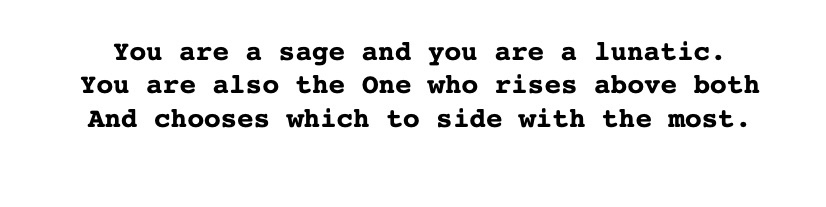
To the untrained eye the principle of Yin Yang may seem like duality on the surface. Once, however, one gets a clearer understanding, the notion of oneness beneath the non-duality becomes apparent. The listener and the speaker within your head are one and the same. But to come to terms with this insight, you need to rise above both and become the observer of the observer.
When this step is achieved you will notice that you’ll often be able to hold two opposite ideas in your mind simultaneously. This is the concept of Coincidentia Oppositorum, which is Latin for Coincidence of Opposites or Unity of Opposites. Those two components — the poles — are not antithetical, incompatible, or incongruent, but they are in fact complementary. One is needed to provide contrast for the other. Both are necessary to the balance of the ‘system’. For the road up and the road down are the same road.
The concept was first suggested by the pre-Socratic Greek philosopher Heraclitus. Then in the 15th C. German polymath, Nicholas of Cusa, coined the neoplatonic term Coincidentia Oppositorum. In On the Vision of God, Cusa described the concept as “The wall of paradise, beyond which is God”.
In modern philosophy, the Coincidentia Oppositorum doctrine is sometimes regarded as a metaphysical concept, a philosophical concept, or a scientific concept. However, the interpenetration, interdependence, and unification of opposites is considered as one of the fundamentals of mystical thought rather than philosophical thought.
Unity of Opposites is equally the central category of dialectics. Also
known as the dialectical method, it is basically a discourse between
two or more people holding different points of view about a subject yet wishing to establish the truth through reasoned methods of
argumentation. In philosophy, it is the art of investigating or discussing the truth of opinions; as it is an inquiry into metaphysical contradictions and their solutions.
The Western dialectical forms include Classical Philosophy — Socrates, Plato, and Aristotle — Medieval Philosophy — Boethius and Thomas Aquinas — and Modern Philosophy — Hegel and Karl Marx. There are also Theological dialectical forms as in the Baháʼí Faith, which advocates a form of dialectical science and religion.
With that, there is also the conceptual triad: Thesis, Antithesis, and Synthesis. The thesis (a proposition) is challenged by an antithesis (a contradiction or negation), leading to resolving the conflict through a synthesis, which forms a novel and more complete proposition by reconciling the truths contained in both poles.
Having just mentioned Hegel’s dialectic, the man however used a different language when developing a dynamic process of development described as a progression from an abstract idea (thesis) through its contradiction (antithesis) to a more concrete, unified concept (synthesis). A process known as Aufhebung or “sublation” involves preserving the truth of a concept while overcoming its limitations, leading to a higher and more complex cognisance.
The Western dialectical forms include Classical Philosophy — Socrates, Plato, and Aristotle — Medieval Philosophy — Boethius and Thomas Aquinas — and Modern Philosophy — Hegel and Karl Marx. There are also Theological dialectical forms as in the Baháʼí Faith, which advocates a form of dialectical science and religion.
With that, there is also the conceptual triad: Thesis, Antithesis, and Synthesis. The thesis (a proposition) is challenged by an antithesis (a contradiction or negation), leading to resolving the conflict through a synthesis, which forms a novel and more complete proposition by reconciling the truths contained in both poles.
Having just mentioned Hegel’s dialectic, the man however used a different language when developing a dynamic process of development described as a progression from an abstract idea (thesis) through its contradiction (antithesis) to a more concrete, unified concept (synthesis). A process known as Aufhebung or “sublation” involves preserving the truth of a concept while overcoming its limitations, leading to a higher and more complex cognisance.
From a psychological perspective, the union of opposites was one of Carl Jung’s fundamental principles for understanding the psyche and maturing into wholeness and reconciliation. He held that reaching this state has philosophical as well as religious implications, which eventually leads to psychology if one wants to understand the psyche dynamic behind it.
Jung called the cooperation of conscious reasoning with the data of the unconscious Transcendental Function. “It is a process and a method at the same time. The production of unconscious compensations is a spontaneous process; the conscious realisation is a method. The function is called ‘transcendent’ because it facilitates the transition from one psychic condition to another by means of the mutual confrontation of opposites.”
From a human perspective, fathoming said polarity and coming to terms with it is how we understand things. For our language is dualistic in nature. This is therefore how our minds have learned to reason, to justify our own conclusions, and to classify and conceptualise situations: through consciously holding opposing choices, ideas, and concepts, and comparing between them. In fact, our species have been conditioned to perceive the world through binary lenses. We therefore also learn by means of opposites. This ability to see through contradictory elements can lead to true — or true enough — and often complex knowledge. As Terence McKenna succinctly put it: “If you don’t at least occasionally contradict yourself your position isn’t nearly complex enough.”
Plenty of other mammoth souls throughout the ages entertained the concept and philosophy — be it mystics, visionaries, scientists, or authors. Among them is American novelist F. Scott Fitzgerald who in 1936 noted:
Jung called the cooperation of conscious reasoning with the data of the unconscious Transcendental Function. “It is a process and a method at the same time. The production of unconscious compensations is a spontaneous process; the conscious realisation is a method. The function is called ‘transcendent’ because it facilitates the transition from one psychic condition to another by means of the mutual confrontation of opposites.”
From a human perspective, fathoming said polarity and coming to terms with it is how we understand things. For our language is dualistic in nature. This is therefore how our minds have learned to reason, to justify our own conclusions, and to classify and conceptualise situations: through consciously holding opposing choices, ideas, and concepts, and comparing between them. In fact, our species have been conditioned to perceive the world through binary lenses. We therefore also learn by means of opposites. This ability to see through contradictory elements can lead to true — or true enough — and often complex knowledge. As Terence McKenna succinctly put it: “If you don’t at least occasionally contradict yourself your position isn’t nearly complex enough.”
Plenty of other mammoth souls throughout the ages entertained the concept and philosophy — be it mystics, visionaries, scientists, or authors. Among them is American novelist F. Scott Fitzgerald who in 1936 noted:
“The test of a first-rate intelligence is the ability to hold two opposed ideas in mind at the same time and still retain the ability to function.”
This quote was kindly shared by a reader commenting on the excerpt, which happened to have been shared hundreds of times on Facebook — mainly through a Terence McKenna page as well as a “Psychedelics and Philosophy” one.

Now back to our bathroom conversation and the nature of reality...
What may first appear like duality on the surface may not really be that polar. Rather than plus vs minus or with vs. without, it is plus and minus as it is with and without. Rarely is it an either or situation. Both coexisting sides are, in fact, complementary. Both are needed to define each other while none is ever absolute. Instead of reactively choosing one side over the other, as winner and loser, one can come to recognise then accept the validity and legitimacy of both seemingly conflicting, contradictory views. As such, we end with a more wholesome, balanced, bigger, and fuller picture to suit the agathokakological universe in which we live.
What may first appear like duality on the surface may not really be that polar. Rather than plus vs minus or with vs. without, it is plus and minus as it is with and without. Rarely is it an either or situation. Both coexisting sides are, in fact, complementary. Both are needed to define each other while none is ever absolute. Instead of reactively choosing one side over the other, as winner and loser, one can come to recognise then accept the validity and legitimacy of both seemingly conflicting, contradictory views. As such, we end with a more wholesome, balanced, bigger, and fuller picture to suit the agathokakological universe in which we live.
Oftentimes, after accepting the existence of both supposedly conflicting ideas and weighing the available options, the observer of the observer then integrates and reconciles by deciding to side with one pole over the other. That’s how decision making is accomplished. Some close cases even to the extent of having 51 percent from one side and 49 percent from the other. Most of times, however, it may be around 40-60 or 30-70 depending on how much of the equation or of the Big Picture you get to essentially “see”.
Something to remember whenever feeling ambivalent, inconclusive, stuck in a quandary, or torn between certain choices or courses of action. As Jung would suggest, do not choose yet... until a third more agreeable option appears. That is by keeping both truths and the tension they represent in your awareness long enough for the deeper self to work on it.
This work is oftentimes accompanied by either mere fortune or through what seems like a cosmic Orphic intervention. We can then find ourselves walking along the Path Of The Razor’s Edge — the periphery. This psychospiritual state entails seeing the full picture, both sides of the coin, including the little good in the bad as well as the little bad in the good. Exemplified in the black dot in the white and the white dot in the black of the Yin Yang symbol, there exists a balance between the two opposite poles; by having a portion of the opposite element in both sections.
Baltering, faltering, coddiwompling, and skedaddling freely along that circular periphery one gets to
simultaneously perceive the light and the darkness, the black and the
white, the in and the out. Then, the sage and the lunatic and the ongoing dialogue between them are transcended by the one who rises above, revealing a deeper, fuller truth. Illumination at last! Enlightenment. Awakening. Soul Liberation. Nirvana. Satori. The Source of Being. The Kingdom of Heaven. Eternal Bliss. The Quintessence.
This razor’s edge is what I anticipate Cusa had called “The wall of paradise, beyond which is God”
when describing Coincidentia Oppositorum.
There truly is no greatest
poetry than being nothing and everything at the same time.
A different example I use in the book is taken from none other than nature. Let us consider a cheetah mother killing an impala to feed herself and her young one. This situation is good for the cheetah and her cub while bad for the impala and her fawn. Or is it?
In reality, this hunter/hunted situation is neither good nor bad. It is simply what it is: Neutral. It is actually part of the circle of life. That is how nature functions. We are nature; hence this is how we function. The scenario could be what we choose to look at. It is solely a matter of perception. Now, what if the fawn was infected with some deadly disease and was about to transmit it to its mother, who, in turn, was going to transmit it to the whole herd causing them to all die at the end? So when the mother antelope is killed, the fawn won’t be able to survive which will save the herd. Who knows, really. We humans are not omniscient like that; we don’t possess this capacity to know all or to see the much larger picture all the time. So judging by labelling people, situations, and things good or bad remains but a subjective experience — the easy way out. Good and bad for whom exactly? The cheetah or the impala? The cub or the fawn? The herd of antelopes or the cheetah population? What about for you, the observer?
In Taoist
metaphysics, distinctions between good and bad shown in Yin Yang, along with other
dichotomous moral judgements, are considered perceptual rather than real; hence the duality remains an indivisible whole leading to true oneness... of the circle.

Now, when further contemplating the matter we realise that while in the bathroom example we’re dealing with what seems like two choices, in reality there are usually more than just two options, as it is rarely ever limited to two absolute extremes. Consider in politics when they slyly corner you with a box-choice by offering “The lesser of two evils”, like it is some kind of absolute necessity to vote. In truth, though, not choosing is clearly a third option. Echoing with Jean-Paul Sartre’s choisir, c’est encore choisir; not choosing is still choosing, you see. That is transcending the apparent duality.
In actuality, when people think in such a binary way they fail to simultaneously incorporate both positive and negative qualities of themselves and of others in order to form a realistic whole. This tends to lead them to think in terms of extremes — widening the dichotomy in-between both poles while making it more rigid and harder to bridge. It becomes: With or against me, us vs. them. Extremism is a suicidal attitude to have in life, which brings upon fear, hatred, and lack of empathy among other detrimental qualities. As such, neither reconciliation nor wholeness can be accomplished.
In actuality, when people think in such a binary way they fail to simultaneously incorporate both positive and negative qualities of themselves and of others in order to form a realistic whole. This tends to lead them to think in terms of extremes — widening the dichotomy in-between both poles while making it more rigid and harder to bridge. It becomes: With or against me, us vs. them. Extremism is a suicidal attitude to have in life, which brings upon fear, hatred, and lack of empathy among other detrimental qualities. As such, neither reconciliation nor wholeness can be accomplished.
In psychology,
Black-and-White thinking is called “Splitting”, which is a common defence
mechanism some people use.
In logic, Black-and-White thinking is also a
fallacy called “False Dilemma”. It occurs when something is falsely
claimed to be an “either/or” situation, limiting the number of
alternatives available when in fact there is at least one additional
option. At least. Certainly a not-deep-enough way to perceive reality.
Once, then, we are to able see the oneness beneath the dance, the marriage — reaching the balanced “Yin-Yang” insight — one can entertain this dialogue between both opposites, learn from them while rising above what misleadingly appears like absolute duality. This is achieved through the mystical experience; by becoming the observer of the observer and embracing the Oneness beneath the polar juxtaposition. This is where we find truth, yet rarely ever it would be absolute. Mayhap truth finds us just as well.
Then other times in life Coincidentia Oppositorum as well as Yin Yang become practical in reflection and contemplation without the need to make any choice. Like the case of the cheetah and the impala. Mere observation suffices. Along with experimentalism, observation can be the best of teachers. Remember that the observer of the observer is the one with the vantage perspective.
Once, then, we are to able see the oneness beneath the dance, the marriage — reaching the balanced “Yin-Yang” insight — one can entertain this dialogue between both opposites, learn from them while rising above what misleadingly appears like absolute duality. This is achieved through the mystical experience; by becoming the observer of the observer and embracing the Oneness beneath the polar juxtaposition. This is where we find truth, yet rarely ever it would be absolute. Mayhap truth finds us just as well.
Then other times in life Coincidentia Oppositorum as well as Yin Yang become practical in reflection and contemplation without the need to make any choice. Like the case of the cheetah and the impala. Mere observation suffices. Along with experimentalism, observation can be the best of teachers. Remember that the observer of the observer is the one with the vantage perspective.
Whether you look for the good in others or the bad you will find it.
 |
| Balance |
As we have seen, Coincidentia Oppositorum deals with the possibility of achieving balance by having the apabicity to perceive both sides of the same coin. Showing how not only is it fine to be able to hold two opposites ideas in our minds at the same time, but also how it actually seems like the wisest of approaches. Apabicity, by the way, is one of 176 words and their definitions which I have come up with, conveniently defined as: The state of having the ability, capability, and capacity all at once. Uhu.
Wisdom aside, we still find that many people are only able to process reality in a binary way, as in “with me” or “without me”. “This or That”. “Fight or Flight”. No Rainbow.
No various colours or shades. No full spectrum. No big, full picture. No different hues or distinct angles. No nuances, degrees, spices or flavours. No subtlety nor even sensibility nor sensitivity. Not even grey. Just black, and white.
Beside helping us in our decision-making, this balance can also be applied when dealing with the outside world. Consider those times when you are exposed to that which goes against a certain belief
or conviction you hold and it triggers an emotional reaction. Acknowledging both sides of the spectrum offers you a chance to re-examine the belief. It does not matter if you may or not not agree
with the novel or different view at the end. But do take the chance to explore the novelty and the difference. Because you will
likely end up learning something or two from the experience. It would either
strengthen your argument or offer you a whole different perspective.
Perhaps a bit of both if you are lucky.
As follows, fear not to understand things, or to entertain ideas, that clash with your own beliefs, traditions, and privileges.
In
our case here, after reasonably observing the dialogue between the
inner voices and the two different courses of action they propose, I eventually chose to carry on not stepping on the bath mat with unclean
feet, but on the floor instead before jumping into the shower.
Smoothing hot water then 20 seconds of significantly cold water until I
moaned out a loud and invigorating “Ahhhhh”. The instant shock makes you feel like being
electrocuted and your brain lightens up in flashes. How refreshing hot
and cold showers are. Both: Synthesis.
Then once all cleansed, it was time to step on the still-clean bath mat. Yes, in a few days it will need washing; because that’s how towels work and that’s what shall happen.
Then once all cleansed, it was time to step on the still-clean bath mat. Yes, in a few days it will need washing; because that’s how towels work and that’s what shall happen.
The
hot-and-cold shower appears to have reset something up and in there as I
was struck with yet another epiphanic moment: The inherently pristine, immaculate beauty of this Oneness we’re speaking of; of the essence of being able to look at things, with impartial eyes, and wholesomely see them for what they really are; not as we want them to be or think they should be. Opening the Doors of Perceptions and entering... without conceptualisation, condemnation, expectation, or prior prejudice or judgement. O’ the Reconciliation. The Union.
Yoga. The Mental Peace. The Soul Dance.
The final verdict was to keep the bath mat for when barefoot before and after
showers, as this time, while removing the bath rug completely. For any other use of the bathroom, especially
when wearing something I use outside the house, the actual floor works fine. Sounds good to us. And
that, Ladies and Gentlemen, is how it’s done. That is how we fundamentally deal with that which appears different, whether inside our heads or in the
outside world.
At the very end, it seems safe to ascertain that if one is capable of integrating their inner polarity, by rising above it and hopefully reaching a certain degree of reconciliation, they will also be equipped to deal with anything different residing outside of them. Calmly, wisely, and with the quintessence of equanimity.
At the very end, it seems safe to ascertain that if one is capable of integrating their inner polarity, by rising above it and hopefully reaching a certain degree of reconciliation, they will also be equipped to deal with anything different residing outside of them. Calmly, wisely, and with the quintessence of equanimity.
À la prochaine conversation with myself. I hope you enjoyed the tour as much as we did. Salute to your Souls.

Et Voilà. The End (Thank you, Seif)
ALSO VIEW:
Who Are We?
My Journey Towards Self-Transcendence
The Intertwining of Genius and Insanity
The Intertwining of Music and Sexuality ― A Djembefola’s Tale
The Intertwining of Pain and Pleasure
My Journey Towards Self-Transcendence
The Intertwining of Genius and Insanity
The Intertwining of Music and Sexuality ― A Djembefola’s Tale
The Intertwining of Pain and Pleasure
Connecting the Dots — a Storyteller Way of Seeing the Big Picture
The Parable Of The Cow: You Are Not Your Thoughts
Why We Should Not Fear Death
Change Is The Only Constant
Why I Share Stuff
For The Love Of Storytelling 20 Things Learned From a 48-Minute Terence McKenna Talk on Hermeticism and Alchemy
The Significance of Letting Go
Unfollow the Crowd
The Art of Approaching Women
Why I Choose to Remain a Non-Dad for Now — Reflections on Being Childless
When Selective Men Reject Women
The Parable Of The Cow: You Are Not Your Thoughts
Why We Should Not Fear Death
Change Is The Only Constant
Why I Share Stuff
For The Love Of Storytelling
The Significance of Letting Go
Unfollow the Crowd
The Art of Approaching Women
Why I Choose to Remain a Non-Dad for Now — Reflections on Being Childless
When Selective Men Reject Women
No comments:
Post a Comment